Showing posts with label Donna Barr. Show all posts

Wednesday, September 3, 2014

#11 Weirdest RPG Owned - The All Australian Role Playing Game #RPGaDAY

While riding a hotel shuttle from the San Diego Comic-Con back in the early 90s, I overheard a young man excitedly describe a game to his friends in the seat behind him. The player characters are cartoon-like alien tourists who go on hunting safaris on backwoods planets, tracking and killing the low intelligence native species there. One particular backwoods planet is called "Earth" though, due to a translation error, the alien hunters call it "Dirt." There, the low intelligence native population of "Whoomens" are fighting back, retaliating with all manner of absurd ordnance. Also, the game is entirely focused on Australia, written by Australians, played by Australians, published in Australia and features an Australia-centric view of Earth on the front cover.

I continued to my hotel, probably to play some AD&D with a cadre of friends I shared a room with (the hotels were expensive even back then).

But the image of that Australia-centric view of Earth never left my mind.

...

Some 15 years later I found Hunter Planet.
Target: Dirt.
The game is every bit as bizarre and Australia-centric as my memory of that overheard description. Imagine a cross between Paranoia, Predator, The Hitchhiker's Guide to the Galaxy and Toon. The alien player characters are working class schlubs who saved up their vacation time for an exotic safari to shoot easy game and bring home a nice trophy for the mantlepiece (or alien equivalent).
Smile!
What they find on our home of Dirt is a Whoomen population ravaged by constant hot wars and cold wars where most citizens have access to arsenals that outclass the tourists' laser rifles and automatic crossbows. The Hunters become the hunted. The powerful Whoomen weapons are also more likely to backfire, so a tourist who steals a Whoomen rocket launcher is bound to end his vacation in a predictably tragic, yet hilarious, manner.
Sample Character
The game is run with several different players in the roles of the Hunters and one player as CM (which may stand for Control Man, Condition Modifier, Chocolate Milk, Carbon Monoxide, Crazy Man, Chance Master or Certified Maniac). The players create their characters by rolling 1d10 for each characteristic (Strength, Dexterity, etc.) in order with two rerolls allowed. Luck is rolled on 1d6 and is rerolled at the start of each game.

At this point, we are directed to refer to footnote 87. Spoiler alert: there is no footnote 87.

Players roll 1d10+10 to determine Hit Points, a term which is not explained. It is assumed the players role-play enough to know what any D&D-derived terms mean.

The players now select their equipment and weapons, but no more than three grenades and no Alpha-Beta Plus Gamma Radiation Neutron Destructo Particle Accelerator Beams. Otherwise, the players are free to choose what gear they wish... with the realization that the natives they encounter will probably have something equally egregious. If the CM determines that your character is carrying too much weight (footnote 35 says you probably are), he will probably strike any excess off the character sheet. Example equipment is listed, such as Light Sword, Tangle Grenades, Dehydrated Water, 10 Sided Die, Anti Gravity Belt and "Whammo" Door Charges.

The CM then describes the scenario the Hunters find themselves in on their one-week tour of Dirt before they are beamed back up to the Hunting Tours Incorporated ship. They probably won't survive.
Note: this is not Emperor I. M. Wunndafull. I think this is his secretary.
My biggest surprise when I picked up Hunter Planet was the realization that this was the second game I owned by designer David Bruggeman. The first was an obscure set of miniature wargaming rules titled WWII Book of Armaments that I picked up somewhere on a whim. The rules are good, but the game is SO obscure that I can't find a good web link for it (EDIT: I created a page about the game HERE). It was published by The Australian Games Group (TAGG) best known for publishing Lace & Steel, the swashbuckling fantasy RPG with innovative card-based mechanics and illustrations by Donna Barr (see Ms. Barr's Boinger and Zereth at the bottom of this post).

The Book of Armaments includes a photo of the designer:
This is Emperor I. M. Wunndafull
Bruggeman devotes four full pages of the 35-page Hunter Planet to his "Guide to Better CMing (or The Dos and Don'ts of CMing)." Some pieces of advice are obvious but many are quite good. I summarized several of them as follows:

DO
Read widely (An extensive general knowledge is an important benefit to all CMs)
Prepare a scenario (Prepare a situation where the Hunters will find themselves)
Concoct various surprises (Ammunition wasting creatures, traps and tricks, strange inhabitants, etc.)
Roll dice frequently (This puts the players on edge and causes them to react to non-existent dangers)
Build tension and action up to the beam up time (The mothership checks in with the Hunters once every four hours. They may be beamed up at this time, but at no other time. Actually, they can request it at other times, but the request is ignored)
Ad lib frequently (Unexpected events create confusion, excitement and fun)
Inspire character conversations with non player characters (The CM gets to role play a more interesting character than a stupid Orc and gets to hear what the players call a logical, convincing argument)
Cheat (But cheat fairly)
Tell the Hunters only what they would know as aliens (Which isn't much)
Ensure that everything in the game has both a good and bad side (Called the "Bad News Factor," all weapons and equipment have at least a 5% chance of something horrible happening when used)
React to players comments (Once a player says something, even in jest, it will be acted upon by the CM)
DON'T
Be sadistic (The adventure should be dangerous, not a suicide trip)
Play strictly to the rules (What rules?)
Give away benefits easily (Benefits must be earned)
Hide behind the CMs screen (The screen is designed to hide the CM's game information, not the CM himself)
Forget (The CM should remember when a player forgets to reload his weapon and tries to shoot, etc.)
Land the Hunters in the middle of nowhere with nothing to destroy (Where they land may "appear" to be peaceful but it should be nothing of the sort)

Monday, August 25, 2014

#10 Favorite Game Fiction - The Maze of Peril #RPGaDAY

Let's face it, most game fiction isn't very good.

Many examples of game fiction tend to break the rules of the game's universe or adhere too closely to the game's format and just end up with mediocre stories. Not every good game designer is a good fiction writer (but many think they are). They often get tangled up in serious, epic, wanna-be Lord of the Rings, everything-depends-on-us quests to save the world and miss out on the fun of adventure gaming. To belabor the famous Joker quote, "Why so serious?"

I've read some of the earliest game fiction novels ever printed. Veteran author Andre Norton's Quag Keep (1978) is notable as a historical, early peek into Gary Gygax's World of Greyhawk/The Great Kingdom setting. The sequel, Return to Quag Keep, loses the Greyhawk setting and the small amount of charm the original held.

The oldest game novel I've found is War-Gamers' World (1978) by Hugh Walker (pen name for Hubert Straßl). It was first published in German as Reiter der Finsternis (Rider of Darkness) in 1975 and is the first book of the Magira series. It is based on the German fantasy wargame/proto-RPG hybrid Armageddon developed by the gaming group FOLLOW in 1966. Since that time, the setting spawned several RPGs. This first novel opens with a player getting sucked into the game's fantasy world. There are several references to seeing the world as interconnected hexagons. Not recommended except as another historical oddity.


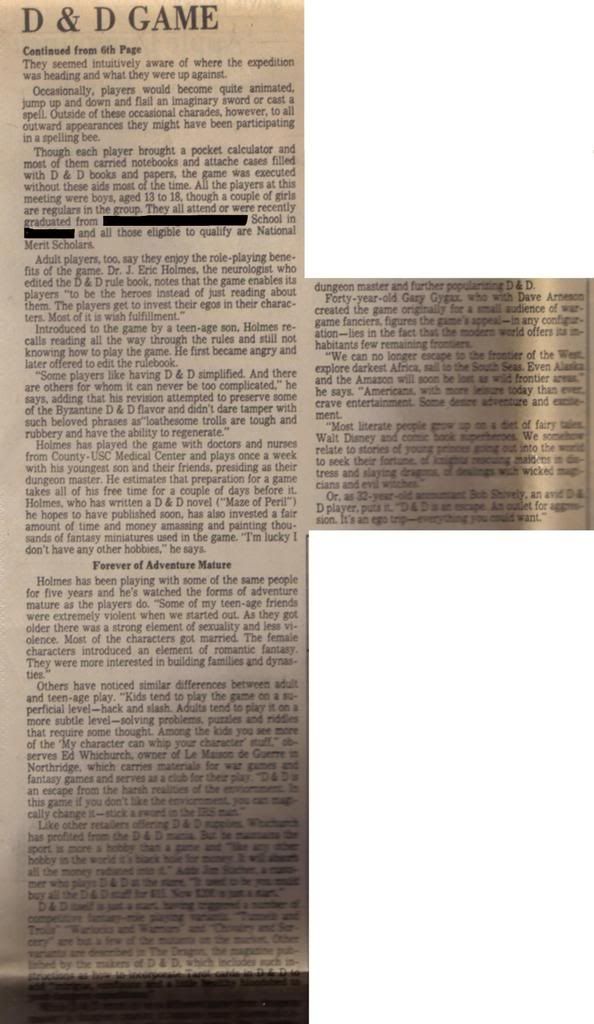
I give a hearty recommendation for my favorite piece of game fiction: The Maze of Peril, a short novel written by the original Basic D&D rules editor, Dr. John Eric Holmes.

SPOILER ALERT: They don't save the world
Contrary to the publisher's blurb. Our heroes don't try to save the world. Boinger the halfling and Zereth the elf are just out to make a buck without having to get a real job. They undertake adventures to make quick cash and live the life of Riley at the Green Dragon Tavern for a few months. When the gold runs thin and the landlord comes a knockin', they undertake another delve into the Underworld to relieve some nasty monsters of their glittering treasures.
Boinger, another party member and Zereth relieving some nasty monster of its glittering treasure (art by Jim Roslof from "The Sorcerer's Jewel")
It is so refreshing to read an adventure story without the gloom and doom of the ultimate destruction of everything good folk hold sacred due to the megalomaniacal plans of some evil Sauron look-alike dark lord. These are two good friends just struggling to get by and maybe, someday, hit it rich. Their camaraderie and their humor really comes through in Holmes' writing. In a good way, it reminds me of the early Star Wars comic books by Marvel. The galaxy was safe from the ultimate apocalypse weapon, the Death Star, and the raised stakes of The Empire Strikes Back hadn't come into play yet. Han, Luke, Leia and their friends were free to adventure and freewheel their way across the galaxy.

BEGIN SPOILER WARNING
Bardan the dwarf's fate (as portrayed by Barely A. Dwarf in "Were-shark," an early version of The Maze of Peril's chapter 2 published as a stand-alone short story, art by Chris Holmes)

Nothing world-shattering is at stake; Boinger &co's quests are of a personal nature. During an early foray into the Underworld, one of the party fighters, Bardan the dwarf, perishes in combat. They bury his body in the cemetary but disturbingly find his grave exhumed and coffin empty a few days later. Boinger implores the party to return to the dungeon to thwart the revenge plans the evil-doers have for his friend's corpse.

The Maze of Peril adventures run the gamut from dungeon delve, urban adventures, bureaucratic red tape cutting, carousing, burglary, back to dungeon delve, Lovecraftian horror and even naval combat. Also, the book features one of the funniest uses of a petrification gaze that I would totally allow to happen if it comes up in a game.

END SPOILER WARNING

Holmes had several short stories about Boinger, Zereth (a.k.a. Xoreth) and their fellow adventurers published in Dragon magazine and Alarums & Excursions APA-zine. It is no secret that these tales were based on Holmes' home D&D campaign; Boinger was the player character of Chris Holmes, Dr. Holmes' son and occasional illustrator. These stories give us a window into Dr. Holmes' campaign and even how he interpreted certain D&D rules.

One famously unclear rule regards magic-users and their restriction from using armor and swords. In the days of OD&D, even famous, accomplished gamers were unclear on the ruling* and many cried foul against the sword restriction (after all, Gandalf used a sword). What logical reason (besides gameplay balance) could there be for this restriction?

Holmes succinctly gives his reasoning in two sentences. On page 34 of The Maze of Peril, Zereth removes all metal from his body, washes up and puts on a wizard robe before casting a spell. He explains to a confused Boinger that he:

"Can't have iron touching the body anywhere; no iron, even nails in the boot heels. It drains the flow of force from the other world."
No further explanation is required. Boinger asks, "It does? How?" Zereth tells him to, "Keep quiet," and no more is said on the matter.

This prevents magic-users from even wearing leather armor (with iron buckles). Presumably, a wizard's dagger must be made of bronze, silver or another non-ferrous metal. This stems from old folklore about iron's protective properties against magical creatures and has become a modern trope. It fits with Tim Powers' piratey fantasy novel On Stranger Tides (HIGHLY recommended reading) where magic disappears from the world as iron spreads with the advances of western civilization. The faerie-folks' aversion to iron seen in Poul Anderson's Three Hearts and Three Lions (also recommended) resonates as well.
Boinger vs. a one-armed troll (art by Chris Holmes from "Trollshead")
This leads to another rule: elves are combination fighters and magic-users and the OD&D rules state they "freely switch class whenever they choose, from adventure to adventure" (Men & Magic, p. 8). How does that apply to spellcasting and armor/weapon use? Holmes gives another example with Zereth in the short story "Trollshead" in The Dragon magazine #31, p. 41:
"Zereth took off his sword belt and helmet and laid them on the ground... He lay flat on his belly and reached into an inner pocket of his linen tunic to produce a pinch of fine sand. This he tossed into the air, mumbling rapidly as he did so."
To switch from fighter to magic-user, Zereth removes his sword belt and helmet (the only iron on his body) before casting a sleep spell on some unexpecting half-orcs. This goes against his own "elves must decide" ruling in his Basic D&D manuscript that states that elves cannot change in the middle of an adventure. In later stories, such as "The Sorcerer's Jewel"** (Dragon #46), Zereth wears armor while casting spells. It is assumed that Holmes was playing AD&D by this time, which does allow for spellcasting, armored, multiclassed magic-users.

Another question arises: just what are the "dungeons" in the world of Dungeons & Dragons? Why is there a near-endless number of underground labyrinths filled with nasty creatures and fabulous treasures? Zereth ponders the titular maze in The Maze of Peril, p. 3:

"Somewhere beneath the surface of this ancient land the tunnels and corridors of some prehistoric race coiled and raveled, delved, and probed unimaginable depths into the core of the world... What race or races had built the original maze no one knew. It seemed in the opinions of the sages and magicians of the time, that there must have been many layers of dungeons and underworlds laid down, one atop the other, as the world crust was formed, so that now no one knew, or even guessed, how many levels it extended below the surface."

Here, in one (wordy) sentence is the justification for a world of dungeons. It explains just enough to give the game world some logic yet leaves plenty of mystery for players to discover in their journeys into the Underworld. Of course, the truth may be very different from what the sages and magicians assume as fact.

Gary Gygax first hinted at such an Underworld with the D series of modules starting in 1978 (about the time The Maze of Peril was written). Later D&D authors would call this subterranean realm the Underdark and give their own reasons for its existence.
Zereth and Boinger (art by Donna Barr from "In the Bag")

In Conclusion:

The Maze of Peril is my favorite piece of game fiction because it feels most like the D&D games I've played. Rarely did we adventure to save the kingdom/world/multiverse. We were a bunch of friends looking for some excitement and quick cash together. We'd hatch elaborate schemes, find ourselves in deep trouble, then put our heads together to make sure they didn't roll off our shoulders come the dawn. We were comrades, bonded in the face of danger, celebrating each success until wanderlust crept back into our hearts and we were off on another wild quest.

Those are good times, and so is this book.

Notes:

Watch for Fight On! magazine issue #15 dedicated to J. E. Holmes coming soon! Read my heavily researched character write-ups for Boinger, Zereth and their "pal" Murray the Mage, along with guidelines for iron-restricted spellcasting, in my article, "Holmes Town Heroes."

The 1000 copy print run of The Maze of Peril is getting harder to find, but still available. Check out Holmes' short stories from Dragon magazine:

"Trollshead" The Dragon #31
"The Sorcerer's Jewel" Dragon #46
"In the Bag" Dragon #58

Complete Holmes Bibliography

* UK game designer Ian Livingstone (Games Workshop co-founder, Fighting Fantasy game books co-creator, etc.) erroneously wrote in his 1982 book Dicing with Dragons: An Introduction to Role-Playing Games when explaining D&D classes: "Each class has restrictions as well. For instance, The Magic User may only wear leather armour or no armour at all..."

** Although The Maze of Peril (1986) was published 5 years after "The Sorcerer's Jewel" (1981), we know Maze was completed earlier as Holmes states that it was ready to publish in an L.A. Times interview from 1979.