Showing posts with label D&D. Show all posts

Tuesday, April 23, 2024

Book update: Fifty Years of Dungeons & Dragons

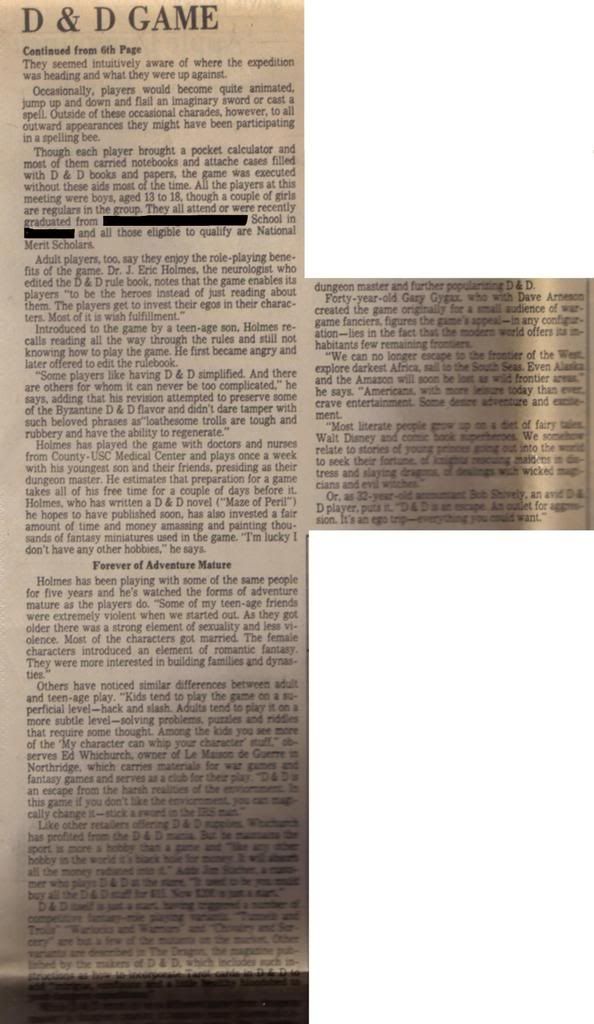
I am happy to announce the upcoming publication of the book chapter "'Dr. Holmes, I Presume?' How a California Neurology Professor Penned the First Dungeons & Dragons Basic Set," co-authored with Zach "Zenopus" of Zenopus Archives. It will be published in Fifty Years of Dungeons & Dragons, scheduled for release on May 14, 2024.


This 392 page tome features 20 chapters by a variety of authors about the history, influence, and the future of Dungeons & Dragons, complete with black and white illustrations by C. Liersch. I am happy to be sharing contributor credits with the likes of Jon PetersonGary Alan FineAaron Trammell, and Amanda Cote. The retail price of $35.00 is downright reasonable for an peer-reviewed work of this size. See the book now at the MIT Press website: https://mitpress.mit.edu/9780262547604/fifty-years-of-idungeons-and-dragonsi/

Our chapter revolves around the life of Dr. J. Eric Holmes and the strange set of circumstances that led this unlikely medical professor from California who had never played a wargame to be the first to author a revision to the original D&D rules for TSR. This is also a history of role-playing games in California, especially the Los Angeles and San Francisco communities, which spawned many varied ways to play in the "California gaming" scene. These are the waters of creation from which rose Runequest, Arduin, Alarums & Excursions, The Manual of Aurania, Warlock, and more, not to mention terms like "dungeon master" and the dice notation system (d8, 2d6, d100, etc.) that we all take for granted.

Early California gaming is a subject that I've written about here on this blog:

California Gaming Part I - Steve Perrin

California Gaming Part II - Erol Otus

I am currently teaching a History of Role-Playing Games course at Drexel University and presented a special lecture based on our chapter.

Don't miss my co-author Zenopus and his take on our chapter at the Zenopus Archives blog:

https://zenopusarchives.blogspot.com/2024/04/50-years-of-d-forthcoming-book-from-mit.html


Monday, December 15, 2014

#12B - California Gaming Part II - LSD&D with Erol Otus #RPGaDAY

Tracing the California Gaming Scene, part II: Erol Otus in NorCal

Erol Otus was one of the "second wave" of TSR artists hired in the mid 70s after the "first wave" of David A. Trampier, Tom Wham, David C. Sutherland and the like. His second wave contemporaries include Jeff Dee, David S. "Diesel" LaForce, Bill Willingham and later, Jim Roslof. Otus' trippy, semi-surreal illustrations brought a macabre yet whimsical, gonzo touch to TSR's publications: D&D, AD&D, Gamma World, Dragon magazine, Boot Hill, Top Secret and more.  He became a fan favorite and his distinct style made his illustrations easy to pick out from the rest.

In about 1983, he left TSR and the RPG industry. Nowadays, he creates art for several RPG companies looking for the classic-era look for their products. It is easy to forget that we didn't see any new weird fantasy RPG art come from him for a long, long time after leaving TSR.

1999 San Francisco: Return to the Art on the Borderlands

Twilight of the Idols (1999)

"LSD&D" succinctly describes Otus' trippy D&D art style, a term I first saw when I contacted Allan Horrocks of San Francisco's Aquarius Records back in 1998. "LSD&D" doesn't mean that Otus uses mind-altering substances to create his art (he doesn't (1)), just that his art mirrors the unrealities that such substances unveil.

Otus illustrated an album cover for SF band The Lord Weird Slough Feg (above) with an image that could've been pulled from a 1980 D&D module. Fellow Otus fan Horrocks, friend of the lead singer, interviewed Otus for his music 'zine, Hoe (now, unfortunately, lost to time).

Down Among the Deadmen (2000)
Slough Feg hired Otus to illustrate their next album the next year (above). Clearly, the members of the band are gamers and if their choice of artist doesn't give it away, you should check out their 2003 concept album Traveller based on the RPG of the same name.

This was the first time fans like Horrocks and me saw Otus work in his classic fantasy D&D style in over 15 years. Remember, this was long before Erol's covers for the DCC adventures The Mysterious Tower and The Haunted Lighthouse and the Hackmaster module Descent into the NetherDeep. By 1999, some D&D fans had even started asking the quesion, "Whatever happened to Erol Otus?"

Humna Humna alien graphics for Starflight 2 (1989)

Humna Humna alien illustration for Starflight 2 (1989)
After Otus left TSR, started his continuing career creating game designs, illustrations, graphics and music for video games. His refined his self-taught art skill first by studying painting at UC Berkeley and later studying illustration at the Academy of Art University in San Francisco. Otus joined his childhood friend Paul Reiche III at the Toys for Bob studio in the early 1990s and still works there today.

My question is: how did this gonzo gamer from Berkeley become an influential artist at such a pivotal time in TSR's history?

1976 Richmond: We'll always have Arduin

The Arduin Grimoire (1977) cover illustrated by Erol Otus
As a young gamer, Otus played miniature battles with his friends using the Chainmail rules. They soon moved on to D&D when a friend bought the original three booklet set (2). Sometime probably in early 1976, Otus began gaming with Dave Hargrave in his already long-running Arduin campaign. Hargrave hired Otus to illustrate his upcoming series of The Arduin Grimoire rulebooks to be published by Chaosium.

The Chaosium deal fell through, as I explored in a previous post, and Hargrave was forced to self-publish The Arduin Grimoire and its two sequels, Welcome to Skull Tower and The Runes of Doom (all three illustrated by Otus). The change of plans delayed publication of the first book until 1977 and the sequels until 1978.

In the forward to The Arduin Grimoire, Hargrave gives this odd note:
Special Note: the artwork for this supplement is the sole doing of one fine young artist: Errol [sic] Otus. I'm only glad I'll be able to say in ten years from now, "I knew him when..." (3)
Did Hargrave have mystical foreknowledge about Otus' future career, even if he couldn't spell his name? Not really. By 1977, Otus was already a published artist with TSR.

1976 Lake Geneva: The Dragon Reaches Westward

The Remhoraz from The Dragon #2
Otus began submitted illustrations to TSR soon after he started playing D&D. TSR Periodicals finally purchased a piece for the August, 1976 issue of The Dragon. Otus describes this in a 2009 interview with tor.com:

One the drawings was of a blue and fuchsia winged worm in an icy landscape, this was published in The Dragon #2 with stats by Gary Gygax as “The Remorhaz.” This was my first published color piece.
The Anhkheg from The Dragon #5

Three issues later, TSR Periodicals published Otus' creature write-up and illustration for the Anhkheg, now an iconic D&D creature (and now spelled Ankheg). Gary Gygax gives Otus credit for both the above creations in the 1st ed. Monster Manual(4). Not long after, TSR needed a new staff artist (possibly because Dave Trampier had just quit(5)) and hired Otus. He moved out to Lake Geneva.

There appears to be some trouble for Dave Hargrave's Arduin after this. About the time The Arduin Grimoire was in its second printing, TSR sent him a cease & desist letter to remove any references to D&D from his books. This may include Erol Otus' art as it starts to disappear from later Arduin printings.

1979 Berkeley: The Booty, the Beasts and the Necromican

Fantasy Art Enterprises logo

Erol Otus still had an effect on California Gaming. In 1979, he teamed up with his buddy Paul Reiche III (who was also being hired by TSR around this time) and Mathias Genser to create a couple of unlicensed fantasy RPG supplements. They founded their tiny publishing company, Fantasy Art Enterprises, in the "hills north of the UC Berkeley campus."(6)

Booty and the Beasts (1979) cover art by Erol Otus

Booty and the Beasts autographed by Otus to Mike, the lead singer of Slough Feg
Otus illustrated all products and contributed numerous designs. Reiche and Genser wrote the rest. They created a compilation of new monsters and treasures (Booty and the Beasts), a book of 132 new spells (The Necromican  (not The Necronomicon)), a set of Geomorphic Mini Dungeon Modules and a set of New Magical and Technological Item Cards. The last item notably includes "HANDY DANDY RANDOM MAGICAL ITEM GENERATION TABLES" with which the user may create an item that deals 3d20 points of damage or a cursed item that slays its user, "permanently."
The Necromican (1979)


Their books were saddle stapled, softcover, roughly digest-sized (more like trade paperback sized 8 1/2" x 5 1/2") booklets and other supplements were printed on letter-sized (8 1/2" x 11") cardstock. This was the de rigueur RPG supplement publishing style at the time, matching the original D&D booklets (1974) and early TSR supplements Dungeon Geomorphs (1976) and Outdoor Geomorphs (1977). One advantage is that the rulebooks and other supplements (once the cards or geomorphs were cut apart) easily fit inside the original D&D box
New Magical and Technological Item Cards (1979) art by Erol Otus
Other Califonia gamers published in this same "digest booklets + cut-apart cardstock" style. Dave Hargrave's The Arduin Grimoire booklets and various Arduin Cards supplements (1977 Grimoire Games) are in this style. Clint Bigglestone, Terry Jackson (Steve Perrin's fellow DunDraCon organizers) and Kate Wadey published Artifact Cards (1979) and both Dungeon and City Geomorphs (1978) under the DunDraCon, Inc. name. Bigglestone's other company, Fantasy Factory, produced similar card-based accessories in 1978. The Playing Board of Albany published the digest-sized The Spellcaster's Bible (1979) (see Conclusions, below). Matthew Walley of Chula Vista self-published his own Wizard's Aide (1977) booklet of the same mold.
Geomorphic Mini Dungeon Modules (1979) art by Erol Otus


Fantasy Art Enterprises' supplements tended to be of better quality than their competitors. Erol Otus' earliest illustrations were still better (or at least, more interesting) than most other amateur artists in the industry at that time. Otus' geomorphs are regarded as better than Bigglestone's or even TSR's offerings. Otus teamed up with legendary-designer-to-be Paul Reiche III (future co-creator of GW1: Legion of Gold, Mail Order Monsters, Archon, Star Control and even the Skylanders franchise) and with an ability to create a legible book (a rarity in that era) made for a winning combination.
The Neila, not H. R. Giger's Alien, from Booty and the Beasts, art by Erol Otus

And their stuff was weird, like, gonzo, out-there, bizarro weird. It was weirder that the poster child of gonzo gaming, The Arduin Trilogy.(7) Like Arduin, there is a mix of sci-fi and fantasy equipment and creatures, including aliens, robots, pulses rifles, ornithopters, particle beam weapons, whirly chairs (personal mini-helicopters) and more.
Vacucumber, victim and pile of treasure/excrement, from Booty and the Beasts, art by Erol Otus

Also, there are plenty of puns, such as the "Vacucumber" seen above, "a gargantuan sea cucumber with one addition: it has 11 huge tentacles... [with which] it combs the ocean around it for bits of food (sailors, scubadivers [sic], large fish, etc.) to suck down into its immense stomach."
Drillbot, from Booty and the Beasts, art by Erol Otus

It was weird, but not abstract. Booty and the Beasts includes a 20-location hit location system used for certain weapons/creature attacks (such as the Drillbot, above). The monsters stats tended to be simple (no alignment or treasure) but always include a Dexterity rating (sometimes as high as 25!), probably due to the dexterity-based initiative rules in the Holmes Basic D&D set (1977) or The Arduin Grimoire.

Whatever happened to Fantasy Art Enterprises? Otus and Reiche were hired by TSR, who would frown on employees making their own products to compete with them. Eventually, all three members of the company (Genser included) moved into the video game industry. FAE produced no more products after 1979.

Conclusions:


ARDUIN WAS EVERYWHERE. Every time I research a 1970s Californian RPG supplement, publisher or game designer, Dave Hargrave is affiliated somehow. Even my copy of The Spellcaster's Bible by The Playing Board has a notice stamped (not printed) to the inside front cover stating, "Some of the material within this book is inspired by and based upon material from "Adruin Trilogy" and other works by David A. Hargrave©." My planned Arduin post will require further research.
Left, Termite People from Booty and the Beast (1979). Right, Buggems (a.k.a. "Termite Men") from GW1: Legion of Gold (1981). All art by Erol Otus.

TSR got a healthy dose of gonzo where it needed it most - Gamma World. Somebody at TSR wisely put both Reiche and Otus together on Gamma World (1978), Jim Ward's new post-apocalypic, science fantasy RPG and pseudo-sequel to Metamorphosis Alpha (1976). Reiche and Otus were able to reuse some old designs, perfect for this game, as seen by the Termite People and Termite Men, above.

The lasting power of friendship? There is something to be said for childhood friends who can work together through the decades. I met both Reiche and Otus in 2011 and they were both warm, receptive guys who were a pleasure to speak with. That will be the subject of another post, dealing with a certain artifact in my possession.


1: "When people ask me if I was on drugs when I created, then I must inform that I never was." Rients, Jeff, "Interview with Erol Otus," Fight On! no. 8 (2010): 78.
2: "We had tried a bit of battling with the Chainmail rules, then a friend bought the boxed set of three pamphlets." Ibid., 77.
3: Hargrave, David, The Arduin Grimoire (Richmond: David Hargrave, 1977),  2.
4: "Erol Otus for doing the preliminary work and illustrations of the anhkheg and remorhaz which appeared in The Dragon." Gygax, Gary, Monster Manual (Lake Geneva: TSR Games, 1977), 4.
5: "My favorite D&D artist is Trampier, though he had just quit before I got there. In fact I believe that was the reason they were looking for an artist at the time." Rients, Jeff, 77.
6: Appelcline, Shannon, Designers & Dragons: The '70s (Silver Spring: Evil Hat Productions, LLC, 2014), 322.
7: "Most consider Fantasy Art's books even more gonzo than Arduin itself." Ibid.


Monday, August 25, 2014

#10 Favorite Game Fiction - The Maze of Peril #RPGaDAY

Let's face it, most game fiction isn't very good.

Many examples of game fiction tend to break the rules of the game's universe or adhere too closely to the game's format and just end up with mediocre stories. Not every good game designer is a good fiction writer (but many think they are). They often get tangled up in serious, epic, wanna-be Lord of the Rings, everything-depends-on-us quests to save the world and miss out on the fun of adventure gaming. To belabor the famous Joker quote, "Why so serious?"

I've read some of the earliest game fiction novels ever printed. Veteran author Andre Norton's Quag Keep (1978) is notable as a historical, early peek into Gary Gygax's World of Greyhawk/The Great Kingdom setting. The sequel, Return to Quag Keep, loses the Greyhawk setting and the small amount of charm the original held.

The oldest game novel I've found is War-Gamers' World (1978) by Hugh Walker (pen name for Hubert Straßl). It was first published in German as Reiter der Finsternis (Rider of Darkness) in 1975 and is the first book of the Magira series. It is based on the German fantasy wargame/proto-RPG hybrid Armageddon developed by the gaming group FOLLOW in 1966. Since that time, the setting spawned several RPGs. This first novel opens with a player getting sucked into the game's fantasy world. There are several references to seeing the world as interconnected hexagons. Not recommended except as another historical oddity.


I give a hearty recommendation for my favorite piece of game fiction: The Maze of Peril, a short novel written by the original Basic D&D rules editor, Dr. John Eric Holmes.

SPOILER ALERT: They don't save the world
Contrary to the publisher's blurb. Our heroes don't try to save the world. Boinger the halfling and Zereth the elf are just out to make a buck without having to get a real job. They undertake adventures to make quick cash and live the life of Riley at the Green Dragon Tavern for a few months. When the gold runs thin and the landlord comes a knockin', they undertake another delve into the Underworld to relieve some nasty monsters of their glittering treasures.
Boinger, another party member and Zereth relieving some nasty monster of its glittering treasure (art by Jim Roslof from "The Sorcerer's Jewel")
It is so refreshing to read an adventure story without the gloom and doom of the ultimate destruction of everything good folk hold sacred due to the megalomaniacal plans of some evil Sauron look-alike dark lord. These are two good friends just struggling to get by and maybe, someday, hit it rich. Their camaraderie and their humor really comes through in Holmes' writing. In a good way, it reminds me of the early Star Wars comic books by Marvel. The galaxy was safe from the ultimate apocalypse weapon, the Death Star, and the raised stakes of The Empire Strikes Back hadn't come into play yet. Han, Luke, Leia and their friends were free to adventure and freewheel their way across the galaxy.

BEGIN SPOILER WARNING
Bardan the dwarf's fate (as portrayed by Barely A. Dwarf in "Were-shark," an early version of The Maze of Peril's chapter 2 published as a stand-alone short story, art by Chris Holmes)

Nothing world-shattering is at stake; Boinger &co's quests are of a personal nature. During an early foray into the Underworld, one of the party fighters, Bardan the dwarf, perishes in combat. They bury his body in the cemetary but disturbingly find his grave exhumed and coffin empty a few days later. Boinger implores the party to return to the dungeon to thwart the revenge plans the evil-doers have for his friend's corpse.

The Maze of Peril adventures run the gamut from dungeon delve, urban adventures, bureaucratic red tape cutting, carousing, burglary, back to dungeon delve, Lovecraftian horror and even naval combat. Also, the book features one of the funniest uses of a petrification gaze that I would totally allow to happen if it comes up in a game.

END SPOILER WARNING

Holmes had several short stories about Boinger, Zereth (a.k.a. Xoreth) and their fellow adventurers published in Dragon magazine and Alarums & Excursions APA-zine. It is no secret that these tales were based on Holmes' home D&D campaign; Boinger was the player character of Chris Holmes, Dr. Holmes' son and occasional illustrator. These stories give us a window into Dr. Holmes' campaign and even how he interpreted certain D&D rules.

One famously unclear rule regards magic-users and their restriction from using armor and swords. In the days of OD&D, even famous, accomplished gamers were unclear on the ruling* and many cried foul against the sword restriction (after all, Gandalf used a sword). What logical reason (besides gameplay balance) could there be for this restriction?

Holmes succinctly gives his reasoning in two sentences. On page 34 of The Maze of Peril, Zereth removes all metal from his body, washes up and puts on a wizard robe before casting a spell. He explains to a confused Boinger that he:

"Can't have iron touching the body anywhere; no iron, even nails in the boot heels. It drains the flow of force from the other world."
No further explanation is required. Boinger asks, "It does? How?" Zereth tells him to, "Keep quiet," and no more is said on the matter.

This prevents magic-users from even wearing leather armor (with iron buckles). Presumably, a wizard's dagger must be made of bronze, silver or another non-ferrous metal. This stems from old folklore about iron's protective properties against magical creatures and has become a modern trope. It fits with Tim Powers' piratey fantasy novel On Stranger Tides (HIGHLY recommended reading) where magic disappears from the world as iron spreads with the advances of western civilization. The faerie-folks' aversion to iron seen in Poul Anderson's Three Hearts and Three Lions (also recommended) resonates as well.
Boinger vs. a one-armed troll (art by Chris Holmes from "Trollshead")
This leads to another rule: elves are combination fighters and magic-users and the OD&D rules state they "freely switch class whenever they choose, from adventure to adventure" (Men & Magic, p. 8). How does that apply to spellcasting and armor/weapon use? Holmes gives another example with Zereth in the short story "Trollshead" in The Dragon magazine #31, p. 41:
"Zereth took off his sword belt and helmet and laid them on the ground... He lay flat on his belly and reached into an inner pocket of his linen tunic to produce a pinch of fine sand. This he tossed into the air, mumbling rapidly as he did so."
To switch from fighter to magic-user, Zereth removes his sword belt and helmet (the only iron on his body) before casting a sleep spell on some unexpecting half-orcs. This goes against his own "elves must decide" ruling in his Basic D&D manuscript that states that elves cannot change in the middle of an adventure. In later stories, such as "The Sorcerer's Jewel"** (Dragon #46), Zereth wears armor while casting spells. It is assumed that Holmes was playing AD&D by this time, which does allow for spellcasting, armored, multiclassed magic-users.

Another question arises: just what are the "dungeons" in the world of Dungeons & Dragons? Why is there a near-endless number of underground labyrinths filled with nasty creatures and fabulous treasures? Zereth ponders the titular maze in The Maze of Peril, p. 3:

"Somewhere beneath the surface of this ancient land the tunnels and corridors of some prehistoric race coiled and raveled, delved, and probed unimaginable depths into the core of the world... What race or races had built the original maze no one knew. It seemed in the opinions of the sages and magicians of the time, that there must have been many layers of dungeons and underworlds laid down, one atop the other, as the world crust was formed, so that now no one knew, or even guessed, how many levels it extended below the surface."

Here, in one (wordy) sentence is the justification for a world of dungeons. It explains just enough to give the game world some logic yet leaves plenty of mystery for players to discover in their journeys into the Underworld. Of course, the truth may be very different from what the sages and magicians assume as fact.

Gary Gygax first hinted at such an Underworld with the D series of modules starting in 1978 (about the time The Maze of Peril was written). Later D&D authors would call this subterranean realm the Underdark and give their own reasons for its existence.
Zereth and Boinger (art by Donna Barr from "In the Bag")

In Conclusion:

The Maze of Peril is my favorite piece of game fiction because it feels most like the D&D games I've played. Rarely did we adventure to save the kingdom/world/multiverse. We were a bunch of friends looking for some excitement and quick cash together. We'd hatch elaborate schemes, find ourselves in deep trouble, then put our heads together to make sure they didn't roll off our shoulders come the dawn. We were comrades, bonded in the face of danger, celebrating each success until wanderlust crept back into our hearts and we were off on another wild quest.

Those are good times, and so is this book.

Notes:

Watch for Fight On! magazine issue #15 dedicated to J. E. Holmes coming soon! Read my heavily researched character write-ups for Boinger, Zereth and their "pal" Murray the Mage, along with guidelines for iron-restricted spellcasting, in my article, "Holmes Town Heroes."

The 1000 copy print run of The Maze of Peril is getting harder to find, but still available. Check out Holmes' short stories from Dragon magazine:

"Trollshead" The Dragon #31
"The Sorcerer's Jewel" Dragon #46
"In the Bag" Dragon #58

Complete Holmes Bibliography

* UK game designer Ian Livingstone (Games Workshop co-founder, Fighting Fantasy game books co-creator, etc.) erroneously wrote in his 1982 book Dicing with Dragons: An Introduction to Role-Playing Games when explaining D&D classes: "Each class has restrictions as well. For instance, The Magic User may only wear leather armour or no armour at all..."

** Although The Maze of Peril (1986) was published 5 years after "The Sorcerer's Jewel" (1981), we know Maze was completed earlier as Holmes states that it was ready to publish in an L.A. Times interview from 1979.

Friday, August 15, 2014

#4 Most Recent RPG purchase - 2 of 9 Doctrines of Darkness #RPGaDAY

I've been focused on studying gaming books from the earliest era of role-playing: anything before 1981, by my reckoning. My most recent acquisition was two related adventures published by Dimension Six, Inc.
The Nine Doctrines of Darkness and The Nine Doctrines of Darkness: The Second Adventure were both written by Randy Fraser and published in 1980 and 1981, respectively. These appear to be designer's only contributions to the hobby. I knew of publisher Dimension Six from their marginally useful Compleat Fantasist book of tables to translate characters from one game to another.

Each adventure focuses on recovering one of the nine titular doctrines of darkness, a set of evil artifact tomes detailing the nine principles that uphold all Evil (that's capital-E evil) as written by Lord Erlich, and Evil Arch Mage, before he perished in his final evil destruction brought on by the evil knowledge of perfect evil. Before collapsing evilly onto the floor, he polymorphed each doctrine into an ordinary object and scattered them around the world. Now, the polymorph spells are wearing off and the elf king's favorite wineskin just turned into a powerful, evil grimoire of evil evil evil.

Why a party would undertake these adventures depends on its alignment. Good characters must prevent the Doctrines from falling into the wrong hands. Evil characters are those wrong hands who want to use the powers of the Doctrines. The first adventure plays very differently due to this duality of interests. A non-evil party comes to the elf king's side to help protect him from every evil-doer looking to claim the Doctrine. An evil party assaults the elf king's castle and steal the book for themselves.

These adventures must have been created for evil parties. It is much more fun to assault or infiltrate the good castle than to patrol the forest kingdom fighting random encounters. The second adventure is loaded with awesome magic items that non-evil characters can't touch without, at best, suffering damage. The lone +3 holy sword doesn't compare to the evil staff that shoots 20d6 lightning bolts (among other powers). Good characters can't even destroy the books as, "no efforts either magical or physical can harm the Doctrine in any way."

The first adventure is short, sparsely detailed and luridly illustrated. There are some odd new monsters (Shammy: a red-furred gorilla wielding a huge axe). The second adventure is about thirteen pages longer than the first and includes some decent room illustrations to be shown to the players (much like S1 Tomb of Horrors). In addition to some wilderness adventuring (complete with some decent hooks for further adventuring) it has a thoroughly detailed, three-level temple complex to explore. This is more of a typical dungeon delve. There are some good tricks, traps and challenges but, like many adventures of the day, it misses details that give the temple the feel of a functioning place. For example, there are guard rooms filled with ninja guards (!) and umber hulks (!!) near the front door but nobody is posted to guard duty.

Since only the first two adventures were published, it begs the question, "what happened to the other seven Doctrines of Darkness?" We may never know, but I know that Catacomb Librarian was subjecting his gaming group to these adventures recently. Whatever became of them? Cat. Lib. also found an old review of the first adventure by Aaron Allston (R.I.P.).

Wednesday, August 13, 2014

#3 First RPG Purchased - Holmes Basic blue box on the cheap #RPGaDAY

I first started role-playing when I was nine years old, learning from friends at school and playing with their books. With an allowance limited to less than one dollar per week, I relied on birthday or Christmas gifts for my first RPG books. I could afford to buy a few dice or miniatures for myself but would take all summer to save up for one AD&D hardback manual.

My mother was an antique dealer and visited thrift stores in a hunt for underpriced artifacts to resell in her shop. I was often in tow and would always scour the games, toys and books. It was on one of these trips that I made my first RPG purchase: an unplayed copy of the original 1st edition Basic D&D boxed set edited by Dr. John Eric Holmes.
Not my original Holmes Basic set, but a close replacement

I was pleased but puzzled as I'd never seen a D&D set like this one. I knew the 2nd edition basic set edited by Tom Moldvay. This game, I was sure, must be the original D&D set: the near-mythical 0th edition (that wasn't quite right, but it was still a good find). The price was right (probably 75 cents - the cost of one new lead miniature) and I took it to the register.
A tale of two B2 spear-wielding, armored minotaurs. Erol Otus' original Holmes-era illustration on the left and Bill Willingham's Moldvay-era version on the right

Once I got home and read the rules, I was even more puzzled. This was a D&D set from an alternate universe. Cardboard chits instead of dice? All weapons deal 1d6 damage? Why does this copy of The Keep on the Borderlands have different illustrations like that goofy minotaur eating a drumstick? Most importantly, where is Morgan Ironwolf?
Instant adventure: just add dice

Long before the days of "edition wars" we used whatever rule books we had together in a mishmosh of Basic/Expert/Advanced D&D. I'd alternate between the Moldvay and Holmes rule books, but defaulted to Moldvay for any rules differences. Soon thereafter, I completely switched to AD&D and rarely played the B/X or BECMI rules after that. We still played some of the modules (B4 The Lost City is still a personal favorite) but adopted them to play with AD&D.

For more on The Keep on the Borderlands and the Holmes edition basic set, be sure to bookmark Zenopus Archives and the Zenopus Archives Blog. Zenopus' latest project is a fascinating, page-by-page examination of Holmes' original manuscript for his rule book and a comparison with the printed version. Highly recommended!

Tuesday, August 12, 2014

#2 First RPG Gamemastered - Beyond the Secret of the Lizard King's Sinister Crystal Tomb #RPGaDAY

My 1982 era elementary school role-playing group played the Moldvay Basic/Expert D&D rules augmented with the AD&D Monster Manual and any other items we could get our hands on. A typical adventure would be to slaughter everyone in the Keep on the Borderlands or hunt dinosaurs on the Isle of Dread with our plate-armored fighter/magic-users brandishing magic shields and +5 two-handed swords. We were typical munchkins of the day.

I vaguely recall creating adventures in that time. One probably from 1983 was influenced by the arcade game hit Dragon's Lair as the dungeon was populated with Giddy Goons instead of orcs and goblins. I'm sure that other adventures stole from The Dark Crystal, The Neverending Story and The Black Cauldron. I was not influenced by The Dungeonmaster.*

Soon enough, I left the "childish" basic rules behind for Advanced D&D (I was entering junior high school, it was time to man up!). By late 1984, I had my own PHB, MM and DMG. I was already an avid reader before Gygax's purple prose cast its lurid dweomer on me, transfixing my orbs to these weighty, bloated tomes.

The dice and tomb that distracted me from Chuck E. Cheese's arcade games

It is around this time that I started game mastering in earnest. My first AD&D module was a gift from a friend at my Chuck E. Cheese's birthday party: I2 Tomb of the Lizard King (the gift included my first d8 and d12 - good friend). I've run that module many times over the last 30+ years and it is still one of my favorites. I still remember adding an Obliviax from my Monster Cards as an extra challenge early in the adventure. Like it needed more of a challenge! In 1991, one group finally managed to kill the "end boss," but that was after losing three members of the party:
Tol Skullsplitter, Silvarius and Overkill were all victims of the Tomb

Another of my first game mastered modules was developed by TSR's UK office: U1 The Sinister Secret of Saltmarsh.  It is a classic adventure and a great twist on the haunted house cliche that made Dungeon magazine's 2004 list of the 30 Greatest D&D Adventures of All Time. UK1 Beyond the Crystal Cave was another British module in my earliest collection but I never got to run it. I left it at a friend's house during a big sleepover where we all played rounds of the James Bond 007 RPG, the Star Trek III Starship Combat Game and other games (I asked him to give it back repeatedly but he refused - bad friend).

In my earliest DM sessions, it was hard to get a large group together. I usually played with a single player with one character. However, these adventures were all designed for parties of at least four adventurers. Sometimes I'd run an NPC companion to lend the player a hand, such as with Saltmarsh. In the case of Lizard King, I remember solving the problem by letting my stepbrother use my high-powered munchkin character: Goldleaf (Ugh... I must've been naming my characters after paint colors).

* The Dungeonmaster (a.k.a. Ragewar) is a schlocky, low-budget movie with no connection to D&D. In fact, newspaper ads for the film read, "This film is not endorsed by, or associated with T.S.R. Inc., publishers of the Advanced Dungeon and Dragons game." I rented this oddity on VHS around 1988. Bull from Night Court plays an evil wizard. The LA metal band W.A.S.P. performs. The computer geek star was the boy lost in a pool in the final episode of The Twilight Zone. The film's goofiness deserves its own blog post and many have already written about it.
With Stone Golem
Without Stone Golem

I leave you with one piece of trivia: The hero must battle a stop-motion-animated living statue in some fantasy landscape. Now, I recognize that landscape as Stoney Point Park in Los Angeles, a popular site for rock climbers that I used to live down the street from. Fortunately, they cleared out the stone golems and churlish dwarfs before I moved there.

Monday, March 31, 2014

Rare Dave Trampier Art Part 3

Uncredited art from B2 The Keep on the Borderlands

The Keep on the Borderlands seems like the last place to find a rare piece of TSR artwork. Gary Gygax himself wrote the module and included it as an introductory adventure in two different editions of the Basic Dungeons & Dragons boxed set (both the blue Holmes set and the magenta Moldvay set). TSR printed an estimated 1.5 million copies and it ranked the 7th greatest D&D adventure of all time in Dungeon magazine issue #116. Countless players and DMs cut their RPG teeth on this module (myself included). It can hardly be considered "rare."

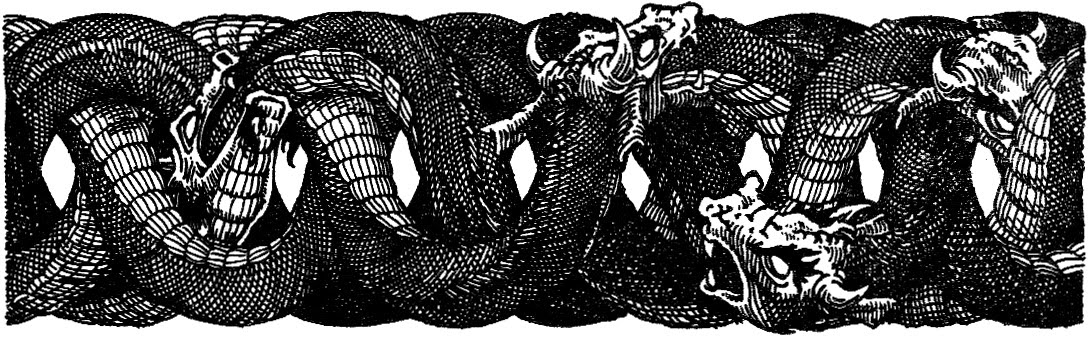
In 1980, one odd illustration appeared only in the second printing of the module where intertwined, horned dragon-serpents devour each other at the bottom of page 5.


The mysterious serpents

Some of the 6th and 7th printings of the Holmes basic sets included this printing of B2 and a few more copies sold individually. Later in 1980, the illustration disappeared from the third and subsequent printings, just as D&D's popularity started its greatest ascent. This makes it safe to call the illustration "rare."

The striking image is reminiscent of Celtic knotwork designs and M. C. Escher but who illustrated it? The artists credited in the module are David S. LaForce (a.k.a. "Diesel"), Erol Otus and Jim Roslof. However, this looks nothing like any of their art styles.

Now compare the illustration to the works of fellow TSR artist Dave Trampier:

Boat masthead (D3 Vault of the Drow), Gorgon (Monster Manual) and Kobold-Hating Dragon (Dungeon Masters Guide) all by David A. Trampier
We see the same toothy snout and careful balance between light and dark in the boat masthead. The gorgon's cross-hatching style and line weight are almost identical; even the shading on the horns is the same. The dragon exhibits the same serpentine neck with similar scales and soft underbelly. I feel safe in saying all four images were created by the same hand.

There were small changes between the first and second printings of the module, including the addition of the intertwined serpents image and a dragon illustration by David S. LaForce (previously seen in The Strategic Review). An editor probably added them to fill some white space between paragraphs. It is highly likely Tramp's contribution was overlooked and TSR staff neglected to include him in the art credits. In fact, third and later printings are heavily revised and include illustrations by Jeff Dee and Bill Willingham, both equally uncredited.

As far as I know, the intertwined serpents image was never published again. I believe this is the first time Trampier is acknowledged as the creator of this image.

For more information about module B2 and the early days of Basic D&D I recommend Zenopus Archives. "Zenopus" maintains a terrific repository of information on the original, blue-book, basic rules set and its author, the late Dr. John Eric Holmes. Stay up to date with his blog where he is currently comparing an original manuscript for Holmes' Basic Set against the printed versions, noting where editor Gary Gygax was making subtle adjustments to the original D&D rules.