Showing posts with label Holmes. Show all posts

Sunday, May 19, 2024

Introduction to The Fantasy Game, part 1

As I posted about briefly in my last post, I am currently co-teaching a History of Role-Playing Games course at Drexel University. The course is a mix of lectures about the history and evolution of RPGs, written reports about specific RPGs, and with in-class activities to create characters, monsters, campaign locations, and play through an adventure using the original 1974-1975 Dungeons & Dragons (OD&D) rules.

This brought something of a dilemma - how do I distribute copies of the game rules to my class? Most of the activities would be in class, but I also wanted them to have the rules to refer to outside of class. I could theoretically distribute PDFs of the rules, citing fair use, but I am wary of the appearance of copyright infringement. The original rules are available for purchase in pdf for the 1974 price of $9.99, but I prefer to offer my students an option that does not eat into their pizza funds. Besides, I didn't want to burden them with the task of understanding how to translate those original, unedited rules.

Retro-clones were the way to go, but which one? I offered Swords & Wizardry White Box, since the creators have graciously made the older versions of the rules free to use. Marcia B.'s critical and thorough Fantastic Medieval Campaigns is nearly ideal, and even includes Chainmail, though I found myself disagreeing with some of her interpretations of the rules (not to disparage her work, these are matters of personal opinion). After the course had already started, The Basic Expert release another OD&D retro-clone, Wight-Box.

These were all good options, and all essentially compatible with one another, but I knew I wouldn't be satisfied unless I crafted my own retro-clone for the class. This would also be an academic research project to finely analyze, comprehend, clarify, and disseminate the earliest of RPG rules.

The Fantasy Game: Basic Player Guide

I set to work rewriting those original 1974 role-playing game rules with a modern sensibility. I adapted the layout of another "fantasy heartbreaker" project of my own design that I'd been working on. For that project, I'd also collected a vast amount of public domain artwork from the classic era of book illustrations (in true retro-clone fashion) that work well for this implied fantasy world. Unlike most other retro-clones, each illustration is credited with the name of the artist (if known) and the publication it was printed in. Much like the 1974 rules, I created 3 rules booklets, though the contents of my books differ somewhat from the 3 LBBs.

I decided to incorporate a few rules that were added a short time after the original game's publication. I did not want to incorporate Greyhawk rules for ability score bonuses, hit point and damage adjustments, and other changes. However, I did adapt the "open doors" rule from Greyhawk (based on strength) into a general rule useful for "ability checks." The common ability check method (roll d20 under you ability score to succeed at a task) is somewhat maligned for being too easy to succeed at (average ability score has more than 50% chance to succeed) and not fitting with other OD&D resolution systems. The open doors check, however, gives an average character a 2-in-6 chance to succeed, and up to 5-in-6 chance to succeed for an 18 strength. I adapted that rule into a feat check to succeed at any test of strength, intelligence, wisdom, dexterity, charisma, or constitution.

I also added the weapon effectiveness charts from Greyhawk (otherwise, there is almost no difference between weapons that all do 1d6 damage), the thief class rules from The Thief Addition (with a nod to fellow Californian Gary Switzer and his Aurania campaign group that came up with the idea),  The Strategic Review FAQ, some equipment weights in Warlock, clarifications on spells and combat from Swords & Spells, and the ability for 1st level magic-users to scribe scrolls from the original Dungeons & Dragons Basic Set edited by Dr. J. Eric Holmes. Otherwise, the rules were as interpreted from the 1974 rules and from Chainmail.

Character Creation and Combat

Basic Player Guide: Character Creation and Combat

The character creation rules were the most critically important rules for my students as they would be rolling up new characters in the second week of the course. That includes how to roll up ability scores, species and class descriptions, alignment, money, equipment, and magic spells. I also wanted to include rules for exploration and combat, which consists of to-hit charts, saving throws, time and movement scales, order of combat, reaction rolls, and morale. The combat rules may end up in a separate booklet later, but for now, they are in with character creation.

I call this a "basic" player guide as the rules only cover characters up to 4th level of experience ("from zero to hero"). This saved me a lot of time in writing up spell descriptions.

Doing Things in the Game

Character Creation and Combat excerpt: Doing Things in the Game

The book needed to start with a guide to when you roll dice, what dice to roll, and why. Analyzing the OD&D rules, I determined there are several basic ways to "do things" that require a dice roll to determine if they happen or not.

Roll d20 and meet or exceed a target number: to-hit rolls and saving throws.

Roll 1d6 and roll low for a thing to happen: find secret doors, fall into a trap, get surprised, and the afore-mentioned "feat check."

Roll 2d6 and roll high to influence someone: reaction rolls, turn undead, and morale checks.

Roll d100 less than or equal to skill rating: most thief skills.

Roll several d6 and add them together, attempt to beat another character's roll: this covers the unusual grappling rules included in the Strategic Review FAQ, something I call a contest roll.

Other Changes

Character Creation and Combat excerpt: Character Classes

Fighting-man and magic-user changed to fighter and wizard.

Race changed to species. On that note, the term hobbit is replaced with halfling.

Order of combat is derived from Swords & Spells, clarifying who acts first in a mixed combat of missile weapons, magics, and melee attacks.

I derived the morale rules from Chainmail, just like the original rules recommend, but the question is: which morale rules? Chainmail has no less than three different morale systems: "post melee morale,"  a morale check for "instability due to excess casualties," and a morale check to "withstand a charge by mounted men." Chainmail's The Fantasy Supplement has specific Morale Ratings for different fantastic creatures in post melee morale, but that rule nigh unusable in an RPG combat. I adapted the "instability due to excess casualties" and had to extrapolate the melee values for various non-human combatants.

Coming soon, I'll write about the other books in this series.

Tuesday, April 23, 2024

Book update: Fifty Years of Dungeons & Dragons

I am happy to announce the upcoming publication of the book chapter "'Dr. Holmes, I Presume?' How a California Neurology Professor Penned the First Dungeons & Dragons Basic Set," co-authored with Zach "Zenopus" of Zenopus Archives. It will be published in Fifty Years of Dungeons & Dragons, scheduled for release on May 14, 2024.


This 392 page tome features 20 chapters by a variety of authors about the history, influence, and the future of Dungeons & Dragons, complete with black and white illustrations by C. Liersch. I am happy to be sharing contributor credits with the likes of Jon PetersonGary Alan FineAaron Trammell, and Amanda Cote. The retail price of $35.00 is downright reasonable for an peer-reviewed work of this size. See the book now at the MIT Press website: https://mitpress.mit.edu/9780262547604/fifty-years-of-idungeons-and-dragonsi/

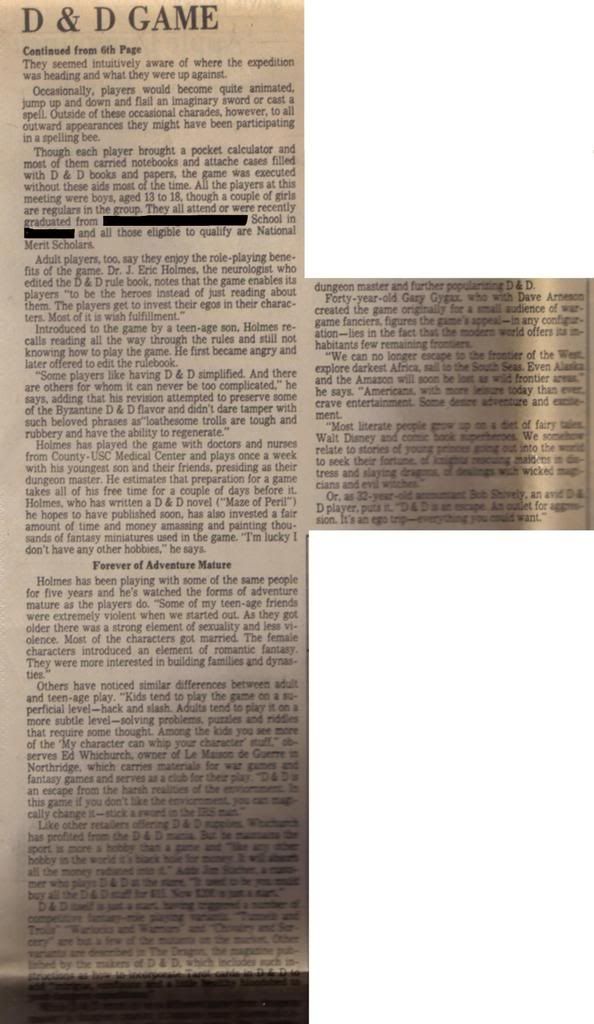
Our chapter revolves around the life of Dr. J. Eric Holmes and the strange set of circumstances that led this unlikely medical professor from California who had never played a wargame to be the first to author a revision to the original D&D rules for TSR. This is also a history of role-playing games in California, especially the Los Angeles and San Francisco communities, which spawned many varied ways to play in the "California gaming" scene. These are the waters of creation from which rose Runequest, Arduin, Alarums & Excursions, The Manual of Aurania, Warlock, and more, not to mention terms like "dungeon master" and the dice notation system (d8, 2d6, d100, etc.) that we all take for granted.

Early California gaming is a subject that I've written about here on this blog:

California Gaming Part I - Steve Perrin

California Gaming Part II - Erol Otus

I am currently teaching a History of Role-Playing Games course at Drexel University and presented a special lecture based on our chapter.

Don't miss my co-author Zenopus and his take on our chapter at the Zenopus Archives blog:

https://zenopusarchives.blogspot.com/2024/04/50-years-of-d-forthcoming-book-from-mit.html


Monday, August 25, 2014

#10 Favorite Game Fiction - The Maze of Peril #RPGaDAY

Let's face it, most game fiction isn't very good.

Many examples of game fiction tend to break the rules of the game's universe or adhere too closely to the game's format and just end up with mediocre stories. Not every good game designer is a good fiction writer (but many think they are). They often get tangled up in serious, epic, wanna-be Lord of the Rings, everything-depends-on-us quests to save the world and miss out on the fun of adventure gaming. To belabor the famous Joker quote, "Why so serious?"

I've read some of the earliest game fiction novels ever printed. Veteran author Andre Norton's Quag Keep (1978) is notable as a historical, early peek into Gary Gygax's World of Greyhawk/The Great Kingdom setting. The sequel, Return to Quag Keep, loses the Greyhawk setting and the small amount of charm the original held.

The oldest game novel I've found is War-Gamers' World (1978) by Hugh Walker (pen name for Hubert Straßl). It was first published in German as Reiter der Finsternis (Rider of Darkness) in 1975 and is the first book of the Magira series. It is based on the German fantasy wargame/proto-RPG hybrid Armageddon developed by the gaming group FOLLOW in 1966. Since that time, the setting spawned several RPGs. This first novel opens with a player getting sucked into the game's fantasy world. There are several references to seeing the world as interconnected hexagons. Not recommended except as another historical oddity.


I give a hearty recommendation for my favorite piece of game fiction: The Maze of Peril, a short novel written by the original Basic D&D rules editor, Dr. John Eric Holmes.

SPOILER ALERT: They don't save the world
Contrary to the publisher's blurb. Our heroes don't try to save the world. Boinger the halfling and Zereth the elf are just out to make a buck without having to get a real job. They undertake adventures to make quick cash and live the life of Riley at the Green Dragon Tavern for a few months. When the gold runs thin and the landlord comes a knockin', they undertake another delve into the Underworld to relieve some nasty monsters of their glittering treasures.
Boinger, another party member and Zereth relieving some nasty monster of its glittering treasure (art by Jim Roslof from "The Sorcerer's Jewel")
It is so refreshing to read an adventure story without the gloom and doom of the ultimate destruction of everything good folk hold sacred due to the megalomaniacal plans of some evil Sauron look-alike dark lord. These are two good friends just struggling to get by and maybe, someday, hit it rich. Their camaraderie and their humor really comes through in Holmes' writing. In a good way, it reminds me of the early Star Wars comic books by Marvel. The galaxy was safe from the ultimate apocalypse weapon, the Death Star, and the raised stakes of The Empire Strikes Back hadn't come into play yet. Han, Luke, Leia and their friends were free to adventure and freewheel their way across the galaxy.

BEGIN SPOILER WARNING
Bardan the dwarf's fate (as portrayed by Barely A. Dwarf in "Were-shark," an early version of The Maze of Peril's chapter 2 published as a stand-alone short story, art by Chris Holmes)

Nothing world-shattering is at stake; Boinger &co's quests are of a personal nature. During an early foray into the Underworld, one of the party fighters, Bardan the dwarf, perishes in combat. They bury his body in the cemetary but disturbingly find his grave exhumed and coffin empty a few days later. Boinger implores the party to return to the dungeon to thwart the revenge plans the evil-doers have for his friend's corpse.

The Maze of Peril adventures run the gamut from dungeon delve, urban adventures, bureaucratic red tape cutting, carousing, burglary, back to dungeon delve, Lovecraftian horror and even naval combat. Also, the book features one of the funniest uses of a petrification gaze that I would totally allow to happen if it comes up in a game.

END SPOILER WARNING

Holmes had several short stories about Boinger, Zereth (a.k.a. Xoreth) and their fellow adventurers published in Dragon magazine and Alarums & Excursions APA-zine. It is no secret that these tales were based on Holmes' home D&D campaign; Boinger was the player character of Chris Holmes, Dr. Holmes' son and occasional illustrator. These stories give us a window into Dr. Holmes' campaign and even how he interpreted certain D&D rules.

One famously unclear rule regards magic-users and their restriction from using armor and swords. In the days of OD&D, even famous, accomplished gamers were unclear on the ruling* and many cried foul against the sword restriction (after all, Gandalf used a sword). What logical reason (besides gameplay balance) could there be for this restriction?

Holmes succinctly gives his reasoning in two sentences. On page 34 of The Maze of Peril, Zereth removes all metal from his body, washes up and puts on a wizard robe before casting a spell. He explains to a confused Boinger that he:

"Can't have iron touching the body anywhere; no iron, even nails in the boot heels. It drains the flow of force from the other world."
No further explanation is required. Boinger asks, "It does? How?" Zereth tells him to, "Keep quiet," and no more is said on the matter.

This prevents magic-users from even wearing leather armor (with iron buckles). Presumably, a wizard's dagger must be made of bronze, silver or another non-ferrous metal. This stems from old folklore about iron's protective properties against magical creatures and has become a modern trope. It fits with Tim Powers' piratey fantasy novel On Stranger Tides (HIGHLY recommended reading) where magic disappears from the world as iron spreads with the advances of western civilization. The faerie-folks' aversion to iron seen in Poul Anderson's Three Hearts and Three Lions (also recommended) resonates as well.
Boinger vs. a one-armed troll (art by Chris Holmes from "Trollshead")
This leads to another rule: elves are combination fighters and magic-users and the OD&D rules state they "freely switch class whenever they choose, from adventure to adventure" (Men & Magic, p. 8). How does that apply to spellcasting and armor/weapon use? Holmes gives another example with Zereth in the short story "Trollshead" in The Dragon magazine #31, p. 41:
"Zereth took off his sword belt and helmet and laid them on the ground... He lay flat on his belly and reached into an inner pocket of his linen tunic to produce a pinch of fine sand. This he tossed into the air, mumbling rapidly as he did so."
To switch from fighter to magic-user, Zereth removes his sword belt and helmet (the only iron on his body) before casting a sleep spell on some unexpecting half-orcs. This goes against his own "elves must decide" ruling in his Basic D&D manuscript that states that elves cannot change in the middle of an adventure. In later stories, such as "The Sorcerer's Jewel"** (Dragon #46), Zereth wears armor while casting spells. It is assumed that Holmes was playing AD&D by this time, which does allow for spellcasting, armored, multiclassed magic-users.

Another question arises: just what are the "dungeons" in the world of Dungeons & Dragons? Why is there a near-endless number of underground labyrinths filled with nasty creatures and fabulous treasures? Zereth ponders the titular maze in The Maze of Peril, p. 3:

"Somewhere beneath the surface of this ancient land the tunnels and corridors of some prehistoric race coiled and raveled, delved, and probed unimaginable depths into the core of the world... What race or races had built the original maze no one knew. It seemed in the opinions of the sages and magicians of the time, that there must have been many layers of dungeons and underworlds laid down, one atop the other, as the world crust was formed, so that now no one knew, or even guessed, how many levels it extended below the surface."

Here, in one (wordy) sentence is the justification for a world of dungeons. It explains just enough to give the game world some logic yet leaves plenty of mystery for players to discover in their journeys into the Underworld. Of course, the truth may be very different from what the sages and magicians assume as fact.

Gary Gygax first hinted at such an Underworld with the D series of modules starting in 1978 (about the time The Maze of Peril was written). Later D&D authors would call this subterranean realm the Underdark and give their own reasons for its existence.
Zereth and Boinger (art by Donna Barr from "In the Bag")

In Conclusion:

The Maze of Peril is my favorite piece of game fiction because it feels most like the D&D games I've played. Rarely did we adventure to save the kingdom/world/multiverse. We were a bunch of friends looking for some excitement and quick cash together. We'd hatch elaborate schemes, find ourselves in deep trouble, then put our heads together to make sure they didn't roll off our shoulders come the dawn. We were comrades, bonded in the face of danger, celebrating each success until wanderlust crept back into our hearts and we were off on another wild quest.

Those are good times, and so is this book.

Notes:

Watch for Fight On! magazine issue #15 dedicated to J. E. Holmes coming soon! Read my heavily researched character write-ups for Boinger, Zereth and their "pal" Murray the Mage, along with guidelines for iron-restricted spellcasting, in my article, "Holmes Town Heroes."

The 1000 copy print run of The Maze of Peril is getting harder to find, but still available. Check out Holmes' short stories from Dragon magazine:

"Trollshead" The Dragon #31
"The Sorcerer's Jewel" Dragon #46
"In the Bag" Dragon #58

Complete Holmes Bibliography

* UK game designer Ian Livingstone (Games Workshop co-founder, Fighting Fantasy game books co-creator, etc.) erroneously wrote in his 1982 book Dicing with Dragons: An Introduction to Role-Playing Games when explaining D&D classes: "Each class has restrictions as well. For instance, The Magic User may only wear leather armour or no armour at all..."

** Although The Maze of Peril (1986) was published 5 years after "The Sorcerer's Jewel" (1981), we know Maze was completed earlier as Holmes states that it was ready to publish in an L.A. Times interview from 1979.

Wednesday, August 13, 2014

#3 First RPG Purchased - Holmes Basic blue box on the cheap #RPGaDAY

I first started role-playing when I was nine years old, learning from friends at school and playing with their books. With an allowance limited to less than one dollar per week, I relied on birthday or Christmas gifts for my first RPG books. I could afford to buy a few dice or miniatures for myself but would take all summer to save up for one AD&D hardback manual.

My mother was an antique dealer and visited thrift stores in a hunt for underpriced artifacts to resell in her shop. I was often in tow and would always scour the games, toys and books. It was on one of these trips that I made my first RPG purchase: an unplayed copy of the original 1st edition Basic D&D boxed set edited by Dr. John Eric Holmes.
Not my original Holmes Basic set, but a close replacement

I was pleased but puzzled as I'd never seen a D&D set like this one. I knew the 2nd edition basic set edited by Tom Moldvay. This game, I was sure, must be the original D&D set: the near-mythical 0th edition (that wasn't quite right, but it was still a good find). The price was right (probably 75 cents - the cost of one new lead miniature) and I took it to the register.
A tale of two B2 spear-wielding, armored minotaurs. Erol Otus' original Holmes-era illustration on the left and Bill Willingham's Moldvay-era version on the right

Once I got home and read the rules, I was even more puzzled. This was a D&D set from an alternate universe. Cardboard chits instead of dice? All weapons deal 1d6 damage? Why does this copy of The Keep on the Borderlands have different illustrations like that goofy minotaur eating a drumstick? Most importantly, where is Morgan Ironwolf?
Instant adventure: just add dice

Long before the days of "edition wars" we used whatever rule books we had together in a mishmosh of Basic/Expert/Advanced D&D. I'd alternate between the Moldvay and Holmes rule books, but defaulted to Moldvay for any rules differences. Soon thereafter, I completely switched to AD&D and rarely played the B/X or BECMI rules after that. We still played some of the modules (B4 The Lost City is still a personal favorite) but adopted them to play with AD&D.

For more on The Keep on the Borderlands and the Holmes edition basic set, be sure to bookmark Zenopus Archives and the Zenopus Archives Blog. Zenopus' latest project is a fascinating, page-by-page examination of Holmes' original manuscript for his rule book and a comparison with the printed version. Highly recommended!

Monday, March 31, 2014

Rare Dave Trampier Art Part 3

Uncredited art from B2 The Keep on the Borderlands

The Keep on the Borderlands seems like the last place to find a rare piece of TSR artwork. Gary Gygax himself wrote the module and included it as an introductory adventure in two different editions of the Basic Dungeons & Dragons boxed set (both the blue Holmes set and the magenta Moldvay set). TSR printed an estimated 1.5 million copies and it ranked the 7th greatest D&D adventure of all time in Dungeon magazine issue #116. Countless players and DMs cut their RPG teeth on this module (myself included). It can hardly be considered "rare."

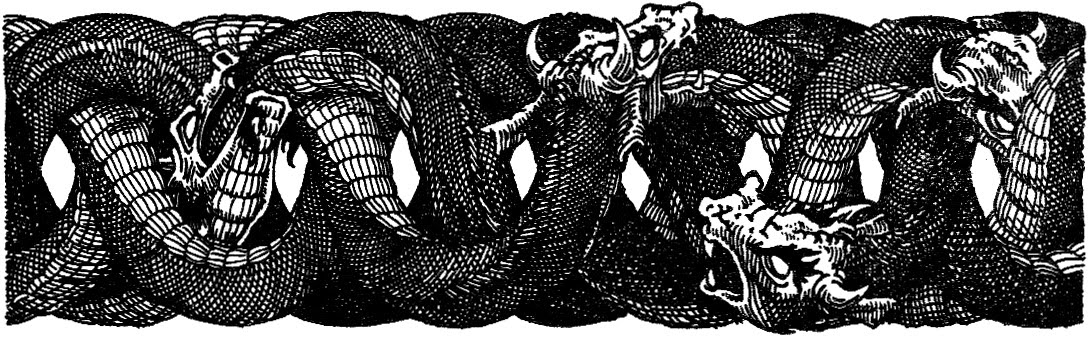
In 1980, one odd illustration appeared only in the second printing of the module where intertwined, horned dragon-serpents devour each other at the bottom of page 5.


The mysterious serpents

Some of the 6th and 7th printings of the Holmes basic sets included this printing of B2 and a few more copies sold individually. Later in 1980, the illustration disappeared from the third and subsequent printings, just as D&D's popularity started its greatest ascent. This makes it safe to call the illustration "rare."

The striking image is reminiscent of Celtic knotwork designs and M. C. Escher but who illustrated it? The artists credited in the module are David S. LaForce (a.k.a. "Diesel"), Erol Otus and Jim Roslof. However, this looks nothing like any of their art styles.

Now compare the illustration to the works of fellow TSR artist Dave Trampier:

Boat masthead (D3 Vault of the Drow), Gorgon (Monster Manual) and Kobold-Hating Dragon (Dungeon Masters Guide) all by David A. Trampier
We see the same toothy snout and careful balance between light and dark in the boat masthead. The gorgon's cross-hatching style and line weight are almost identical; even the shading on the horns is the same. The dragon exhibits the same serpentine neck with similar scales and soft underbelly. I feel safe in saying all four images were created by the same hand.

There were small changes between the first and second printings of the module, including the addition of the intertwined serpents image and a dragon illustration by David S. LaForce (previously seen in The Strategic Review). An editor probably added them to fill some white space between paragraphs. It is highly likely Tramp's contribution was overlooked and TSR staff neglected to include him in the art credits. In fact, third and later printings are heavily revised and include illustrations by Jeff Dee and Bill Willingham, both equally uncredited.

As far as I know, the intertwined serpents image was never published again. I believe this is the first time Trampier is acknowledged as the creator of this image.

For more information about module B2 and the early days of Basic D&D I recommend Zenopus Archives. "Zenopus" maintains a terrific repository of information on the original, blue-book, basic rules set and its author, the late Dr. John Eric Holmes. Stay up to date with his blog where he is currently comparing an original manuscript for Holmes' Basic Set against the printed versions, noting where editor Gary Gygax was making subtle adjustments to the original D&D rules.