Showing posts with label RPG. Show all posts

Tuesday, December 9, 2014

#12A - California Gaming Part I - Steve Perrin's Conventions - #RPGaDAY

Tracing the California Gaming Scene, part I: Steve Perrin in NorCal

I still read a number of old RPG supplements in my study of the early history of gaming. While many game historians study the origins of the hobby that spread from the wargame groups of the Great Lakes region (specifically, Lake Geneva and the Twin Cities of St. Paul/Minneapolis), I focus on the gaming scene that developed in my home state of California. West coast gamers created their own "flavors" of playing. I'll cover these in several posts and see how they wrap back into the official D&D game.

1976 Berkeley: Dundracon I, An Unconventional Convention for Perrin's Conventions


DunDraCon (Dungeons & Dragons Convention) was first held in Berkeley's Claremont Hotel in March, 1976. There, the public first encountered The Perrin Conventions, a set of D&D house rules handed out by organizer Steve Perrin (who was also a founding member of the Society for Creative Anachronism (SCA)).
Location of the first Dundracon

The Perrin Conventions included details for D&D combat, like: breaking up a round into phases, adding a "dexterity roll" to do other actions, knocking down opponents and two-weapon fighting. These were likely inspired by Perrin and his friends' experiences in mock battles with the SCA. This initial set of rules modified the magic system and included Dave Hargrave's critical hit rules(1).

 Perrin's own Dundracon bio admits that he didn't design all the rules, he was just the guy who typed them up for distribution. The rules received some notice from the convention attendants, but this was a limited group of mostly gamers from the Bay Area and surrounding regions. Still, it served as an early mutation on the original D&D rules from 1974 and showed that some players were interested in a less abstract combat system.
Steve Perrin and his wife Luise in SCA regalia at the 1968 Worldcon (source)

Steve Perrin wanted to become more involved in the nascent RPG industry and teamed up with fellow gamer Jeff Pimper to edit together a book of monsters, complete with stats for D&D and two newer games: Tunnels & Trolls (T&T, first published 1975) and Arduin (first published as The Arduin Grimoire in 1977).

In addition to their own creations, Perrin and Pimper compiled creature designs mostly from APA zines (The Wild Hunt and Alarums & Excursions (A&E)) or from local gamers. The designers included Dave Hargrave (local gamer and creator of The Arduin Grimoire), Clint Bigglestone (Dundracon organizer), Sean Cleary (A&E and Wild Hunt), Hilda Hannifen ("The Ignoble Mockturtle" A&E zine), Roger Harvey (later, an illustrator for Judges Guild), Steve Henderson (another SCA and Dundracon founder), Dan Pierson and Glenn Blacow (both from Wild Hunt), and others.

Jennell Jaquays (using the name Paul) contributed a few designs from her RPG fanzine, The Dungeoneer (about one year later, this became a Judges Guild magazine). Jaquays went on to a prolific career designing and illustrating RPGs, authored classic modules like Dark Tower, became one of the first tabletop designers in video game design (at Coleco). (12-11-14 edited for clarity)

They had more than one book's worth of material, so the editors decided to only print monsters that were never published before. Thus some of Jaquays and Hargrave's designs were left on the cutting room floor with some others from A&E. The monsters were given only D&D stats, though each entry included ranges for "IQ" (Intelligence) and Dexterity. They just needed a publisher.


1977 Albany: Chaosium publishes a Monster Manual or two before TSR

Greg Stafford founded his company The Chaosium in 1975 to publish White Bear & Red Moon (later reprinted as Dragon Pass), the first board game set in his fantasy world of Glorantha. Stafford was an D&D player and maybe purchased the first D&D set ever sold. Perrin, Pimper and Stafford met through mutual friends and when Stafford heard about their project, he was eager to have Chaosium publish it and get into the RPG supplement business.

Stafford was trying and failing to get a Gloranthan RPG off the ground. First, Dave Hargrave tried to make a Gloranthan version of his Arduin system and Chaosium had planned to publish The Arduin Grimoire; Chaosium house magazine Wyrm's Footnotes issue 2 notes: "THE ARDUIN GRIMOIRE will be the first of our new products." A few months later, the very next issue states: "When we finally received the manuscript to ARDUIN GRIMOIRE, it was not quite what we had hoped for... we have decided not to publish the rules." Hargrave had to self-publish The Arduin Grimoire (more on this later).  It is said that Chaosium felt Arduin was too derivative of D&D; issue 3 doesn't say this directly, but it does refer to Arduin as, "a supplement, if you will," and highly recommend it for, "experienced dungeoneers," (i.e. anyone who already owns the D&D rules?).

Stafford's design team of Hendrik Jan Pfeiffer, Art Turney and Ray Turney worked on the Gloranthan RPG as a D&D supplement but Stafford's world was unique and needed its own unique game system. Impressed with The Perrin Conventions, Stafford asked Perrin to "look in and see if he could help the situation" on July 4, 1976(2).

Perrin came up with revolutionary changes to the new system, like doing away with experience points, having no character classes and flat hit point values that don't increase linearly with experience. Slowly, Perrin was put in charge of the project. Only Ray Turney stayed on from the original design team and Perrin added fellow SCA members Steve Henderson and Warren James. Stafford was very pleased with the team's work on his fantasy world.

Chaosium published Perrin and Pimper's All the World's Monsters sometime in 1977, getting to market before TSR's official monster collection, the AD&D Monster Manual (released in December, 1977).
All the All the Worlds' Monsters, volumes 1-3
All the World's Monsters vol. 2 followed that same year and maybe hit the shelves before Monster Manual as well. In addition to adding in cut designs by Hargrave, Jaquays and others, the second volume included T&T conversion notes (by Ken St. Andre) and a refined, revised set of The Perrin Conventions (dated November, 1977) that focused mostly on D&D combat, less Hargrave's critical hit rules. Now, the house rules were available to a much wider audience.
RuneQuest, 1st printing cover. Illustration by Luise Perrin
In 1978, the new Perrin-led Gloranthan game RuneQuest was born and, with it, Chaosium's in-house Basic Role-Playing (BRP) system. This BRP system was also modified into Worlds of Wonder, Call of Cthulhu, Elfquest, Stormbringer/Elric!, Hawkmoon, Pendragon, Superworld, Ringworld and many other games. This was also one of the earliest "universal" RPG systems (though many of the different games were only barely compatible).

The combat system was quite detailed, with parries, fumbles, critical hits, hit locations and more. RuneQuest the first totally skill-based RPG without classes (Traveller (1977) had character skills but no way to improve them) where the player could develop their character as they desire. For some years, RuneQuest provided competition to TSR's sales and Chaosium is one of the few game companies from that era still in business today.

12-11-14 Update: 
I'll let Dr. J. Eric Holmes, editor of the first D&D Basic Set and a SoCal gamer, describe RuneQuest's combat system as he compared it to D&D in 1981.
The combat system requires a little more bookkeeping than D&D and is, therefore, more "realistic."(3)
Could you elaborate, Dr. Holmes?
Combat rules are extremely complex. There are die rolls for each hit and its parry, for the location of the hit as well as for the extent of the damage. There are special scores which indicate a "critical hit" or a "fumble," and then another roll to see what the nature of the critical injury or fumble might be. Special training will increase the character's ability to hit with a particular weapon. Each weapon must, realistically, be trained for individually, at a cost of silver lunars (the coin of the realm) or maybe by doing some more die rolls to see if your character has learned from experience after a successful fight.
 All of this takes a lot of bookkeeping, die rolling and calculation with every blow struck. This is not necessarily a criticism. A great deal of any game is spent in the calculations and die rolling involved in combat... A pocket calculator might come in handy. Many game players revel in these complicated calculations. The more complex the computations of each weapon blow, the better they like it.(4) (emphasis mine)
So, Holmes found players in Southern California that, like many Northern California counterparts, preferred a complex, "realistic" combat system. Holmes did not share that opinion, himself:
What are the advantages of this game over its (inevitable comparison) competitor, Dungeons & Dragons? In terms of basic game mechanics, character generation, experience, combat, magic, I would say none. Some fans of the game would cry that it has greater "realism," but I think these are minor differences.(5)

Holmes appears to like the RuneQuest game and speaks highly of its clarity in writing, numerous examples and the novelty of a game manual with an index (something he wished for his own Basic D&D(6)). Besides the combat complexities, his main complaint was he didn't feel the RPG captured the "feel" of Glorantha (as seen in White Bear & Red Moon). It missed out on the "eerie feeling of reality to his imaginary world(7)" that Greg Stafford brings when he writes games, himself.

Note: Holmes probably played 2nd edition RuneQuest as opposed to 1st edition. As far as I understand, the differences between the two are minimal.
End 12-11-14 Update 

Conclusions:


First of all, RuneQuest did not evolve directly from The Perrin Conventions. It may seem obvious, but the internet is full of quotes like, "Runequest's rules were made from The Perrin Conventions," or, "RuneQuest is a codification and development of the Perrin Conventions." (quotes slightly obfuscated) These statements imply that RuneQuest is nothing more than a D&D variant, but that simply isn't the case. There are similarities between the two, but no more so than with countless other systems. If Chaosium just wanted a D&D variant, they would've used Pfeiffer, Turney and Turney's design and gone to market with it back in 1977.

Second, SCA members and wargamers play differently. D&D evolved from wargame rules by members of the Castle & Crusade Society, founded by Gary Gygax and Rob Kuntz as a chapter of the International Federation of Wargaming, itself founded by Gygax, Scott Duncan and Bill Speer in 1966. These gamers got together around a sand table (usually in Gary's basement) ordering miniature armies into mock battles. Abstract combat was simple and made sense.

Conversely, the SCA was founded in Berkeley in 1966 with armored members going outside to fight mock battles with padded weapons. Their point of view was not that of a military commander with a bird's eye view of battle, but as a common soldier who has felt the heft of their shield and the sting of a (padded) sword. Combat seems abstract if you aren't the one fighting. The reenactors saw something missing in abstract combat and created their own rules and games to fill those gaps.

Maybe it all comes down to the weather. In sunny California, you can go outside and play practically all year round. When it gets cold up North, it is best to hunker down next near the heater and go to war with some good friends around the sand table.

Wednesday, September 3, 2014

#11 Weirdest RPG Owned - The All Australian Role Playing Game #RPGaDAY

While riding a hotel shuttle from the San Diego Comic-Con back in the early 90s, I overheard a young man excitedly describe a game to his friends in the seat behind him. The player characters are cartoon-like alien tourists who go on hunting safaris on backwoods planets, tracking and killing the low intelligence native species there. One particular backwoods planet is called "Earth" though, due to a translation error, the alien hunters call it "Dirt." There, the low intelligence native population of "Whoomens" are fighting back, retaliating with all manner of absurd ordnance. Also, the game is entirely focused on Australia, written by Australians, played by Australians, published in Australia and features an Australia-centric view of Earth on the front cover.

I continued to my hotel, probably to play some AD&D with a cadre of friends I shared a room with (the hotels were expensive even back then).

But the image of that Australia-centric view of Earth never left my mind.

...

Some 15 years later I found Hunter Planet.
Target: Dirt.
The game is every bit as bizarre and Australia-centric as my memory of that overheard description. Imagine a cross between Paranoia, Predator, The Hitchhiker's Guide to the Galaxy and Toon. The alien player characters are working class schlubs who saved up their vacation time for an exotic safari to shoot easy game and bring home a nice trophy for the mantlepiece (or alien equivalent).
Smile!
What they find on our home of Dirt is a Whoomen population ravaged by constant hot wars and cold wars where most citizens have access to arsenals that outclass the tourists' laser rifles and automatic crossbows. The Hunters become the hunted. The powerful Whoomen weapons are also more likely to backfire, so a tourist who steals a Whoomen rocket launcher is bound to end his vacation in a predictably tragic, yet hilarious, manner.
Sample Character
The game is run with several different players in the roles of the Hunters and one player as CM (which may stand for Control Man, Condition Modifier, Chocolate Milk, Carbon Monoxide, Crazy Man, Chance Master or Certified Maniac). The players create their characters by rolling 1d10 for each characteristic (Strength, Dexterity, etc.) in order with two rerolls allowed. Luck is rolled on 1d6 and is rerolled at the start of each game.

At this point, we are directed to refer to footnote 87. Spoiler alert: there is no footnote 87.

Players roll 1d10+10 to determine Hit Points, a term which is not explained. It is assumed the players role-play enough to know what any D&D-derived terms mean.

The players now select their equipment and weapons, but no more than three grenades and no Alpha-Beta Plus Gamma Radiation Neutron Destructo Particle Accelerator Beams. Otherwise, the players are free to choose what gear they wish... with the realization that the natives they encounter will probably have something equally egregious. If the CM determines that your character is carrying too much weight (footnote 35 says you probably are), he will probably strike any excess off the character sheet. Example equipment is listed, such as Light Sword, Tangle Grenades, Dehydrated Water, 10 Sided Die, Anti Gravity Belt and "Whammo" Door Charges.

The CM then describes the scenario the Hunters find themselves in on their one-week tour of Dirt before they are beamed back up to the Hunting Tours Incorporated ship. They probably won't survive.
Note: this is not Emperor I. M. Wunndafull. I think this is his secretary.
My biggest surprise when I picked up Hunter Planet was the realization that this was the second game I owned by designer David Bruggeman. The first was an obscure set of miniature wargaming rules titled WWII Book of Armaments that I picked up somewhere on a whim. The rules are good, but the game is SO obscure that I can't find a good web link for it (EDIT: I created a page about the game HERE). It was published by The Australian Games Group (TAGG) best known for publishing Lace & Steel, the swashbuckling fantasy RPG with innovative card-based mechanics and illustrations by Donna Barr (see Ms. Barr's Boinger and Zereth at the bottom of this post).

The Book of Armaments includes a photo of the designer:
This is Emperor I. M. Wunndafull
Bruggeman devotes four full pages of the 35-page Hunter Planet to his "Guide to Better CMing (or The Dos and Don'ts of CMing)." Some pieces of advice are obvious but many are quite good. I summarized several of them as follows:

DO
Read widely (An extensive general knowledge is an important benefit to all CMs)
Prepare a scenario (Prepare a situation where the Hunters will find themselves)
Concoct various surprises (Ammunition wasting creatures, traps and tricks, strange inhabitants, etc.)
Roll dice frequently (This puts the players on edge and causes them to react to non-existent dangers)
Build tension and action up to the beam up time (The mothership checks in with the Hunters once every four hours. They may be beamed up at this time, but at no other time. Actually, they can request it at other times, but the request is ignored)
Ad lib frequently (Unexpected events create confusion, excitement and fun)
Inspire character conversations with non player characters (The CM gets to role play a more interesting character than a stupid Orc and gets to hear what the players call a logical, convincing argument)
Cheat (But cheat fairly)
Tell the Hunters only what they would know as aliens (Which isn't much)
Ensure that everything in the game has both a good and bad side (Called the "Bad News Factor," all weapons and equipment have at least a 5% chance of something horrible happening when used)
React to players comments (Once a player says something, even in jest, it will be acted upon by the CM)
DON'T
Be sadistic (The adventure should be dangerous, not a suicide trip)
Play strictly to the rules (What rules?)
Give away benefits easily (Benefits must be earned)
Hide behind the CMs screen (The screen is designed to hide the CM's game information, not the CM himself)
Forget (The CM should remember when a player forgets to reload his weapon and tries to shoot, etc.)
Land the Hunters in the middle of nowhere with nothing to destroy (Where they land may "appear" to be peaceful but it should be nothing of the sort)

Monday, August 18, 2014

#8 Favorite Character - Wonko the Sane #RPGaDAY

My favorite character is my silver-haired, half-elf jester, Wonko the Sane (yes, named after the Hitchhiker's Guide to the Galaxy character).
Wonko's main stats

I first rolled Wonko up in November, 1990 - a 1st edition AD&D character using the Jester NPC rules from the pages of Dragon magazine (revised and reprinted in Best of Dragon Vol. IV). When 2nd edition AD&D and the Complete Splat Books were all released, I used the Jester kit rules from The Complete Bard's Handbook. Those rules were notably less silly (no more punfighting).


Wonko playing his electric mandolin, still smiling at only 2 HP
Wonko is a lot of fun to draw, especially with his striped leisure suit jacket, polka-dotted cape and checkered trousers. In the top image, you see Wonko wielding his Short Sword +1/+4 Vs. Reptiles and another strange weapon.  It is a stick with an Odie stuffed animal on one end and a Rug of Smothering with the command word "Don't Make Me Laugh!" on the other. Wonko must need his Buck and a Quarter Quarterstaff weapon proficiency to wield it.

Other unusual supplies on his character sheet include his electric mandolin (see second image), a hanging fern, one can of WD-40, a dust rag and "five belts of priestly origin" that I am assuming came from some Gygaxian adventure.


Lars Leafblower is fed up with Wonko's tomfoolery
Wonko survived to 10th level, annoying a number of nasty bad guys along the way, including Strahd von Zarovich in I6 Ravenloft and whoever was in "A Rose for Talakara" (which I have in my notes as "A Rose for Somebody"). Like most jesters, he had a tendency to annoy his fellow party members as well. In the third image, we see what happens when you push a druid too far.*

Want to a jester in an old-school campaign? This website compiles all the early Jester rules for D&D, including errata and Gary Gygax's musings on the class.

* My friend Duane came up with some of the goofiest character names. In addition to Lars Leafblower he ran another memorable druid: Waz Weedwhacker.

Monday, March 31, 2014

Rare Dave Trampier Art Part 3

Uncredited art from B2 The Keep on the Borderlands

The Keep on the Borderlands seems like the last place to find a rare piece of TSR artwork. Gary Gygax himself wrote the module and included it as an introductory adventure in two different editions of the Basic Dungeons & Dragons boxed set (both the blue Holmes set and the magenta Moldvay set). TSR printed an estimated 1.5 million copies and it ranked the 7th greatest D&D adventure of all time in Dungeon magazine issue #116. Countless players and DMs cut their RPG teeth on this module (myself included). It can hardly be considered "rare."

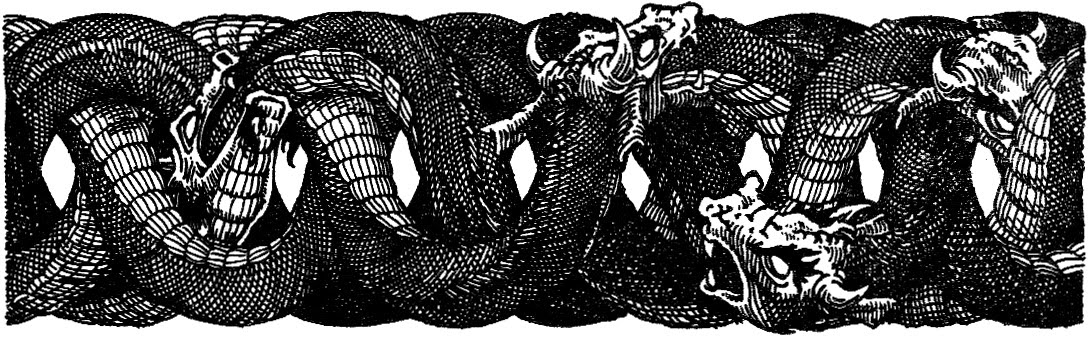
In 1980, one odd illustration appeared only in the second printing of the module where intertwined, horned dragon-serpents devour each other at the bottom of page 5.


The mysterious serpents

Some of the 6th and 7th printings of the Holmes basic sets included this printing of B2 and a few more copies sold individually. Later in 1980, the illustration disappeared from the third and subsequent printings, just as D&D's popularity started its greatest ascent. This makes it safe to call the illustration "rare."

The striking image is reminiscent of Celtic knotwork designs and M. C. Escher but who illustrated it? The artists credited in the module are David S. LaForce (a.k.a. "Diesel"), Erol Otus and Jim Roslof. However, this looks nothing like any of their art styles.

Now compare the illustration to the works of fellow TSR artist Dave Trampier:

Boat masthead (D3 Vault of the Drow), Gorgon (Monster Manual) and Kobold-Hating Dragon (Dungeon Masters Guide) all by David A. Trampier
We see the same toothy snout and careful balance between light and dark in the boat masthead. The gorgon's cross-hatching style and line weight are almost identical; even the shading on the horns is the same. The dragon exhibits the same serpentine neck with similar scales and soft underbelly. I feel safe in saying all four images were created by the same hand.

There were small changes between the first and second printings of the module, including the addition of the intertwined serpents image and a dragon illustration by David S. LaForce (previously seen in The Strategic Review). An editor probably added them to fill some white space between paragraphs. It is highly likely Tramp's contribution was overlooked and TSR staff neglected to include him in the art credits. In fact, third and later printings are heavily revised and include illustrations by Jeff Dee and Bill Willingham, both equally uncredited.

As far as I know, the intertwined serpents image was never published again. I believe this is the first time Trampier is acknowledged as the creator of this image.

For more information about module B2 and the early days of Basic D&D I recommend Zenopus Archives. "Zenopus" maintains a terrific repository of information on the original, blue-book, basic rules set and its author, the late Dr. John Eric Holmes. Stay up to date with his blog where he is currently comparing an original manuscript for Holmes' Basic Set against the printed versions, noting where editor Gary Gygax was making subtle adjustments to the original D&D rules.


Monday, June 3, 2013

Man, Myth & Magic Cartoon Intermission

If you've been following my blog series on Man, Myth & Magic, you've seen that the Sage class is the perfect choice for the know-it-all rules lawyer in your game group.

Ben Sargent's Murphy's Rules cartoon from Space Gamer magazine #63 sums the Sage up nicely:
Art by Ben Sargent, published by Steve Jackson Games
SJG's series of Murphy's Rules cartoons from Space Gamer were compiled and republished in 1988 and again in 1998 with more cartoons from Pyramid magazine. You can order a PDF of the 1998 version direct from SJG: http://www.sjgames.com/murphys/

Sunday, June 2, 2013

Obscure RPG Appreciation: Man, Myth & Magic pt. III

This is a continuation of my Obscure RPG Appreciation Day overview of Yaquinto's Man, Myth & Magic game. Click here to read part I of the series.

Reincarnations

Briton Druid
A major part of MM&M is the concept of Reincarnations. As the game states, "In MM&M, you reincarnate anew for each adventure, enabling you to experience a vast variety of viewpoints and abilities. And from incarnation to incarnation, you carry something of your past experience with you, building up a character type as far beyond your first (character) as a man is beyond an amoeba."

No pressure! Note that in MM&M, and "adventure" is more like what would be a "campaign" in D&D, spanning the equivalent of three to seven adventure modules.
Roman Gladiator

I mentioned in my last post that a character's Accumulated Power affects the Reincarnation Process in two ways:

First, when a character with 200 or more Power dies and the player "Incarnates" (rolls up) a new character and gets one of the same Class, he may ignore this result and reroll until he comes up with a different class. Once a player accumulates 200 Power in a Class, they are done with that Class if they so choose to be. This incarnation is a completely new character starting with zero Power.

Second, a character with 200 or more Power may voluntarily undergo a Reincarnatory Metamorphosis ("one of the most spectacular achievements in MM&M"). By act of will, the character is transformed into a new being, retaining all the character's original possessions and Characteristics (except Skill and Power). Think of it like one of Doctor Who's reincarnations. The player rolls for a new Nationality, Class and Skill level. All Power is lost, except that gained from gold possessed.
Hibernian Leprechaun

For every 25 points of Power the character has accumulated at the time of Reincarnatory Metamorphosis, the character has a 1% chance of retaining a Distant Memory. This allows the character to retain the skills and abilities of his previous Class in his new incarnation. Essentially, this is the way to multiclass in MM&M. A Greek Warrior may reincarnate as an Egyptian Sorcerer and retain his memories and skills as a warrior. The character would have two Skill levels, one for Combat and one for Sorcery. The Warrior/Sorcerer may reincarnate again as say, a Hibernian Leprechaun. He may retain both his previous memories and be a Warrior/Sorcerer/Leprechaun (as silly as that sounds).

Optional Characteristics

Visigoth Barbarian
In addition to the seven primary Characteristics, there are 24 additional Optional Characteristics that may be rolled up. These include Agility, Charm, Determination, Dexterity, Drinking (!!), Devotion, Hearing, Height, Language, Loyalty, Luck, Mental Stability, Read & Write, Senses, Sight, Stealth, Swimming, Throwing, Weight, City Knowledge, Desert Knowledge, Mountain Knowledge, Sea Knowledge and Woods Knowledge. The player rolls d100 to determine the starting levels for each Characteristic (except Luck), modified by Nationality and Class.

The Luck Characteristic is generated by rolling d10 divided by 3 (round up). These points may be used as "mulligans" to reroll failed rolls during the game. Luck points are regenerated at the end of an adventure (though, that should probably read the end of a scenario).

Drinking is used to stave off the effects of intoxicating beverages (this ability decreases by 5% for each drink consumed). Senses (unlike Sight or Hearing) is more like "Intuition," used to avoid stepping on a trap at the last moment. Determination is how many times a character will attempt a non-combat action, such as starting a fire, before giving up. Loyalty determines a character's loyalty to the party, Nationality or character class. However, Devotion also refers to the player's devotion to his party and I don't know which one takes precedence. Height and Weight are used with another table to determine height and weight. A Leprechaun character is never more than 4 feet tall.

As we saw in my last post, this game has a universal task resolution system called the MM&M Paradox. It seems this system is not used with Optional Characteristics. Instead, the rules specify a typical percentage-based system where d100 is thrown to score less than the Characteristic in question, such as rolling under Agility to climb a tree or under Throwing to throw something at a target. However, other examples of Optional Characteristics indicate that rolling low against the Characteristic indicates failure. Also, when a character gets drunk, their Characteristics are "either doubled or halved, whichever is worse for the player." What does that mean? When is having a high stat a bad thing? This chapter needs a good round of editing.

Weapon Skill and More Combat Details

Roman Centurian
The SPECIAL WEAPONS HANDLING ABILITIES rule allows characters to have different skills with different weapon types. The To Hit Number with a Sword is affected by Agility, Skill, Speed and Strength. The Archery THN is affected by Sight, Dexterity and Skill. Other weapon categories include Thrown, Bludgeon, Dagger/Knife and Axe. This reminds me of the Chaosium/Runequest RPG system where many abilities may affect hit chances, not just Strength or Dexterity.

When combat begins, initiative goes to the unit with the highest First Strike Capacity (Speed + Courage). The number of strikes a unit may make in combat before resting is equal to  ((Endurance/10[RU]) + (Courage/20[RD])). A unit's Combined Modifier Figure (Skill + Strength) is added to an opponent's THN when attempting to dodge an attack. I have no idea why it isn't called "Dodge Value" or something. Note that a character's Speed value is reduced by any armor worn.

Next up, we'll take a look at Magic!

Obscure RPG Appreciation: Man, Myth & Magic pt. II

This is a continuation of my Obscure RPG Appreciation Day overview of Yaquinto's Man, Myth & Magic game. Click here to read part I of the series.

Character Attributes and Power

MM&M uses seven attributes (here called Characteristics) for character generation: Strength, Speed, Skill, Endurance, Intelligence, Courage and Power. Most are common FRPG attributes that need no explanation. Each Characteristic (except Power) is rolled up on a d100 (confusingly called 2d20% in this game, using two 20-sided percentile dice). This gives a broad range of 1-100 with no weighting toward the middle of the range, though 50 is considered average. The abilities are modified depending on the character's Nationality and Class.

Skill is the character's aptitude with their class's Prime Ability (combat for warriors, magic for magicians, healing for healers, potion manufacture for apothecaries, wealth increase for merchants (?!), bribery for senators (!!), psychic abilities for other characters, etc.). 

A player adds together the first six Characteristics (all except Power) to calculate the starting character's Life Points, averaging about 300 LP. That's enough to take quite a few sword blows.
Egyptian Sorcerer
"In MM&M, the purpose of life is the pursuit of POWER."
Power always starts at zero for a new character and increases by accumulating wealth (every 1,000 gold libra you own increases Power by 1) and through experience (players usually add d100 Power at the end of a scenario). Magicians and Psychics temporarily tap into their Power reserves to use their supernatural abilities. Characters may permanently sacrifice 250 points of Power to raise another stat by 1 (this is not a good trade). For every 30 points of Power over 100, a character reduces their failure rate by 1% (see The MM&M Paradox, below). Accumulated Power also affects a character's Reincarnations (more on this later).

Note that since a starting magician or psychic has no Power, they cannot cast any spells until they survive their first adventure!

Action Resolution System (The MM&M Paradox)


Where most game systems work on a character's chance to succeed at a certain action (skill check, cast a magic spell, make an attack, etc.), MM&M instead focuses on the chance to fail at such actions. This ties into the game's sense of impending doom for your character and if things go bad, maybe your next reincarnation will be better. It boils down to this: a character has about a base 50% chance to fail at anything they attempt to do. I'll let the game speak for itself:
You are going to fail


That last paragraph is questionable: it would take an accumulated Power of 1600 to "cut the rate right down to nothing." That is a lot of adventure time.

Using failure percentages does have some advantages. To determine success, the player rolls d100 and attempts to roll high, over the failure rate for the skill tested. The desire to "roll high" feels intuitive and is not often seen in percentage-based games. The failure rate is modified by appropriate Characteristics, but not by much. For every 10 points over 50, the failure rate is reduced by 1%. Conversely, every 10 points under 50 increases the failure rate by 1%. This modification range of +5% to -4% is downright negligible statistically insignificant; I feel that 2% for every 5 points over/under 50 would make more sense.

All of this gets thrown out the window when using the rules for Optional Characteristics (more on this in another post).

Combat

Combat resolution uses the same MM&M Paradox action resolution rules with a base failure rate of 50%. Only warriors modify their "to hit" failure rate (a.k.a. "To Hit Number" or THN) by their Skill ratings (high Skill = lower failure, low Skill = higher failure). Strangely, this gives untrained philosophers higher to hit chances than low-Skill warriors.

Rolling the THN exactly means a hit is scored with no damage. Every point scored over the THN counts as damage from the strike (rolling 70 with a THN of 50 means a hit for 20 points of base damage). Melee hits are increased or decreased by 1 point of damage for every 10 points of Strength above/below 50. Damage is further increased by the type of weapon used (+20 for a club, +30 for a sword) and decreased by the armor on the hit location (-5 for a leather gauntlet, -25 for a metal breastplate). It is not clear if rolling the THN exactly counts only as a glancing blow or as a hit for a base of 0 damage that may be modified by the attacker's Strength and weapon type.

An unmodified attack roll of 100 results in an instant kill.

Attacks are presumed to target the torso and damage is depleted from the defender's Life Points. An attacker may optionally target a specific body part, such as head, arm, foot or finger. Each body part increases the attacker's failure rate to hit but only has a certain number of life points (75 for an arm or leg, 25 for a finger or toe, 100 for the head). Damage is taken from the defender's Life Point total and the body part's life points. When reduced to zero, the body part is destroyed. As the game suggests, it may be easier to lop off an opponent's leg rather than wear down his life point total. This works well with the game's piecemeal armor system.

The "subtract failure rate from roll to determine base damage" is simple and intuitive and reduces to hit and damage determination to only one roll. However, there is an extra step of subtracting the failure rate that could be eliminated with a standard percentage success system. Say, a player had a to hit rate of 55% and rolled d100 to score 55 or less (as opposed to a 45% failure rate as used in MM&M's system). As long as the hit succeeds, the roll is equal to the base damage. Rolling an 01 could count as an instant kill instead of 100. This gives almost exactly the same result with less math, plus the intuitiveness that high Characteristics give a plus to hit rates rather than a minus to failure rates.

Click here for part III of this review. We get to Optional Characteristics (and a whole new action resolution system!) and Reincarnations.

Saturday, June 1, 2013

Obscure RPG Appreciation: Man, Myth & Magic pt. I


Short-lived wargame publisher Yaquinto first published Man, Myth & Magic in 1982, just one year before the company went defunct. Better known for wargames like The Sword and the Flame, Ironclads and "Album Games" like Swashbuckler, Role-Playing Games were new to Yaquinto. Following the tradition of Dungeons & Dragons, they chose the "Ampersands & Alliteration" method of game naming (much like Tunnels & Trolls, Powers & Perils, Chivalry & Sorcery and Yaquinto's own swashbuckling RPG Pirates & Plunder).

Character Backgrounds

MM&M's game world is ostensibly set in a mythical, yet historical version of Earth. The default campaign is the 1st century A.D. (C.E.) Roman Empire. Characters hail from an extremely cosmopolitan variety of backgrounds ranging from deepest Africa to Briton and Hibernia (a.k.a. Ireland) to the far east Orient.

MM&M Advanced Rulebook Cover
This diverse range of backgrounds is the first point where this game shows problems. Players determine a character's Nationality by rolling on a chart with ten different options: African, Briton, Egyptian, Gaul, Greek, Hebrew, Hibernian, Visigoth, Roman or Oriental. However, no nationality is more or less common than any others; you have the same chance of running into an Irishman in ancient Rome as you do encountering a Roman!? How do such different characters join together to have adventures in the first place? The referee (Lore Master) has his/her work cut out for them to piece together a coherent party.

Character Classes

Another random roll determines a character's Class. Different nationalities use different class charts. Some classes are common (such as Merchant or Warrior) while others are exclusive to specific nations (Druids to Britons, Centurions to Romans). Many classes are typical fantasy RPG tropes, but a few oddities stand out: Sibyl (female oracle), Leprechaun (!!) and Weirding Fighter (Kung Fu master). There are different abilities for each class and many may cast magic spells.

Two classes deserve special attention: ORATOR and SAGE. These are more like player roles and are taken in addition to the randomly determined character class.

To become an Orator, a player must "apply for examination by the Lore Master at a mutually convenient time." To pass the exam, the player must "speak fluently, amusingly and without a break for three minutes (real time) on any subject the Lore Master choses (sic)." Yes, prior preparation is permitted. What does the player get for entering the RPG version of a Toastmaster's club? The player may stop the game to give a two minute (real time) speech that will "so fascinate any number of opponents that the Orator's colleagues may always attack first." This is a sure-fire way to slow down the game before every combat encounter.

The other unusual class is the Sage, otherwise known as the Rules Lawyer. The game acknowledges players who "soak up the rules of Fantasy Role Play like a sponge" and memorize entire rulebooks. "Now this sort of talent is pretty sick-making to any decent upright player who wasn't born with a memory like some stupid computer, but once this sort of thing gets a grip, it is very difficult to control." (emphasis mine) This game allows such players to "capitalize on their knowledge by becoming a Sage." Once a player tells the Lore Master they wish to become a Sage, that player is "obliged to sell information to fellow players." This is not a choice. When a Sage correctly answers another player's question about the game rules, the player must pay the Sage 25 gold libra. An incorrect Sage is fined 50 gold libra which is split among the other players. This may be the most bizarre class I've ever seen in any RPG.

[UPDATE: Click here for a classic cartoon about MM&M's Sage Class]

The game explains the Sage system thusly: "Good Sages are very valuable to a party. Know-all Sages are a pain. Either way, the MM&M Sage system keeps them under control."

Click here for part II with attributes, the action resolution system, and combat.

Click here for part III with reincarnations, optional attributes and more details on combat

Thanks for joining Obscure RPG Appreciation Day!