Showing posts with label Rare Dave Trampier Art. Show all posts

Sunday, December 6, 2020

Rare Dave Trampier Art - Addendum to Part 1

Adventure Gaming magazine vol. 1 no. 5 cover art, addendum

Back in early 2014, I wrote a series of blog posts about little-seen art by Dave Trampier, the enigmatic artist from TSR's early days, creator of the comic strip Wormy, and co-designer of the board game Titan. As I was in the middle of my series, Dave Trampier emerged from hiding after decades of nobody knowing where he was, agreeing to sell artwork and come to a convention in Carbondale, IL. Unfortunately, he passed away soon before the convention. I had to post the solemn news on this blog.

In my first blog post in this series, I discussed one of Tramp's impressive color works for Titan, a painting was used on the cover of Adventure Gaming magazine #5 for a special issue with several Titan articles.
Adventure Gaming vol. 1, no. 5

I speculated that the image was probably intended as cover art for the new edition of Titan, which was published by Avalon Hill with cover art by Kenn Nishiuye instead of Trampier. I created a mock-up image of what the Avalon Hill game might've looked like with Tramp's art (see Rare Dave Trampier Art - Part 1). Earlier this month (December 2020), I had a Zoom meeting with Tim Kask, publisher/editor of Adventure Gaming and close friend of Trampier's. I asked if he remembered what the image was originally intended for, but he did not. Tramp had given Kask the original artwork long enough to make color separations for printing the cover, then required that the original be returned.

Since that time, Jason McAllister, Titan's other co-creator, also passed away. I assisted the McAllister family in identifying and helping find an auction agent for a number of Jason's personal effects, including several art pieces created by Dave Trampier. One item was a sketch of a store display for Titan games.
Titan display sketch, detail
 by David A. Trampier

The display is sketched in perspective, as if it is sitting on a store counter. The Gorgonstar logo at the base tells us this is not meant as a concept for Avalon Hill's Titan, but for a new self-published edition under McAllister and Trampier's Gorgonstar name. This looks like a new "bookcase" style game box, made popular by Avalon Hill and 3M, and very different from the flat and wide 1st edition Titan game box. The black, white, and red coloring of the display case closely matches the 1st edition game box, so they may have intended to screen print these cases using the same method, with broad swathes of flat colors. The game boxes sketched here would require color separation and CMYK printing, more difficult but not impossible for the Gorgonstar "basement" print shop.

Also, that is clearly the dragon-on-a-volcano art on the cover, the same art seen on Adventure Gaming #5! This looks like definitive evidence that a new edition of the game was intended, without Avalon Hill, and with this stunning artwork to serve as the cover image.

My speculative interpretation of a Trampier Titan box lid, take two

In light of this information, I've updated my interpretation of what this unpublished Titan might've looked like with a black border and TITAN in bold, white lettering.

Tuesday, April 22, 2014

Rare Dave Trampier Art Part 5

Gas at Guadalcanal; Chemical Wargaming

UPDATE 1 - I got in contact with Tim Kask and he was kind enough to take a look at the illustration. He believes this unsigned piece may NOT  be one of Dave Trampier's.  I will research this one more and see if we can  determine if this is a Trampier piece and if not, who drew it? Stay tuned! 

UPDATE 2 - Signature found! An eagle-eyed reader helped me see the forest for the trees (again). Thanks to John Hardin for spotting David A. Trampier's signature DAT initials hidden in the foliage in the lower right hand corner of the picture.


When most gamers think about TSR's magazine publications, Dragon and Dungeon (Dungeon & Dragon?) pop into their heads first. The Strategic Review paved the way for Dragon. Some also remember the RPGA's Polyhedron or TSR's purchase of Ares from SPI before incorporating it into Dragon. TSR UK put out Imagine and sci-fi fans recall that TSR started publshing Amazing Stories in the early 80s.

A few grognards remember TSR's short-lived Little Wars, named after H. G. Wells' creation of the first popular wargame.

As I briefly mentioned before, when Tim Kask started TSR Periodicals, he founded two new magazines to replace The Strategic Review: The Dragon focused on fantasy and sci-fi gaming and Little Wars focused on historical wargaming (especially miniature wargaming). The TSR Periodicals art department soon consisted of Dave Sutherland, Dave Trampier and Tom Wham.

When LW and TD launched in 1975, role-players were still a very small, niche audience. Miniature wargaming, in comparison, was an established industry and board wargames were booming. It made sense to launch publications for both hobbies. Little Wars even devoured Dick Bryant's long-established gaming magazine The Courier (early issue covers read "Little Wars including The Courier").

Soon, the success of D&D and the many RPGs that followed brought a sea change to the industry. LW lasted as an independent publication for twelve issues. Issue 13's contents were incorporated into TD #22 (that cover reads "The Dragon/Little Wars"). The dual publication only lasted one issue before LW vanished. Even today, there is little information about the magazine. The Courier returned to Dick Bryant, who relaunched the magazine in 1979.

Trampier contributed little to Little Wars (though I still haven't checked the entire run) but one article of alternate rules for Avalon Hill's Guadalcanal in issue #11 (August 1978) features his image:
Gas at Guadalcanal; Chemical Wargaming. Art by David A. Trampier.
The piece is unsigned but the striking use of blacks and the line styles are clearly Trampier's. We see two WWII-era American troops (Marines, probably) loading a 105mm M3 howitzer in a jungle somewhere in the Pacific. A sergeant on the right operates a radio. It looks like the scene is taken from a photograph, but what was the source?
 

Oct. 29, 1942: U.S. Marines man a .75 MM gun on Guadalcanal Island in the Solomon Islands during World War II. (AP Photo)


Here we see US Marines on Guadalcanal Island, so the location is right. The howitzer looks about right, but it is actually way off. That is a 75mm M116 howitzer using a similar carriage to that of the 105mm M3.
The 9th Infantry Cannon Company in Northern France, 1944

Right howitzer, wrong location. This photo was taken in the ETO (hence, "Hitler's Doom" on the barrel instead of, say, something vulgar about Emperor Hirohito).
1/35 scale Tamiya 75mm M1 howitzer model
Instead of a war photo, it may be from a photograph of a model diorama, such as the one above (source). Tramp and Tim Kask played numerous miniature wargames together and probably had quite a few military modeling magazines.

At this point, I'm stumped. Does anyone recognize the image Tramp used as reference for this illustration?

Friday, April 18, 2014

Rare Dave Trampier Art Part 4

Tom Wham's Gangsters Title Page Art

"Famous game designer" Tom Wham developed Tom Wham's Gangsters: The Game of Disorganized Crime for over 23 years before it was ever published.


Gangsters is a humorous spoof of Monopoly where players roll and move around the board pressing businesses for protection money, bootlegging, robbing banks, selling narcotics, etc. Wham originally developed the game in 1960 for his high school friends and named it "Gunzos."

"I was in high school and I had this regular group of friends I used to play games with. They helped me come up with a lot of the names."* Tom Wham
Wham spent the early 60s submitting designs to different game companies and getting rejection letters in return. "Gunzos" went through numerous revisions as Wham spent four years serving in the US Navy but soon went on the back burner. In 1972, he got a job at Panzerfaust (a.k.a. Campaign) magazine and penned a set of Civil War naval miniature rules with Don Lowry. Wham joined TSR as employee number thirteen in May 1977 where he soon went to work illustrating the AD&D Monster Manual with his future brother-in-law, David A. Trampier.

Wham designed and illustrated numerous fun, innovative board games that TSR published, mostly in Dragon magazine. This was the era of Snit Smashing, Snit's Revenge, The Awful Green Things from Outer Space, Runngus' Game, Search for the Emperor's Treasure, Planet Busters, Icebergs, File 13 and King of the Tabletop.

To stay afloat between game sales, TSR paid Wham "advances against future purchases."** The early 80s brought big changes to the company and they were more interested in needlepoint than paying his salary. Sometime around 1983, TSR cut off his advances. Wham had to diversify, working with several companies to make ends meet.

Meanwhile, Dragon magazine editor Gary Lee "Jake" Jaquet left TSR Periodicals in late 1982 to found his own magazine (much like his former boss Tim Kask did in 1980). Jaquet's Gameplay magazine launched with the February 1983 issue marking its premier. Gameplay served as a resource for all gamers, covering card games, war games, board games and RPGs alike. This high-quality publication would only last for fourteen glorious issues.

Jaquet needed good games to publish in Gameplay and was well familiar with Wham's talents from their days at Dragon. Jaquet's team saw Gangsters (no longer called Gunzos) in prototype form in 1983 with play money from The Game of Life and Risk pieces used to track cronies. They liked it and asked Wham to modify the game for publication in a magazine. A deal was struck and Jaquet sent Features Editor Pamela O'Neill to Wham's home for a feature interview to go with the game.

Tom readied the game for publication and illustrated the game board and components. Dave Trampier illustrated the title page art (below) but Tom hadn't seen him for at least a year. The image is not dated but Tom states, "Dave and I last communicated in 1982." I believe Dave was already married to Tom's sister, Nina P. Wham by this time.

At any rate, the game saw print in issue #11 dated January 1984.

Tom Wham's Gangsters Title Page. Art by David A. Trampier.
The piece depicts a wild car chase through a cartoony city street. A man sells frozen kiwis (???) from a cart as The Red Men gang speed away from the cops, guns blazing. "Nerdly Manor Nightclub" and "Fnebly Music Co." are two business properties on the game board. I don't know the significance behind the "SP4IZ" license plate.

I can't help but notice the similarities to another Trampier illustration:

Emirikol the Chaotic from 1st Edition AD&D Dungeon Masters Guide. Art by David A. Trampier.
Here we have another chase down a sidewalked street drawn in one-point perspective. Rows of buildings wall in the action. The central character shoots his pursuer behind him as a surprised passerby witnesses everything from the image's left side. A sign hangs above a doorway on the right side.

Maybe it is just coincidence. Maybe it is also coincidence that soon after Tom and Dave saw each other for the last time, O'Neill spied a strange note tacked onto Tom's bulletin board. There, among a rejection slip and an assortment of Tom's cartoons was a message from a friend:
Stopped by. Didn't want to wake you. You'll never see me again.***


* Pamela O'Neill, "Crystal Publications Interoffice Memo: Information Gathered on Game Designer Tom Wham for Possible Gameplay Feature," Gameplay no. 11 (1984): 26
** Ibid.: 24
*** Ibid.: 26

Wednesday, April 16, 2014

Dave Trampier Homage

In Dave's memory, I'd like to share this ink and watercolor piece I painted about ten years ago. It is a copy of the Hyperborean centrigriff from the Wormy comic in Dragon magazine #47. She appears to Irving in a dream and is probably the only female character in the entire comic.

Hyperborean Centrigriff
She looks a little sadder after Dave's passing.

Monday, March 31, 2014

Rare Dave Trampier Art Part 3

Uncredited art from B2 The Keep on the Borderlands

The Keep on the Borderlands seems like the last place to find a rare piece of TSR artwork. Gary Gygax himself wrote the module and included it as an introductory adventure in two different editions of the Basic Dungeons & Dragons boxed set (both the blue Holmes set and the magenta Moldvay set). TSR printed an estimated 1.5 million copies and it ranked the 7th greatest D&D adventure of all time in Dungeon magazine issue #116. Countless players and DMs cut their RPG teeth on this module (myself included). It can hardly be considered "rare."

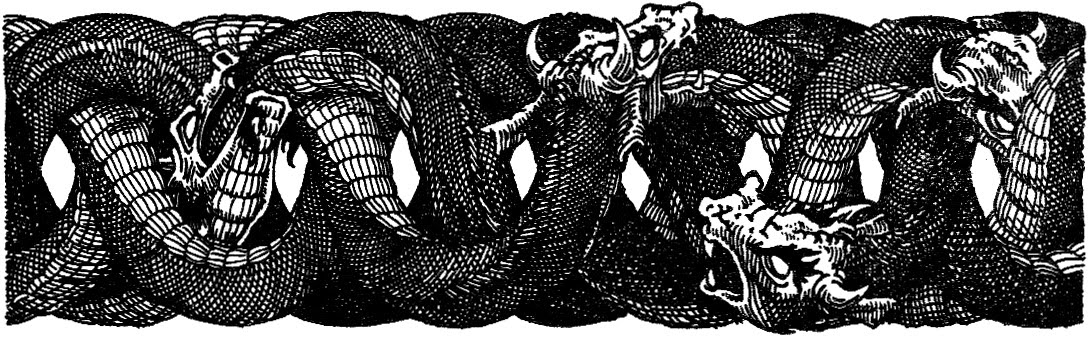
In 1980, one odd illustration appeared only in the second printing of the module where intertwined, horned dragon-serpents devour each other at the bottom of page 5.


The mysterious serpents

Some of the 6th and 7th printings of the Holmes basic sets included this printing of B2 and a few more copies sold individually. Later in 1980, the illustration disappeared from the third and subsequent printings, just as D&D's popularity started its greatest ascent. This makes it safe to call the illustration "rare."

The striking image is reminiscent of Celtic knotwork designs and M. C. Escher but who illustrated it? The artists credited in the module are David S. LaForce (a.k.a. "Diesel"), Erol Otus and Jim Roslof. However, this looks nothing like any of their art styles.

Now compare the illustration to the works of fellow TSR artist Dave Trampier:

Boat masthead (D3 Vault of the Drow), Gorgon (Monster Manual) and Kobold-Hating Dragon (Dungeon Masters Guide) all by David A. Trampier
We see the same toothy snout and careful balance between light and dark in the boat masthead. The gorgon's cross-hatching style and line weight are almost identical; even the shading on the horns is the same. The dragon exhibits the same serpentine neck with similar scales and soft underbelly. I feel safe in saying all four images were created by the same hand.

There were small changes between the first and second printings of the module, including the addition of the intertwined serpents image and a dragon illustration by David S. LaForce (previously seen in The Strategic Review). An editor probably added them to fill some white space between paragraphs. It is highly likely Tramp's contribution was overlooked and TSR staff neglected to include him in the art credits. In fact, third and later printings are heavily revised and include illustrations by Jeff Dee and Bill Willingham, both equally uncredited.

As far as I know, the intertwined serpents image was never published again. I believe this is the first time Trampier is acknowledged as the creator of this image.

For more information about module B2 and the early days of Basic D&D I recommend Zenopus Archives. "Zenopus" maintains a terrific repository of information on the original, blue-book, basic rules set and its author, the late Dr. John Eric Holmes. Stay up to date with his blog where he is currently comparing an original manuscript for Holmes' Basic Set against the printed versions, noting where editor Gary Gygax was making subtle adjustments to the original D&D rules.


Thursday, March 27, 2014

David Trampier passed away March 24, 2014

This certainly isn't the next blog post about David Trampier that I had planned.

http://www.legacy.com/obituaries/thesouthern/obituary.aspx?n=david-trampier&pid=170356694&fhid=8429


A man with David Trampier's name, matching David Trampier's age and last known location, passed away in Helia Healthcare in Carbondale, IL. I can hope for a case of mistaken identity but this looks like DAT himself. He would have turned 60 on April 22 this year.

Thanks to Charles Akins for reporting the news:

http://dyverscampaign.blogspot.com/2014/03/did-david-trampier-just-die-at-age-of-59.html

Dave, we hardly knew ye. I hoped that as a community of fans we might better understand you in this series of posts. Like so many great artists, we lost you too early.

All is quiet in Toad Town tonight.

[UPDATE] Castle Perilous game store of Carbondale has more information:

http://thecastlesramparts.blogspot.com/2014/03/dave-trampier-wormy-artist-passes-away.html 

Saturday, March 8, 2014

Rare Dave Trampier Art Part 2

Adventure Gaming magazine vol. 1 no. 5 "hidden" interior art

UPDATED - see bottom of page

This piece took some work to "unearth" as it was left hidden behind a wall of text.

Tim Kask recalls hiring his friend, Dave Trampier, to work on issue 5 of Adventure Gaming magazine:

"After I started ADVENTURE GAMING Magazine, he did a couple pieces of art for me, and I did a cover story article on TITAN that he added and published some advanced rules in."
We discussed the first of the "couple pieces of art" in my last post, a vibrant, full-color painting of a scene from the world of Titan. As Titan co-creator, Trampier also wrote a two-page article titled, "Evolving Forces in TITAN." It provides an excellent analysis on how to compare creatures of slightly differing power levels and how to know when creatures become a liability instead of an asset.

The magazine also features two articles by Titan's other co-creator, Jason B. McAllister. "The History of TITAN" gives a thorough look at the development of the game, much more interesting than his "The Giver of the Law: TITAN Design Notes" article later published in Avalon Hill's The General magazine Vol. 20, No. 2. "The History" contains lots of details on game board design and simplification of unit stats that we game designers enjoy. "Waging TITAN: Tactics" serves as a good primer on both the tactics and strategies needed for this unusual game.

Note that none of the three articles contain any "advanced rules" that Kask mentions, above.

It is in McAllister's first article, "The History of TITAN," where we find Trampier's other piece of art, printed in light gray and hidden behind the text:
I could see what appeared to be a scene from the game with a titan, a minotaur and what appeared to be an angel hugging a dragon all on a volcanic landscape. Trampier's signature was clearly legible in the lower left, but not much else was. It might be a rough sketch for the cover image painting for this issue.

With a little bit of Photoshop wizardry, I removed all the text and worked to restore the image as best I could. I painted in some of the missing lines with my Wacom tablet. What I discovered surprised me:
There are a lot of creatures in this scene! On the left, two rangers and a warbear surround a lone minotaur, who knocks one of ranger off his pegasus (in Titan, every ranger gets a pegasus. It's one of the perks of the job). A titan stands behind the volcano, avoiding combat (as often happens in the game. Two trolls with their iconic hammers are near the center of the image. On the right, an archangel is clearly not hugging that dragon so much as he is jabbing his greatsword through its head. I thought their relationship might be a lot friendlier. Ah well...
The scene is richly detailed and sometimes hard to read (those trolls tend to blend into the rock face). Above is a guide to the creatures in the image. There may be another creature as I think I see something between the two rangers. If you spot any more details, please let me know!

As far as I know, this drawing was never published anywhere else. Can anybody with the Gorgonstar publications of Titan and Battlelands of Titan confirm that it was not published in those games?

UPDATE - Reader Teacher, Trooper, Gamer, Dad (that is a long name!) helped me out by recognizing one more creature in this melee: a lion helping the minotaur strike down that poor ranger on the left.
Updated recovery of Tramp's image.
That now puts the total at TEN Titan creatures, until now only probably only seen by a few people involved in the production of Titan and Adventure Gaming magazine.


Tuesday, March 4, 2014

Rare Dave Trampier Art Part 1

Adventure Gaming magazine vol. 1 no. 5 cover art

Mar. 2025 UPDATED UPDATE to the UPDATE: The photo gallery hosted by Castle Perilous can be seen at this new link: https://castleperilousgames.com/photos/galleries/album/d-a-dave-trampier-artwork

Dec. 2020 UPDATE to the UPDATE: See my new blog post with more revelations about this artwork.  Note that the Castle Perilous photo gallery link in the next paragraph is now dead.

UPDATE: The original painting is now at Castle Perilous Games and Books in Carbondale, IL. See it and more in this photo gallery.

The painting in situ at Castle Perilous


Tim Kask, head of TSR Periodicals and founding editor of Dragon magazine, met Dave Trampier sometime in 1977 (possibly at Gen Con X in August, though probably before*). Tim and Dave soon became fast friends and gamer buddies, as Kask recalls:**
"He spent many an hour with me in my basement playing games. playing miniatures on my sand-table (mostly WWII micro-armor, which we both LOVED, fooling with TITAN, partying together and racing slotless HO racecars for hours on end. My wife really liked Dave and thought he was one of the more "normal" seeming of all my gaming and industry friends."
Kask hired Trampier as staff artist for TSR Periodicals' Dragon (then titled The Dragon) and their wargaming magazine, Little Wars. Kask also published Trampier's comic strip parody of fantasy wargamers, the Pogo-influenced Wormy. Kask continues:
"I loved Wormy from the very first time I saw it; giving Dave a place to publish Wormy I rank as one of the finest things I did with the magazine."
Kask resigned from his position at TSR in 1980. He then founded Adventure Gaming, a high-quality, independent magazine for role-players, miniature gamers and boardgamers alike. He kept in touch with his good friend and hired him for work on issue #5 (November, 1981):
"After I started ADVENTURE GAMING Magazine, he did a couple pieces of art*** for me, and I did a cover story article on TITAN that he added and published some advanced rules in."

The first piece is a striking painting of Titan creatures on a bleak landscape. A dragon perches atop the volcanic mountain, effectively under-lit by the molten lava. At the base of the mountain, a lion is ready to pounce. The minotaur stands at the ready, wielding a shield and ball-and-chain weapon like the minotaur counters in the game. A titular titan, with cape, sword and shield, watches from behind the protection of his strange legion.

Adventure Gaming vol. I no. 5 cover art
The image stands out as more elaborate than most covers of Adventure Gaming from that era. At the same time, it has an unfinished quality: I can see pencil marks on the lion's face. Could this be a first pass at a planned box cover for the 2nd printing of Titan?

To recap the Titan history from my last post, Trampier co-created the game with Jason B. McAllister and self-published it in 1980. This first printing featured a simple, two-color box cover. They expanded the game with Battlelands of Titan in 1981, the same year this painting was created and the magazine issue was published. Avalon Hill finally combined Titan with Battlelands and published the 2nd edition of the game sometime around autumn of 1982.

Kenneth Nishiuye's Titan box lid
Avalon Hill chose to use staff artist Kenneth Nishiuye's functional but stiff "angry titan" painting on the front of the game box. The image has an iconic look and stands out on the store shelf but the prancing unicorn and the rampant dragon don't do much to fire up the imagination. It is in striking contrast to Trampier's skilled, yet fun and cartoony art style.

Notably, Trampier's art does not appear in any Titan articles published by AH's house magazine, The General. I don't know if this points a disagreement between AH and Trampier or if it was simply AH's policy to purchase the rights to a game and use their own in-house people to support it.

My speculative interpretation of a Trampier Titan box lid
Imagine if AH used this Trampier painting for the cover. Admittedly, there isn't any action (the creatures appear to be waiting for enemies to "spawn in" on the other side of the battle board) and the image is hard to read from a distance but at least it informs the viewer about the product. This looks like a scene from the game, unlike the Nishiuye cover, above.

If I had to quickly art direct for AH, I'd add one creature to battle the lion in the foreground, add another advancing on the right to clash with the minotaur, then lighten the color of the sky and darken the background figures to make them "pop" more. The dragon in the volcano would remain the central focus.

Stay tuned for more!

* Trampier started as staff artist for The Dragon's September, 1977 issue. That isn't much lead time to produce a magazine if he only met Kask the month before.
** Kask's thinking he met Trampier at "at GenCon at Parkside" must be incorrect.  GenCon did not move to University of Wisconsin-Parkside until August, 1978.
*** I will take a look at the other "hidden" piece of Trampier art in the next blog post.

Sunday, March 2, 2014

Rare Dave Trampier Art Introduction

Recently, Jason Zavoda used his Hall of the Mountain King blog to start an in-depth look at the characters in Dave Trampier's comic strip, Wormy. Since Tramp is a subject of study for me, I've revived my oft-abandoned blog to discuss some of his lesser-known art pieces.

A Brief Trampier Biography

TSR Games

In 1977, sometime around his 23nd birthday, David A. Trampier became one of the early artists working for TSR illustrating Dungeons & Dragons and other games. He created some of the most iconic illustrations in D&D. His influence is still felt in countless homages across the role playing industry.


Trampier's grizzled, bearded face and 6' 3" frame often appears in his own illustrations, such as the above piece of three successful adventurers from AD&D's Players Handbook. Even Trampier's monstrous manticore face feels like a self-portrait.

Around 1981 or so, Trampier's work disappeared from TSR games but his Wormy comic continued to appear in TSR Periodicals' Dragon magazine.


Titan


With co-designer Jason B. McAllister, Trampier self-published the fantasy "Monster Slugathon" board game Titan under the name Gorgonstar Publications in 1980. Tramp created all the artwork for the game box, board, components, rulebook and advertising. 1981's expansion Battlelands of Titan added new features to be incorporated into all future printings of the base game. The game eventually became a hit, one of the seminal fantasy board games of the 1980s.

Supposedly, TSR was given first crack at publishing the game but refused. In 1982, Avalon Hill published the game as part of their Bookcase Game series. Strangely, the box cover featured art by Avalon Hill's Kenneth Nishiuye. Nishiuye's purple painting of a titan, unicorn and dragon was functional and iconic but ran counter to Trampier's distinctive style seen on the game components. I'll discuss more about a possible Trampier Titan cover in the next post.
Titan remains a classic and was republished in numerous forms. Avalon Hill licensed the game to Hobby Japan who released a computer game version as Beast Lord in 1991 followed by a sequel in 1992.  In 2008, Valley Games, Inc. created a high-quality reprint with an iPad edtion appearing three years later. A German edtion appeared in 2012. It is unknown if Trampier continues to profit from these reprints.

Wormy


Tramp started worked for TSR Periodicals in 1977, illustrating Dragon and Little Wars magazines. Dragon started publishing his Wormy comic strip about a cigar-chomping, snooker-hustling, wargaming dragon and the strange being that inhabit his world. Much like Cerebus the Aardvark years later, Wormy began as something of a "funny animal" comic, a parody of gamers just as Cerebus parodied the Sword & Sorcery genre. Wormy's story matured over the years as Trampier's skills as artist and storyteller improved significantly, much like Dave Sim with Cerebus. Unlike Cerebus,* Wormy continued to be funny. It remained a parody of the very gamers flipping to the back of each new Dragon magazine to read the latest installment.

Disappearance


Sadly, Wormy's second storyline was abruptly truncated in 1988. A cryptic announcement informed us that Wormy would no longer appear in Dragon. Trampier's brother-in-law, game designer Tom Wham, had no contact with him since 1982. Trampier seemingly fell off the face of the Earth, leaving fans to wonder what happened to the artist who was an influence on so many.
In 2002, amid rumors of his death, it turned out he was working as a cab driver in Illinois. The Daily Egyptian, a Southern Illinois University newspaper, posted a short piece about the life of a cab driver in Carbondale named David Trampier. There was that grizzled, bearded face last seen peering out from behind a shield on the AD&D Dungeon Masters Screen. TSR insiders confirmed that this was the very same David Trampier.

For whatever reason, he wanted to be left alone and get away from art and the gaming industry. Attempts to contact him about his art were politely declined.

Rare Trampier Art


Over the next several posts, I will examine some of the lesser-known Trampier works. The illustrations from the Monster Manual and Deities & Demigods are all well-known. Jason Zavoda is doing an admiral job at exploring the art from Dragon magazine. I will share the rarer, published pieces I've discovered along with any pertinent information I know about them.


* I am quite a fan of Cerebus and read each and every issue (yes, even the prose with almost no illustrations, even when it seemed like he'd never get out of that bar). I admire Dave Sim's ability to self-publish and do what he wants with his creator's rights. Lord Julius remains one of the best interpretations of Groucho Marx I've ever seen (take that, M*A*S*H-era Alan Alda). I just wish Wormy had a chance to see a 6000 page storyline published, like Cerebus did. Who knows, It could've degenerated into a misogynistic diatribe with Wormy worshipping an amalgam of the Abrahamic religions at the end.