Showing posts with label #RPGaDAY. Show all posts

Tuesday, December 9, 2014

#12A - California Gaming Part I - Steve Perrin's Conventions - #RPGaDAY

Tracing the California Gaming Scene, part I: Steve Perrin in NorCal

I still read a number of old RPG supplements in my study of the early history of gaming. While many game historians study the origins of the hobby that spread from the wargame groups of the Great Lakes region (specifically, Lake Geneva and the Twin Cities of St. Paul/Minneapolis), I focus on the gaming scene that developed in my home state of California. West coast gamers created their own "flavors" of playing. I'll cover these in several posts and see how they wrap back into the official D&D game.

1976 Berkeley: Dundracon I, An Unconventional Convention for Perrin's Conventions


DunDraCon (Dungeons & Dragons Convention) was first held in Berkeley's Claremont Hotel in March, 1976. There, the public first encountered The Perrin Conventions, a set of D&D house rules handed out by organizer Steve Perrin (who was also a founding member of the Society for Creative Anachronism (SCA)).
Location of the first Dundracon

The Perrin Conventions included details for D&D combat, like: breaking up a round into phases, adding a "dexterity roll" to do other actions, knocking down opponents and two-weapon fighting. These were likely inspired by Perrin and his friends' experiences in mock battles with the SCA. This initial set of rules modified the magic system and included Dave Hargrave's critical hit rules(1).

 Perrin's own Dundracon bio admits that he didn't design all the rules, he was just the guy who typed them up for distribution. The rules received some notice from the convention attendants, but this was a limited group of mostly gamers from the Bay Area and surrounding regions. Still, it served as an early mutation on the original D&D rules from 1974 and showed that some players were interested in a less abstract combat system.
Steve Perrin and his wife Luise in SCA regalia at the 1968 Worldcon (source)

Steve Perrin wanted to become more involved in the nascent RPG industry and teamed up with fellow gamer Jeff Pimper to edit together a book of monsters, complete with stats for D&D and two newer games: Tunnels & Trolls (T&T, first published 1975) and Arduin (first published as The Arduin Grimoire in 1977).

In addition to their own creations, Perrin and Pimper compiled creature designs mostly from APA zines (The Wild Hunt and Alarums & Excursions (A&E)) or from local gamers. The designers included Dave Hargrave (local gamer and creator of The Arduin Grimoire), Clint Bigglestone (Dundracon organizer), Sean Cleary (A&E and Wild Hunt), Hilda Hannifen ("The Ignoble Mockturtle" A&E zine), Roger Harvey (later, an illustrator for Judges Guild), Steve Henderson (another SCA and Dundracon founder), Dan Pierson and Glenn Blacow (both from Wild Hunt), and others.

Jennell Jaquays (using the name Paul) contributed a few designs from her RPG fanzine, The Dungeoneer (about one year later, this became a Judges Guild magazine). Jaquays went on to a prolific career designing and illustrating RPGs, authored classic modules like Dark Tower, became one of the first tabletop designers in video game design (at Coleco). (12-11-14 edited for clarity)

They had more than one book's worth of material, so the editors decided to only print monsters that were never published before. Thus some of Jaquays and Hargrave's designs were left on the cutting room floor with some others from A&E. The monsters were given only D&D stats, though each entry included ranges for "IQ" (Intelligence) and Dexterity. They just needed a publisher.


1977 Albany: Chaosium publishes a Monster Manual or two before TSR

Greg Stafford founded his company The Chaosium in 1975 to publish White Bear & Red Moon (later reprinted as Dragon Pass), the first board game set in his fantasy world of Glorantha. Stafford was an D&D player and maybe purchased the first D&D set ever sold. Perrin, Pimper and Stafford met through mutual friends and when Stafford heard about their project, he was eager to have Chaosium publish it and get into the RPG supplement business.

Stafford was trying and failing to get a Gloranthan RPG off the ground. First, Dave Hargrave tried to make a Gloranthan version of his Arduin system and Chaosium had planned to publish The Arduin Grimoire; Chaosium house magazine Wyrm's Footnotes issue 2 notes: "THE ARDUIN GRIMOIRE will be the first of our new products." A few months later, the very next issue states: "When we finally received the manuscript to ARDUIN GRIMOIRE, it was not quite what we had hoped for... we have decided not to publish the rules." Hargrave had to self-publish The Arduin Grimoire (more on this later).  It is said that Chaosium felt Arduin was too derivative of D&D; issue 3 doesn't say this directly, but it does refer to Arduin as, "a supplement, if you will," and highly recommend it for, "experienced dungeoneers," (i.e. anyone who already owns the D&D rules?).

Stafford's design team of Hendrik Jan Pfeiffer, Art Turney and Ray Turney worked on the Gloranthan RPG as a D&D supplement but Stafford's world was unique and needed its own unique game system. Impressed with The Perrin Conventions, Stafford asked Perrin to "look in and see if he could help the situation" on July 4, 1976(2).

Perrin came up with revolutionary changes to the new system, like doing away with experience points, having no character classes and flat hit point values that don't increase linearly with experience. Slowly, Perrin was put in charge of the project. Only Ray Turney stayed on from the original design team and Perrin added fellow SCA members Steve Henderson and Warren James. Stafford was very pleased with the team's work on his fantasy world.

Chaosium published Perrin and Pimper's All the World's Monsters sometime in 1977, getting to market before TSR's official monster collection, the AD&D Monster Manual (released in December, 1977).
All the All the Worlds' Monsters, volumes 1-3
All the World's Monsters vol. 2 followed that same year and maybe hit the shelves before Monster Manual as well. In addition to adding in cut designs by Hargrave, Jaquays and others, the second volume included T&T conversion notes (by Ken St. Andre) and a refined, revised set of The Perrin Conventions (dated November, 1977) that focused mostly on D&D combat, less Hargrave's critical hit rules. Now, the house rules were available to a much wider audience.
RuneQuest, 1st printing cover. Illustration by Luise Perrin
In 1978, the new Perrin-led Gloranthan game RuneQuest was born and, with it, Chaosium's in-house Basic Role-Playing (BRP) system. This BRP system was also modified into Worlds of Wonder, Call of Cthulhu, Elfquest, Stormbringer/Elric!, Hawkmoon, Pendragon, Superworld, Ringworld and many other games. This was also one of the earliest "universal" RPG systems (though many of the different games were only barely compatible).

The combat system was quite detailed, with parries, fumbles, critical hits, hit locations and more. RuneQuest the first totally skill-based RPG without classes (Traveller (1977) had character skills but no way to improve them) where the player could develop their character as they desire. For some years, RuneQuest provided competition to TSR's sales and Chaosium is one of the few game companies from that era still in business today.

12-11-14 Update: 
I'll let Dr. J. Eric Holmes, editor of the first D&D Basic Set and a SoCal gamer, describe RuneQuest's combat system as he compared it to D&D in 1981.
The combat system requires a little more bookkeeping than D&D and is, therefore, more "realistic."(3)
Could you elaborate, Dr. Holmes?
Combat rules are extremely complex. There are die rolls for each hit and its parry, for the location of the hit as well as for the extent of the damage. There are special scores which indicate a "critical hit" or a "fumble," and then another roll to see what the nature of the critical injury or fumble might be. Special training will increase the character's ability to hit with a particular weapon. Each weapon must, realistically, be trained for individually, at a cost of silver lunars (the coin of the realm) or maybe by doing some more die rolls to see if your character has learned from experience after a successful fight.
 All of this takes a lot of bookkeeping, die rolling and calculation with every blow struck. This is not necessarily a criticism. A great deal of any game is spent in the calculations and die rolling involved in combat... A pocket calculator might come in handy. Many game players revel in these complicated calculations. The more complex the computations of each weapon blow, the better they like it.(4) (emphasis mine)
So, Holmes found players in Southern California that, like many Northern California counterparts, preferred a complex, "realistic" combat system. Holmes did not share that opinion, himself:
What are the advantages of this game over its (inevitable comparison) competitor, Dungeons & Dragons? In terms of basic game mechanics, character generation, experience, combat, magic, I would say none. Some fans of the game would cry that it has greater "realism," but I think these are minor differences.(5)

Holmes appears to like the RuneQuest game and speaks highly of its clarity in writing, numerous examples and the novelty of a game manual with an index (something he wished for his own Basic D&D(6)). Besides the combat complexities, his main complaint was he didn't feel the RPG captured the "feel" of Glorantha (as seen in White Bear & Red Moon). It missed out on the "eerie feeling of reality to his imaginary world(7)" that Greg Stafford brings when he writes games, himself.

Note: Holmes probably played 2nd edition RuneQuest as opposed to 1st edition. As far as I understand, the differences between the two are minimal.
End 12-11-14 Update 

Conclusions:


First of all, RuneQuest did not evolve directly from The Perrin Conventions. It may seem obvious, but the internet is full of quotes like, "Runequest's rules were made from The Perrin Conventions," or, "RuneQuest is a codification and development of the Perrin Conventions." (quotes slightly obfuscated) These statements imply that RuneQuest is nothing more than a D&D variant, but that simply isn't the case. There are similarities between the two, but no more so than with countless other systems. If Chaosium just wanted a D&D variant, they would've used Pfeiffer, Turney and Turney's design and gone to market with it back in 1977.

Second, SCA members and wargamers play differently. D&D evolved from wargame rules by members of the Castle & Crusade Society, founded by Gary Gygax and Rob Kuntz as a chapter of the International Federation of Wargaming, itself founded by Gygax, Scott Duncan and Bill Speer in 1966. These gamers got together around a sand table (usually in Gary's basement) ordering miniature armies into mock battles. Abstract combat was simple and made sense.

Conversely, the SCA was founded in Berkeley in 1966 with armored members going outside to fight mock battles with padded weapons. Their point of view was not that of a military commander with a bird's eye view of battle, but as a common soldier who has felt the heft of their shield and the sting of a (padded) sword. Combat seems abstract if you aren't the one fighting. The reenactors saw something missing in abstract combat and created their own rules and games to fill those gaps.

Maybe it all comes down to the weather. In sunny California, you can go outside and play practically all year round. When it gets cold up North, it is best to hunker down next near the heater and go to war with some good friends around the sand table.

Wednesday, September 3, 2014

#11 Weirdest RPG Owned - The All Australian Role Playing Game #RPGaDAY

While riding a hotel shuttle from the San Diego Comic-Con back in the early 90s, I overheard a young man excitedly describe a game to his friends in the seat behind him. The player characters are cartoon-like alien tourists who go on hunting safaris on backwoods planets, tracking and killing the low intelligence native species there. One particular backwoods planet is called "Earth" though, due to a translation error, the alien hunters call it "Dirt." There, the low intelligence native population of "Whoomens" are fighting back, retaliating with all manner of absurd ordnance. Also, the game is entirely focused on Australia, written by Australians, played by Australians, published in Australia and features an Australia-centric view of Earth on the front cover.

I continued to my hotel, probably to play some AD&D with a cadre of friends I shared a room with (the hotels were expensive even back then).

But the image of that Australia-centric view of Earth never left my mind.

...

Some 15 years later I found Hunter Planet.
Target: Dirt.
The game is every bit as bizarre and Australia-centric as my memory of that overheard description. Imagine a cross between Paranoia, Predator, The Hitchhiker's Guide to the Galaxy and Toon. The alien player characters are working class schlubs who saved up their vacation time for an exotic safari to shoot easy game and bring home a nice trophy for the mantlepiece (or alien equivalent).
Smile!
What they find on our home of Dirt is a Whoomen population ravaged by constant hot wars and cold wars where most citizens have access to arsenals that outclass the tourists' laser rifles and automatic crossbows. The Hunters become the hunted. The powerful Whoomen weapons are also more likely to backfire, so a tourist who steals a Whoomen rocket launcher is bound to end his vacation in a predictably tragic, yet hilarious, manner.
Sample Character
The game is run with several different players in the roles of the Hunters and one player as CM (which may stand for Control Man, Condition Modifier, Chocolate Milk, Carbon Monoxide, Crazy Man, Chance Master or Certified Maniac). The players create their characters by rolling 1d10 for each characteristic (Strength, Dexterity, etc.) in order with two rerolls allowed. Luck is rolled on 1d6 and is rerolled at the start of each game.

At this point, we are directed to refer to footnote 87. Spoiler alert: there is no footnote 87.

Players roll 1d10+10 to determine Hit Points, a term which is not explained. It is assumed the players role-play enough to know what any D&D-derived terms mean.

The players now select their equipment and weapons, but no more than three grenades and no Alpha-Beta Plus Gamma Radiation Neutron Destructo Particle Accelerator Beams. Otherwise, the players are free to choose what gear they wish... with the realization that the natives they encounter will probably have something equally egregious. If the CM determines that your character is carrying too much weight (footnote 35 says you probably are), he will probably strike any excess off the character sheet. Example equipment is listed, such as Light Sword, Tangle Grenades, Dehydrated Water, 10 Sided Die, Anti Gravity Belt and "Whammo" Door Charges.

The CM then describes the scenario the Hunters find themselves in on their one-week tour of Dirt before they are beamed back up to the Hunting Tours Incorporated ship. They probably won't survive.
Note: this is not Emperor I. M. Wunndafull. I think this is his secretary.
My biggest surprise when I picked up Hunter Planet was the realization that this was the second game I owned by designer David Bruggeman. The first was an obscure set of miniature wargaming rules titled WWII Book of Armaments that I picked up somewhere on a whim. The rules are good, but the game is SO obscure that I can't find a good web link for it (EDIT: I created a page about the game HERE). It was published by The Australian Games Group (TAGG) best known for publishing Lace & Steel, the swashbuckling fantasy RPG with innovative card-based mechanics and illustrations by Donna Barr (see Ms. Barr's Boinger and Zereth at the bottom of this post).

The Book of Armaments includes a photo of the designer:
This is Emperor I. M. Wunndafull
Bruggeman devotes four full pages of the 35-page Hunter Planet to his "Guide to Better CMing (or The Dos and Don'ts of CMing)." Some pieces of advice are obvious but many are quite good. I summarized several of them as follows:

DO
Read widely (An extensive general knowledge is an important benefit to all CMs)
Prepare a scenario (Prepare a situation where the Hunters will find themselves)
Concoct various surprises (Ammunition wasting creatures, traps and tricks, strange inhabitants, etc.)
Roll dice frequently (This puts the players on edge and causes them to react to non-existent dangers)
Build tension and action up to the beam up time (The mothership checks in with the Hunters once every four hours. They may be beamed up at this time, but at no other time. Actually, they can request it at other times, but the request is ignored)
Ad lib frequently (Unexpected events create confusion, excitement and fun)
Inspire character conversations with non player characters (The CM gets to role play a more interesting character than a stupid Orc and gets to hear what the players call a logical, convincing argument)
Cheat (But cheat fairly)
Tell the Hunters only what they would know as aliens (Which isn't much)
Ensure that everything in the game has both a good and bad side (Called the "Bad News Factor," all weapons and equipment have at least a 5% chance of something horrible happening when used)
React to players comments (Once a player says something, even in jest, it will be acted upon by the CM)
DON'T
Be sadistic (The adventure should be dangerous, not a suicide trip)
Play strictly to the rules (What rules?)
Give away benefits easily (Benefits must be earned)
Hide behind the CMs screen (The screen is designed to hide the CM's game information, not the CM himself)
Forget (The CM should remember when a player forgets to reload his weapon and tries to shoot, etc.)
Land the Hunters in the middle of nowhere with nothing to destroy (Where they land may "appear" to be peaceful but it should be nothing of the sort)

Monday, August 25, 2014

#10 Favorite Game Fiction - The Maze of Peril #RPGaDAY

Let's face it, most game fiction isn't very good.

Many examples of game fiction tend to break the rules of the game's universe or adhere too closely to the game's format and just end up with mediocre stories. Not every good game designer is a good fiction writer (but many think they are). They often get tangled up in serious, epic, wanna-be Lord of the Rings, everything-depends-on-us quests to save the world and miss out on the fun of adventure gaming. To belabor the famous Joker quote, "Why so serious?"

I've read some of the earliest game fiction novels ever printed. Veteran author Andre Norton's Quag Keep (1978) is notable as a historical, early peek into Gary Gygax's World of Greyhawk/The Great Kingdom setting. The sequel, Return to Quag Keep, loses the Greyhawk setting and the small amount of charm the original held.

The oldest game novel I've found is War-Gamers' World (1978) by Hugh Walker (pen name for Hubert Straßl). It was first published in German as Reiter der Finsternis (Rider of Darkness) in 1975 and is the first book of the Magira series. It is based on the German fantasy wargame/proto-RPG hybrid Armageddon developed by the gaming group FOLLOW in 1966. Since that time, the setting spawned several RPGs. This first novel opens with a player getting sucked into the game's fantasy world. There are several references to seeing the world as interconnected hexagons. Not recommended except as another historical oddity.


I give a hearty recommendation for my favorite piece of game fiction: The Maze of Peril, a short novel written by the original Basic D&D rules editor, Dr. John Eric Holmes.

SPOILER ALERT: They don't save the world
Contrary to the publisher's blurb. Our heroes don't try to save the world. Boinger the halfling and Zereth the elf are just out to make a buck without having to get a real job. They undertake adventures to make quick cash and live the life of Riley at the Green Dragon Tavern for a few months. When the gold runs thin and the landlord comes a knockin', they undertake another delve into the Underworld to relieve some nasty monsters of their glittering treasures.
Boinger, another party member and Zereth relieving some nasty monster of its glittering treasure (art by Jim Roslof from "The Sorcerer's Jewel")
It is so refreshing to read an adventure story without the gloom and doom of the ultimate destruction of everything good folk hold sacred due to the megalomaniacal plans of some evil Sauron look-alike dark lord. These are two good friends just struggling to get by and maybe, someday, hit it rich. Their camaraderie and their humor really comes through in Holmes' writing. In a good way, it reminds me of the early Star Wars comic books by Marvel. The galaxy was safe from the ultimate apocalypse weapon, the Death Star, and the raised stakes of The Empire Strikes Back hadn't come into play yet. Han, Luke, Leia and their friends were free to adventure and freewheel their way across the galaxy.

BEGIN SPOILER WARNING
Bardan the dwarf's fate (as portrayed by Barely A. Dwarf in "Were-shark," an early version of The Maze of Peril's chapter 2 published as a stand-alone short story, art by Chris Holmes)

Nothing world-shattering is at stake; Boinger &co's quests are of a personal nature. During an early foray into the Underworld, one of the party fighters, Bardan the dwarf, perishes in combat. They bury his body in the cemetary but disturbingly find his grave exhumed and coffin empty a few days later. Boinger implores the party to return to the dungeon to thwart the revenge plans the evil-doers have for his friend's corpse.

The Maze of Peril adventures run the gamut from dungeon delve, urban adventures, bureaucratic red tape cutting, carousing, burglary, back to dungeon delve, Lovecraftian horror and even naval combat. Also, the book features one of the funniest uses of a petrification gaze that I would totally allow to happen if it comes up in a game.

END SPOILER WARNING

Holmes had several short stories about Boinger, Zereth (a.k.a. Xoreth) and their fellow adventurers published in Dragon magazine and Alarums & Excursions APA-zine. It is no secret that these tales were based on Holmes' home D&D campaign; Boinger was the player character of Chris Holmes, Dr. Holmes' son and occasional illustrator. These stories give us a window into Dr. Holmes' campaign and even how he interpreted certain D&D rules.

One famously unclear rule regards magic-users and their restriction from using armor and swords. In the days of OD&D, even famous, accomplished gamers were unclear on the ruling* and many cried foul against the sword restriction (after all, Gandalf used a sword). What logical reason (besides gameplay balance) could there be for this restriction?

Holmes succinctly gives his reasoning in two sentences. On page 34 of The Maze of Peril, Zereth removes all metal from his body, washes up and puts on a wizard robe before casting a spell. He explains to a confused Boinger that he:

"Can't have iron touching the body anywhere; no iron, even nails in the boot heels. It drains the flow of force from the other world."
No further explanation is required. Boinger asks, "It does? How?" Zereth tells him to, "Keep quiet," and no more is said on the matter.

This prevents magic-users from even wearing leather armor (with iron buckles). Presumably, a wizard's dagger must be made of bronze, silver or another non-ferrous metal. This stems from old folklore about iron's protective properties against magical creatures and has become a modern trope. It fits with Tim Powers' piratey fantasy novel On Stranger Tides (HIGHLY recommended reading) where magic disappears from the world as iron spreads with the advances of western civilization. The faerie-folks' aversion to iron seen in Poul Anderson's Three Hearts and Three Lions (also recommended) resonates as well.
Boinger vs. a one-armed troll (art by Chris Holmes from "Trollshead")
This leads to another rule: elves are combination fighters and magic-users and the OD&D rules state they "freely switch class whenever they choose, from adventure to adventure" (Men & Magic, p. 8). How does that apply to spellcasting and armor/weapon use? Holmes gives another example with Zereth in the short story "Trollshead" in The Dragon magazine #31, p. 41:
"Zereth took off his sword belt and helmet and laid them on the ground... He lay flat on his belly and reached into an inner pocket of his linen tunic to produce a pinch of fine sand. This he tossed into the air, mumbling rapidly as he did so."
To switch from fighter to magic-user, Zereth removes his sword belt and helmet (the only iron on his body) before casting a sleep spell on some unexpecting half-orcs. This goes against his own "elves must decide" ruling in his Basic D&D manuscript that states that elves cannot change in the middle of an adventure. In later stories, such as "The Sorcerer's Jewel"** (Dragon #46), Zereth wears armor while casting spells. It is assumed that Holmes was playing AD&D by this time, which does allow for spellcasting, armored, multiclassed magic-users.

Another question arises: just what are the "dungeons" in the world of Dungeons & Dragons? Why is there a near-endless number of underground labyrinths filled with nasty creatures and fabulous treasures? Zereth ponders the titular maze in The Maze of Peril, p. 3:

"Somewhere beneath the surface of this ancient land the tunnels and corridors of some prehistoric race coiled and raveled, delved, and probed unimaginable depths into the core of the world... What race or races had built the original maze no one knew. It seemed in the opinions of the sages and magicians of the time, that there must have been many layers of dungeons and underworlds laid down, one atop the other, as the world crust was formed, so that now no one knew, or even guessed, how many levels it extended below the surface."

Here, in one (wordy) sentence is the justification for a world of dungeons. It explains just enough to give the game world some logic yet leaves plenty of mystery for players to discover in their journeys into the Underworld. Of course, the truth may be very different from what the sages and magicians assume as fact.

Gary Gygax first hinted at such an Underworld with the D series of modules starting in 1978 (about the time The Maze of Peril was written). Later D&D authors would call this subterranean realm the Underdark and give their own reasons for its existence.
Zereth and Boinger (art by Donna Barr from "In the Bag")

In Conclusion:

The Maze of Peril is my favorite piece of game fiction because it feels most like the D&D games I've played. Rarely did we adventure to save the kingdom/world/multiverse. We were a bunch of friends looking for some excitement and quick cash together. We'd hatch elaborate schemes, find ourselves in deep trouble, then put our heads together to make sure they didn't roll off our shoulders come the dawn. We were comrades, bonded in the face of danger, celebrating each success until wanderlust crept back into our hearts and we were off on another wild quest.

Those are good times, and so is this book.

Notes:

Watch for Fight On! magazine issue #15 dedicated to J. E. Holmes coming soon! Read my heavily researched character write-ups for Boinger, Zereth and their "pal" Murray the Mage, along with guidelines for iron-restricted spellcasting, in my article, "Holmes Town Heroes."

The 1000 copy print run of The Maze of Peril is getting harder to find, but still available. Check out Holmes' short stories from Dragon magazine:

"Trollshead" The Dragon #31
"The Sorcerer's Jewel" Dragon #46
"In the Bag" Dragon #58

Complete Holmes Bibliography

* UK game designer Ian Livingstone (Games Workshop co-founder, Fighting Fantasy game books co-creator, etc.) erroneously wrote in his 1982 book Dicing with Dragons: An Introduction to Role-Playing Games when explaining D&D classes: "Each class has restrictions as well. For instance, The Magic User may only wear leather armour or no armour at all..."

** Although The Maze of Peril (1986) was published 5 years after "The Sorcerer's Jewel" (1981), we know Maze was completed earlier as Holmes states that it was ready to publish in an L.A. Times interview from 1979.

Tuesday, August 19, 2014

#9 Favorite Dice - Random Number Generators of Chaos and Entropy #RPGaDAY

I already wrote about my favorite die and how it started me on the path of gaming over 30 years ago. I use it in a set with some of my other oldest dice when feeling nostalgic (which is often).

But one of my other favorite sets is my Chaos Dice.

Can't you feel the CHAOS!? Blood and souls for my lord Arioch!
Blood red on obsidian black is the perfect color scheme for Servants of Chaos laying waste to all Order in the world. Unfortunately, it is a terrible color scheme to read unless the lighting is really bright. In sub-optimal conditions, I'll use a set with stronger contrast.
I rolled an 8... I think
These are Chessex's old "Arrows of Chaos" dice. I purchased them when they first became available and built the rest of the set from other Chessex dice. They look cool but, like most specialty dice, are a real pain to read. I supplement the set with a brick of smaller, matching d6s with normal pips, perfect for those high-level fireballs (not pictured here because I can't find them... darned entropy!).

Monday, August 18, 2014

#8 Favorite Character - Wonko the Sane #RPGaDAY

My favorite character is my silver-haired, half-elf jester, Wonko the Sane (yes, named after the Hitchhiker's Guide to the Galaxy character).
Wonko's main stats

I first rolled Wonko up in November, 1990 - a 1st edition AD&D character using the Jester NPC rules from the pages of Dragon magazine (revised and reprinted in Best of Dragon Vol. IV). When 2nd edition AD&D and the Complete Splat Books were all released, I used the Jester kit rules from The Complete Bard's Handbook. Those rules were notably less silly (no more punfighting).


Wonko playing his electric mandolin, still smiling at only 2 HP
Wonko is a lot of fun to draw, especially with his striped leisure suit jacket, polka-dotted cape and checkered trousers. In the top image, you see Wonko wielding his Short Sword +1/+4 Vs. Reptiles and another strange weapon.  It is a stick with an Odie stuffed animal on one end and a Rug of Smothering with the command word "Don't Make Me Laugh!" on the other. Wonko must need his Buck and a Quarter Quarterstaff weapon proficiency to wield it.

Other unusual supplies on his character sheet include his electric mandolin (see second image), a hanging fern, one can of WD-40, a dust rag and "five belts of priestly origin" that I am assuming came from some Gygaxian adventure.


Lars Leafblower is fed up with Wonko's tomfoolery
Wonko survived to 10th level, annoying a number of nasty bad guys along the way, including Strahd von Zarovich in I6 Ravenloft and whoever was in "A Rose for Talakara" (which I have in my notes as "A Rose for Somebody"). Like most jesters, he had a tendency to annoy his fellow party members as well. In the third image, we see what happens when you push a druid too far.*

Want to a jester in an old-school campaign? This website compiles all the early Jester rules for D&D, including errata and Gary Gygax's musings on the class.

* My friend Duane came up with some of the goofiest character names. In addition to Lars Leafblower he ran another memorable druid: Waz Weedwhacker.

#7 Most "Intellectual" RPG Owned - It's not the game, it's the setting #RPGaDAY

How does one define an "intellectual" game?

I never owned or played Mage: the Ascension, Ars Magica, In Nomine or Aria: Canticle of the Monomyth - all games known for being intellectual or, at least, pretentious.

Call of Cthulhu comes to mind as most player characters are intellectuals: academics, scientists and librarians. However, the game tends to push the characters (and sometimes players) to their emotional breaking points. Close, but it doesn't quite fit.

Jonathan Tweet's Everway system generates random results by interpreting draws from a tarot-like Fortune deck. Players "read" paintings in the game's Vision deck to create their character concepts.This has the potential for the most intellectual title. I'd like to see a game played while touring a museum, always interpreting the next piece of art whenever a random result is needed.

Ultimately, I don't think it is the system that is so intellectual so much as the campaign and setting. For that, I give the "most intellectual" award to a Traveller: 2300 AD inspired campaign played with GURPS rules I played back in 1994.
My character, Tachi, and some photocopied pages from the GURPS Space rule book. Even intellectual game characters need samurai swords.
The GM was an excellent world designer and the campaign made us take a hard look at a possible after-Earth, near-future humanity. There were no extreme technologies like hyperdrives and black hole guns. Most of the human diaspora lived in the colonies of the Moon, Mars, Titan and a few LaGrange Points after a poorly-understood cataclysm left the Earth uninhabitable. Our characters were troubleshooters in the largest human settlement: the interconnected Lunar colonies. The opaque, brown, toxic atmosphere obscuring the Earth above served as an ever-present reminder that mankind may never go home again.

The reason behind the Earth's catastrophe was never important. What we explored and focused on was how humanity and its culture changes moving forward in a post-Terran existence. Different societies perpetuated their respective cultures in pockets divided by their ancestral homelands, like ex-pat communities settling in Chinatowns, Japan Towns and Little Italys of major American cities. Those country origins of yore meant less and less with each generation as the true differences were between so-called Martians, Moonies, Titanians and the others.

For example, my character was Tachi, the tactician and weapons expert of the group and the only Mars native. Growing up in little over 1/3 of Earth's gravity, she was 6 feet tall and somewhat strong for a Martian. Compared to the Lunar natives who grew up in only 1/6 of Earth's gravity, she was very short and brawny! I was the "bruiser" of the party with an 11 Strength.

As someone who loves futurist books like Ben Bova's underappreciated The High Road, this game was easy to get into. The world was exotic yet familiar (bicycle was the common mode of transportation) and altogether plausible. This was a thoughtful campaign still punctuated by scenes of excitement and combat (often instigated by my character, ahem).

It was hard sci-fi at its best and it made us think.

Sunday, August 17, 2014

#6 Favorite RPG Never Get to Play - The Original Edition #RPGaDAY

There are plenty of choices for games that I have played in the past but don't get to play enough - Call of Cthulhu, James Bond 007, West End's Star Wars RPG, Powers & Perils and Gamma World come to mind. There are other games I own that I never played - Dallas ("The Television Role-Playing Game"), Gangbusters, Hawkmoon, Behind Enemy Lines and Boot Hill would all be fun for different reasons.

There is one game I know backwards and forwards, own every rule supplement for, and yet never officially played: the Original Edition of Dungeons & Dragons.

My complete set of OD&D digest-sized rule books
How did this happen? When I started playing in 1982, AD&D 1st ed. was the new hawtness. This edition had already faded into the mythic past like the contents of the Library of Alexandria. I did play nearly every other edition of the game (B/X, BECMI, 1st ed, 2nd ed, 3.0 ed, 3.5 ed).

My first exposure to this edition was a photocopy of Gods, Demi-Gods & Heroes that somebody gave me in the late 80s. It wasn't the entire book; just the Hyborian and Melnibonean mythos. In the mid 90s, I was blessed with luck and found a near-perfect "white box" OD&D set at a comic book store for $10. I picked up Chainmail from a dealer at the San Diego Comic-Con for $9.95. I assembled the rest of the set piece by piece, finally completing with Swords & Spells (invaluable for its definitions of OD&D spell ranges and durations).

I also have a copy of Tractics, perfect for combining with OD&D into a game of Sturmgeschutz & Sorcery!

Saturday, August 16, 2014

#5 Most old school RPG owned - Older than Braunstein #RPGaDAY

My oldest RPG might be a controversial choice - "Proto RPG" is a better term. This predates 1974's release of Dungeons & Dragons and 1971's Chainmail. It is older than the first Braunstein game played in 1967, direct inspiration for Dave Arneson's Blackmoor.

When this game was released, The Milton Berle Show was still on the air and the Apollo Program was yet to launch its first, fateful mission.

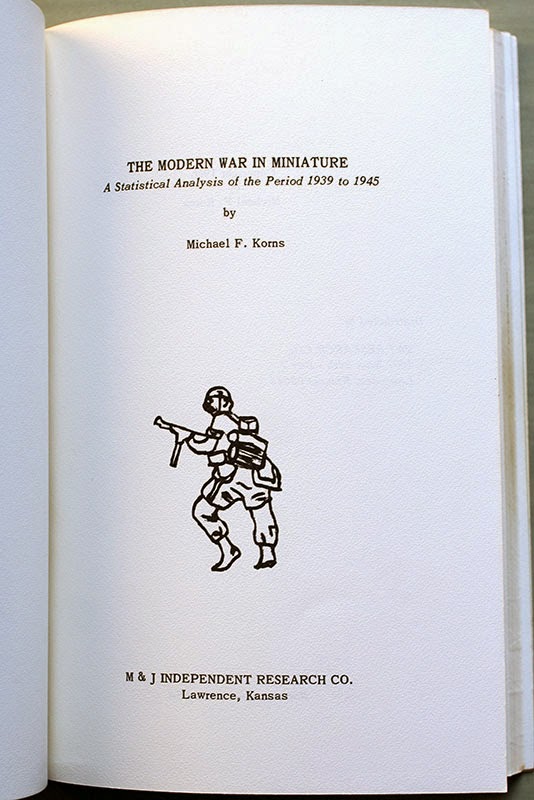
Modern War in Miniature by Michael F. Korns

This is Michael F. Korns' 1966 game Modern War in Miniature (MWIM), probably self-published by Korns and a partner in Kansas under "M & J Research Co." I believe the rules are still available in reprint as part of the book More Wargaming Pioneers from The History of Wargaming Project.

MWIM is an unusual WWII, skirmish-level wargame. As normal, two players act as commanders (one Allied, one Axis), directing their combat units in battle. Miniatures are moved across the terrain on a sand table. What is unusual is that a Judge mediates all actions and is the only one with full access to the sand table. The judge is the only one who needs to know the rules and randomly determines the outcomes of all actions. He talks to the Allied and Axis players individually, out of earshot of each other, describing what they can see and hear in 2-second segments of time. It sort of takes the adversarial roles and judge's mediations of a Braunstein game into short time-span, tactical turns. Everything is on a personal scale making it different from a typical wargame.

Partial example of gameplay
The above example of gameplay shows that the player is expected to embrace their role and step into the boots of the commanding officer. This reads much like samples of gameplay in many RPGs, with the players stating what "I" do in the situation to the GM. Only the adversarial rather than cooperative roles of the players are different.

Note that any TEXT IN ALL-CAPS is said loud enough for both players to hear. "Schmeisser" is used here as a colloquial term for a German MP38 or MP40 sub-machine gun (which always annoyed me since they were designed by Heinrich Vollmer, not Hugo Schmeisser).

How to generate random percentile numbers with d6s
How do you generate random percentile or fractional results without percentile dice? This chart, a subject of discussion on Jon Peterson's Playing at the World blog, shows how to use a 2d6 result for rough percentages. As Peterson mentions, Mike Carr adapted this chart for use in the 1972 edition his game Fight in the Skies (it is titled "Percentage Index" in my 6th edition TSR rules). This shows that the gamers in the Twin Cities of Minnesota were aware of MWIM.

Small Unit Tactical Combat Referee's Rule Book
Modern War in Miniature eventually developed into Small Unit Tactical Combat (SUTC) in 1971. Above, you see my 2nd edition Referee's Rule Book from 1972. Several other SUTC products were released  published by "The Limpex Company" of Mountain View, CA. From what I could gather, Korns lived and gamed there during that time. Coincidentally, I moved to that area in 2005.

A Monster Manual of WWII combat forces
SUTC is very similar to its MWIM predecessor. Gone is the chart of simulating random percentile results with 2d6; now there is a chart of random two-digit numbers for the referee to pick from. It appears that this alternate evolutionary line of gaming died out after SUTC. I can't find any games that Korns published after that.

Was MWIM an influence on Gary Gygax? Probably not for Dungeons & Dragons, but according to Peterson, it did insppire Leon Tucker, Gygax's and Mike Reese's co-designer in the development of Tractics.

Friday, August 15, 2014

#4 Most Recent RPG purchase - 2 of 9 Doctrines of Darkness #RPGaDAY

I've been focused on studying gaming books from the earliest era of role-playing: anything before 1981, by my reckoning. My most recent acquisition was two related adventures published by Dimension Six, Inc.
The Nine Doctrines of Darkness and The Nine Doctrines of Darkness: The Second Adventure were both written by Randy Fraser and published in 1980 and 1981, respectively. These appear to be designer's only contributions to the hobby. I knew of publisher Dimension Six from their marginally useful Compleat Fantasist book of tables to translate characters from one game to another.

Each adventure focuses on recovering one of the nine titular doctrines of darkness, a set of evil artifact tomes detailing the nine principles that uphold all Evil (that's capital-E evil) as written by Lord Erlich, and Evil Arch Mage, before he perished in his final evil destruction brought on by the evil knowledge of perfect evil. Before collapsing evilly onto the floor, he polymorphed each doctrine into an ordinary object and scattered them around the world. Now, the polymorph spells are wearing off and the elf king's favorite wineskin just turned into a powerful, evil grimoire of evil evil evil.

Why a party would undertake these adventures depends on its alignment. Good characters must prevent the Doctrines from falling into the wrong hands. Evil characters are those wrong hands who want to use the powers of the Doctrines. The first adventure plays very differently due to this duality of interests. A non-evil party comes to the elf king's side to help protect him from every evil-doer looking to claim the Doctrine. An evil party assaults the elf king's castle and steal the book for themselves.

These adventures must have been created for evil parties. It is much more fun to assault or infiltrate the good castle than to patrol the forest kingdom fighting random encounters. The second adventure is loaded with awesome magic items that non-evil characters can't touch without, at best, suffering damage. The lone +3 holy sword doesn't compare to the evil staff that shoots 20d6 lightning bolts (among other powers). Good characters can't even destroy the books as, "no efforts either magical or physical can harm the Doctrine in any way."

The first adventure is short, sparsely detailed and luridly illustrated. There are some odd new monsters (Shammy: a red-furred gorilla wielding a huge axe). The second adventure is about thirteen pages longer than the first and includes some decent room illustrations to be shown to the players (much like S1 Tomb of Horrors). In addition to some wilderness adventuring (complete with some decent hooks for further adventuring) it has a thoroughly detailed, three-level temple complex to explore. This is more of a typical dungeon delve. There are some good tricks, traps and challenges but, like many adventures of the day, it misses details that give the temple the feel of a functioning place. For example, there are guard rooms filled with ninja guards (!) and umber hulks (!!) near the front door but nobody is posted to guard duty.

Since only the first two adventures were published, it begs the question, "what happened to the other seven Doctrines of Darkness?" We may never know, but I know that Catacomb Librarian was subjecting his gaming group to these adventures recently. Whatever became of them? Cat. Lib. also found an old review of the first adventure by Aaron Allston (R.I.P.).