Showing posts with label Trampier. Show all posts

Sunday, June 6, 2021

Tim Kask's Adventure Gaming Magazine Available in PDF

 Adventure Gaming magazine is available on DriveThruRPG!

Adventure Gaming, vol. 1, no. 5, November 1981

I've written in the past about Adventure Gaming magazine, especially about issue no. 5 and some rarely-seen art by Dave Trampier that appears in that issue (along with articles about Titan by creators Trampier and Jason B. McAllister).


Tim Kask was editor of the first 33 issues of Dragon magazine (a.k.a. The Dragon. He also edited Little Wars and the last issue of The Strategic Review). He left TSR in 1980 and soon founded Manzakk Publishing to publish his own independent gaming magazine, Adventure Gaming. It was a quality periodical with informative content, but the magazine business is a tough business, and the magazine folded after 13 issues.

But now, at long last, the first five issues are back "in print" thanks to Mudpuppy Games. They are available on Mudpuppy's site or at DriveThruRPG. They are currently being sold for only $1.99 each - that's less than the original cover price 40 years ago!

Mudpuppy Games Adventure Gaming ad (source)

Some Issue Highlights

Adventure Gaming, no. 1

  • Royal Pains in Traveller!
  • Civilization
  • Knights of Camelot
  • Divine Right variant by Glenn Rahman
  • Ace of Aces
  • Titan, both a review/analysis by Tim Kask and article by Jason B. McAllister
  • Thoughts on Diplomacy variations by Lewis Pulsipher
  • Magical kisses for D&D?
  • Gambling in Traveller
I got to meet Adventure Gaming interviewee Al Leonardi at Too Many Games in 2015

Adventure Gaming, no. 4

  • Part 1 of an interview with Al Leonardi, designer of Ace of Aces, Lost Worlds, etc.
  • SFB scenarios covering the First Romulan War
  • Feudal Diplomacy by Lewis Pulsipher
  • TITAN
  • TITAN
  • AND MORE TITAN
  • Part 2 of the Al Leonardi interview
  • TFT character backgound variant rules
  • Mini-campaign for SFB
  • Strategies for playing Space Invaders on an Atari VCS console!
  • Rules for Star Wars and Battlestar Galactica ships for use in Traveller!

    Sunday, December 6, 2020

    Rare Dave Trampier Art - Addendum to Part 1

    Adventure Gaming magazine vol. 1 no. 5 cover art, addendum

    Back in early 2014, I wrote a series of blog posts about little-seen art by Dave Trampier, the enigmatic artist from TSR's early days, creator of the comic strip Wormy, and co-designer of the board game Titan. As I was in the middle of my series, Dave Trampier emerged from hiding after decades of nobody knowing where he was, agreeing to sell artwork and come to a convention in Carbondale, IL. Unfortunately, he passed away soon before the convention. I had to post the solemn news on this blog.

    In my first blog post in this series, I discussed one of Tramp's impressive color works for Titan, a painting was used on the cover of Adventure Gaming magazine #5 for a special issue with several Titan articles.
    Adventure Gaming vol. 1, no. 5

    I speculated that the image was probably intended as cover art for the new edition of Titan, which was published by Avalon Hill with cover art by Kenn Nishiuye instead of Trampier. I created a mock-up image of what the Avalon Hill game might've looked like with Tramp's art (see Rare Dave Trampier Art - Part 1). Earlier this month (December 2020), I had a Zoom meeting with Tim Kask, publisher/editor of Adventure Gaming and close friend of Trampier's. I asked if he remembered what the image was originally intended for, but he did not. Tramp had given Kask the original artwork long enough to make color separations for printing the cover, then required that the original be returned.

    Since that time, Jason McAllister, Titan's other co-creator, also passed away. I assisted the McAllister family in identifying and helping find an auction agent for a number of Jason's personal effects, including several art pieces created by Dave Trampier. One item was a sketch of a store display for Titan games.
    Titan display sketch, detail
     by David A. Trampier

    The display is sketched in perspective, as if it is sitting on a store counter. The Gorgonstar logo at the base tells us this is not meant as a concept for Avalon Hill's Titan, but for a new self-published edition under McAllister and Trampier's Gorgonstar name. This looks like a new "bookcase" style game box, made popular by Avalon Hill and 3M, and very different from the flat and wide 1st edition Titan game box. The black, white, and red coloring of the display case closely matches the 1st edition game box, so they may have intended to screen print these cases using the same method, with broad swathes of flat colors. The game boxes sketched here would require color separation and CMYK printing, more difficult but not impossible for the Gorgonstar "basement" print shop.

    Also, that is clearly the dragon-on-a-volcano art on the cover, the same art seen on Adventure Gaming #5! This looks like definitive evidence that a new edition of the game was intended, without Avalon Hill, and with this stunning artwork to serve as the cover image.

    My speculative interpretation of a Trampier Titan box lid, take two

    In light of this information, I've updated my interpretation of what this unpublished Titan might've looked like with a black border and TITAN in bold, white lettering.

    Monday, December 15, 2014

    #12B - California Gaming Part II - LSD&D with Erol Otus #RPGaDAY

    Tracing the California Gaming Scene, part II: Erol Otus in NorCal

    Erol Otus was one of the "second wave" of TSR artists hired in the mid 70s after the "first wave" of David A. Trampier, Tom Wham, David C. Sutherland and the like. His second wave contemporaries include Jeff Dee, David S. "Diesel" LaForce, Bill Willingham and later, Jim Roslof. Otus' trippy, semi-surreal illustrations brought a macabre yet whimsical, gonzo touch to TSR's publications: D&D, AD&D, Gamma World, Dragon magazine, Boot Hill, Top Secret and more.  He became a fan favorite and his distinct style made his illustrations easy to pick out from the rest.

    In about 1983, he left TSR and the RPG industry. Nowadays, he creates art for several RPG companies looking for the classic-era look for their products. It is easy to forget that we didn't see any new weird fantasy RPG art come from him for a long, long time after leaving TSR.

    1999 San Francisco: Return to the Art on the Borderlands

    Twilight of the Idols (1999)

    "LSD&D" succinctly describes Otus' trippy D&D art style, a term I first saw when I contacted Allan Horrocks of San Francisco's Aquarius Records back in 1998. "LSD&D" doesn't mean that Otus uses mind-altering substances to create his art (he doesn't (1)), just that his art mirrors the unrealities that such substances unveil.

    Otus illustrated an album cover for SF band The Lord Weird Slough Feg (above) with an image that could've been pulled from a 1980 D&D module. Fellow Otus fan Horrocks, friend of the lead singer, interviewed Otus for his music 'zine, Hoe (now, unfortunately, lost to time).

    Down Among the Deadmen (2000)
    Slough Feg hired Otus to illustrate their next album the next year (above). Clearly, the members of the band are gamers and if their choice of artist doesn't give it away, you should check out their 2003 concept album Traveller based on the RPG of the same name.

    This was the first time fans like Horrocks and me saw Otus work in his classic fantasy D&D style in over 15 years. Remember, this was long before Erol's covers for the DCC adventures The Mysterious Tower and The Haunted Lighthouse and the Hackmaster module Descent into the NetherDeep. By 1999, some D&D fans had even started asking the quesion, "Whatever happened to Erol Otus?"

    Humna Humna alien graphics for Starflight 2 (1989)

    Humna Humna alien illustration for Starflight 2 (1989)
    After Otus left TSR, started his continuing career creating game designs, illustrations, graphics and music for video games. His refined his self-taught art skill first by studying painting at UC Berkeley and later studying illustration at the Academy of Art University in San Francisco. Otus joined his childhood friend Paul Reiche III at the Toys for Bob studio in the early 1990s and still works there today.

    My question is: how did this gonzo gamer from Berkeley become an influential artist at such a pivotal time in TSR's history?

    1976 Richmond: We'll always have Arduin

    The Arduin Grimoire (1977) cover illustrated by Erol Otus
    As a young gamer, Otus played miniature battles with his friends using the Chainmail rules. They soon moved on to D&D when a friend bought the original three booklet set (2). Sometime probably in early 1976, Otus began gaming with Dave Hargrave in his already long-running Arduin campaign. Hargrave hired Otus to illustrate his upcoming series of The Arduin Grimoire rulebooks to be published by Chaosium.

    The Chaosium deal fell through, as I explored in a previous post, and Hargrave was forced to self-publish The Arduin Grimoire and its two sequels, Welcome to Skull Tower and The Runes of Doom (all three illustrated by Otus). The change of plans delayed publication of the first book until 1977 and the sequels until 1978.

    In the forward to The Arduin Grimoire, Hargrave gives this odd note:
    Special Note: the artwork for this supplement is the sole doing of one fine young artist: Errol [sic] Otus. I'm only glad I'll be able to say in ten years from now, "I knew him when..." (3)
    Did Hargrave have mystical foreknowledge about Otus' future career, even if he couldn't spell his name? Not really. By 1977, Otus was already a published artist with TSR.

    1976 Lake Geneva: The Dragon Reaches Westward

    The Remhoraz from The Dragon #2
    Otus began submitted illustrations to TSR soon after he started playing D&D. TSR Periodicals finally purchased a piece for the August, 1976 issue of The Dragon. Otus describes this in a 2009 interview with tor.com:

    One the drawings was of a blue and fuchsia winged worm in an icy landscape, this was published in The Dragon #2 with stats by Gary Gygax as “The Remorhaz.” This was my first published color piece.
    The Anhkheg from The Dragon #5

    Three issues later, TSR Periodicals published Otus' creature write-up and illustration for the Anhkheg, now an iconic D&D creature (and now spelled Ankheg). Gary Gygax gives Otus credit for both the above creations in the 1st ed. Monster Manual(4). Not long after, TSR needed a new staff artist (possibly because Dave Trampier had just quit(5)) and hired Otus. He moved out to Lake Geneva.

    There appears to be some trouble for Dave Hargrave's Arduin after this. About the time The Arduin Grimoire was in its second printing, TSR sent him a cease & desist letter to remove any references to D&D from his books. This may include Erol Otus' art as it starts to disappear from later Arduin printings.

    1979 Berkeley: The Booty, the Beasts and the Necromican

    Fantasy Art Enterprises logo

    Erol Otus still had an effect on California Gaming. In 1979, he teamed up with his buddy Paul Reiche III (who was also being hired by TSR around this time) and Mathias Genser to create a couple of unlicensed fantasy RPG supplements. They founded their tiny publishing company, Fantasy Art Enterprises, in the "hills north of the UC Berkeley campus."(6)

    Booty and the Beasts (1979) cover art by Erol Otus

    Booty and the Beasts autographed by Otus to Mike, the lead singer of Slough Feg
    Otus illustrated all products and contributed numerous designs. Reiche and Genser wrote the rest. They created a compilation of new monsters and treasures (Booty and the Beasts), a book of 132 new spells (The Necromican  (not The Necronomicon)), a set of Geomorphic Mini Dungeon Modules and a set of New Magical and Technological Item Cards. The last item notably includes "HANDY DANDY RANDOM MAGICAL ITEM GENERATION TABLES" with which the user may create an item that deals 3d20 points of damage or a cursed item that slays its user, "permanently."
    The Necromican (1979)


    Their books were saddle stapled, softcover, roughly digest-sized (more like trade paperback sized 8 1/2" x 5 1/2") booklets and other supplements were printed on letter-sized (8 1/2" x 11") cardstock. This was the de rigueur RPG supplement publishing style at the time, matching the original D&D booklets (1974) and early TSR supplements Dungeon Geomorphs (1976) and Outdoor Geomorphs (1977). One advantage is that the rulebooks and other supplements (once the cards or geomorphs were cut apart) easily fit inside the original D&D box
    New Magical and Technological Item Cards (1979) art by Erol Otus
    Other Califonia gamers published in this same "digest booklets + cut-apart cardstock" style. Dave Hargrave's The Arduin Grimoire booklets and various Arduin Cards supplements (1977 Grimoire Games) are in this style. Clint Bigglestone, Terry Jackson (Steve Perrin's fellow DunDraCon organizers) and Kate Wadey published Artifact Cards (1979) and both Dungeon and City Geomorphs (1978) under the DunDraCon, Inc. name. Bigglestone's other company, Fantasy Factory, produced similar card-based accessories in 1978. The Playing Board of Albany published the digest-sized The Spellcaster's Bible (1979) (see Conclusions, below). Matthew Walley of Chula Vista self-published his own Wizard's Aide (1977) booklet of the same mold.
    Geomorphic Mini Dungeon Modules (1979) art by Erol Otus


    Fantasy Art Enterprises' supplements tended to be of better quality than their competitors. Erol Otus' earliest illustrations were still better (or at least, more interesting) than most other amateur artists in the industry at that time. Otus' geomorphs are regarded as better than Bigglestone's or even TSR's offerings. Otus teamed up with legendary-designer-to-be Paul Reiche III (future co-creator of GW1: Legion of Gold, Mail Order Monsters, Archon, Star Control and even the Skylanders franchise) and with an ability to create a legible book (a rarity in that era) made for a winning combination.
    The Neila, not H. R. Giger's Alien, from Booty and the Beasts, art by Erol Otus

    And their stuff was weird, like, gonzo, out-there, bizarro weird. It was weirder that the poster child of gonzo gaming, The Arduin Trilogy.(7) Like Arduin, there is a mix of sci-fi and fantasy equipment and creatures, including aliens, robots, pulses rifles, ornithopters, particle beam weapons, whirly chairs (personal mini-helicopters) and more.
    Vacucumber, victim and pile of treasure/excrement, from Booty and the Beasts, art by Erol Otus

    Also, there are plenty of puns, such as the "Vacucumber" seen above, "a gargantuan sea cucumber with one addition: it has 11 huge tentacles... [with which] it combs the ocean around it for bits of food (sailors, scubadivers [sic], large fish, etc.) to suck down into its immense stomach."
    Drillbot, from Booty and the Beasts, art by Erol Otus

    It was weird, but not abstract. Booty and the Beasts includes a 20-location hit location system used for certain weapons/creature attacks (such as the Drillbot, above). The monsters stats tended to be simple (no alignment or treasure) but always include a Dexterity rating (sometimes as high as 25!), probably due to the dexterity-based initiative rules in the Holmes Basic D&D set (1977) or The Arduin Grimoire.

    Whatever happened to Fantasy Art Enterprises? Otus and Reiche were hired by TSR, who would frown on employees making their own products to compete with them. Eventually, all three members of the company (Genser included) moved into the video game industry. FAE produced no more products after 1979.

    Conclusions:


    ARDUIN WAS EVERYWHERE. Every time I research a 1970s Californian RPG supplement, publisher or game designer, Dave Hargrave is affiliated somehow. Even my copy of The Spellcaster's Bible by The Playing Board has a notice stamped (not printed) to the inside front cover stating, "Some of the material within this book is inspired by and based upon material from "Adruin Trilogy" and other works by David A. Hargrave©." My planned Arduin post will require further research.
    Left, Termite People from Booty and the Beast (1979). Right, Buggems (a.k.a. "Termite Men") from GW1: Legion of Gold (1981). All art by Erol Otus.

    TSR got a healthy dose of gonzo where it needed it most - Gamma World. Somebody at TSR wisely put both Reiche and Otus together on Gamma World (1978), Jim Ward's new post-apocalypic, science fantasy RPG and pseudo-sequel to Metamorphosis Alpha (1976). Reiche and Otus were able to reuse some old designs, perfect for this game, as seen by the Termite People and Termite Men, above.

    The lasting power of friendship? There is something to be said for childhood friends who can work together through the decades. I met both Reiche and Otus in 2011 and they were both warm, receptive guys who were a pleasure to speak with. That will be the subject of another post, dealing with a certain artifact in my possession.


    1: "When people ask me if I was on drugs when I created, then I must inform that I never was." Rients, Jeff, "Interview with Erol Otus," Fight On! no. 8 (2010): 78.
    2: "We had tried a bit of battling with the Chainmail rules, then a friend bought the boxed set of three pamphlets." Ibid., 77.
    3: Hargrave, David, The Arduin Grimoire (Richmond: David Hargrave, 1977),  2.
    4: "Erol Otus for doing the preliminary work and illustrations of the anhkheg and remorhaz which appeared in The Dragon." Gygax, Gary, Monster Manual (Lake Geneva: TSR Games, 1977), 4.
    5: "My favorite D&D artist is Trampier, though he had just quit before I got there. In fact I believe that was the reason they were looking for an artist at the time." Rients, Jeff, 77.
    6: Appelcline, Shannon, Designers & Dragons: The '70s (Silver Spring: Evil Hat Productions, LLC, 2014), 322.
    7: "Most consider Fantasy Art's books even more gonzo than Arduin itself." Ibid.


    Monday, August 11, 2014

    #1 First RPG Played - Also, first game designed #RPGaDAY

    I didn't have a clue what a role-playing game was until I was nine years old. Most of my gaming experiences were with my family playing Sorry!, Uno, Mille Bornes, Dogfight (my first "wargame") and Star Wars: Escape from the Death Star. I was obsessed with video games, but had no home game system or easy access to arcades to satisfy me.

    Back in 1981 or 1982 when I was in 4th or 5th grade, I went to my elementary school library during lunch. There I saw a few older boys I didn't know seated around a table, poring over a collection of books, papers and odd dice. The library was empty, so they were free to speak openly about some strange adventure. I invited myself to sit at the table, transfixed.

    G3 Treasure Coffer illustration by Dave A. Trampier
    One image from their adventure remains emblazoned in my mind: a treasure chest filled with gold rings. They must have been playing through Gary Gygax's G3 Hall of the Fire Giant King, the only adventure in which I could find such an image (in Gygaxian semantics, it is a treasure coffer and not a treasure chest). Of course, the first image I have from D&D would be an illustration by Dave Trampier, the same artist I've written  about many, many, many times and had the unfortunate duty to report his death to many readers.

    After that lunch, I was left to puzzle over the experience I'd just witnessed. This was both a game and an adventure story in one, like a much better version of a Choose Your Own Adventure book. It was all about exploring old castles and labyrinths, fighting monsters and claiming great treasures. It had a lot of books, but its core was about graph paper and dice.

    I had graph paper and some six-siders, but where would I get the other dice?

    A few days later, I had my answer. My class was all marching single-file back to our classroom after lunch or recess or something. As we walked past the library building, I spied a shining ruby in the muddy grass by the sidewalk. I snatched the gem from the ground: my first d20!

    Still rolling true after all these years
    It remains my favorite die to this day. The numbers were hard to read (a year later I learned to mark the numbers in with crayon) but now I had the key to role-playing. I just needed a game to play, so I designed one of my own.

    This was a design of need. I didn't know the older boys I saw in the library. I didn't know anyone else who played. I didn't know where to get the rule books and, as a kid, I couldn't afford them. It was far easier and cheaper to make something myself.

    I drew out a labyrinth on graph paper, draw in nasty creatures guarding treasure chests (I remember populating it with giant spiders and bats) and trace my way through the maze as a solo adventurer. I had a rudimentary combat system using the d20 and a d6 (probably stolen from some board game) and drew up a small chart of monsters and their stats. I created a custom folder to hold my game, complete with a "pocket" made of construction paper and tape to hold the dice, so I could safely transport my game to and from school. I never played it with anyone else; this was a solitary, meditative pursuit.

    My d20 is the only material from that game to survive the ages. I can't remember any further details about the game system or how many labyrinths and creatures I designed. I abandoned the game when, a few months later, a friend taught me how to play from Moldvay's purple box Basic D&D set. I created a fighter, learning new words like "Dexterity" and "Chaos" and that "Constitution" doesn't always mean the paper upon which our founding fathers created the American government. My ignoble fighter battled a few guards and got killed, but I was hooked.

    I also had no idea how many games I would design in the years to follow.

    Monday, June 9, 2014

    Dave Trampier dedication in PORK magazine

    I was out this weekend and discovered PORK, an oversized punk rock and "weirdo art" magazine/fanzine published on newsprint. A hooded Black Wizard complete with Vecna's Middle Finger stands before a technicolor labyrinth, lair to evil warriors, cyclopses, chaos beasties and orcish bikers. How could I resist grabbing a copy?
    PORK issue 15 cover art
    Much to my surprise, I discovered that this issue was dedicated to the memory of two great artists the world lost recently: H. R. Giger and David A. Trampier!
    For HR Giger & David Trampier

    It turns out the PORK creator Sean Aaberg is a big fan of Tramp and he wrote this heartfelt piece complete with art selections from the Monster Manual and Players Handbook.
    RIP DAT
    If you are wondering, the HP Lovecraft quote cut off at the bottom of the above image is, "The process of delving into the black abyss is to me the keenest form of fascination."

    You can read more about PORK at the GOBLINKO website. WARNING: some of their imagery is very NSFW.

    BONUS: This issue also includes an interview with longtime Games Workshop and Citadel Miniatures artist Ian Miller!
    Ian Miller interview


    6/14/17 EDIT: Removed some old links that rotted to spam.

    Tuesday, April 22, 2014

    Rare Dave Trampier Art Part 5

    Gas at Guadalcanal; Chemical Wargaming

    UPDATE 1 - I got in contact with Tim Kask and he was kind enough to take a look at the illustration. He believes this unsigned piece may NOT  be one of Dave Trampier's.  I will research this one more and see if we can  determine if this is a Trampier piece and if not, who drew it? Stay tuned! 

    UPDATE 2 - Signature found! An eagle-eyed reader helped me see the forest for the trees (again). Thanks to John Hardin for spotting David A. Trampier's signature DAT initials hidden in the foliage in the lower right hand corner of the picture.


    When most gamers think about TSR's magazine publications, Dragon and Dungeon (Dungeon & Dragon?) pop into their heads first. The Strategic Review paved the way for Dragon. Some also remember the RPGA's Polyhedron or TSR's purchase of Ares from SPI before incorporating it into Dragon. TSR UK put out Imagine and sci-fi fans recall that TSR started publshing Amazing Stories in the early 80s.

    A few grognards remember TSR's short-lived Little Wars, named after H. G. Wells' creation of the first popular wargame.

    As I briefly mentioned before, when Tim Kask started TSR Periodicals, he founded two new magazines to replace The Strategic Review: The Dragon focused on fantasy and sci-fi gaming and Little Wars focused on historical wargaming (especially miniature wargaming). The TSR Periodicals art department soon consisted of Dave Sutherland, Dave Trampier and Tom Wham.

    When LW and TD launched in 1975, role-players were still a very small, niche audience. Miniature wargaming, in comparison, was an established industry and board wargames were booming. It made sense to launch publications for both hobbies. Little Wars even devoured Dick Bryant's long-established gaming magazine The Courier (early issue covers read "Little Wars including The Courier").

    Soon, the success of D&D and the many RPGs that followed brought a sea change to the industry. LW lasted as an independent publication for twelve issues. Issue 13's contents were incorporated into TD #22 (that cover reads "The Dragon/Little Wars"). The dual publication only lasted one issue before LW vanished. Even today, there is little information about the magazine. The Courier returned to Dick Bryant, who relaunched the magazine in 1979.

    Trampier contributed little to Little Wars (though I still haven't checked the entire run) but one article of alternate rules for Avalon Hill's Guadalcanal in issue #11 (August 1978) features his image:
    Gas at Guadalcanal; Chemical Wargaming. Art by David A. Trampier.
    The piece is unsigned but the striking use of blacks and the line styles are clearly Trampier's. We see two WWII-era American troops (Marines, probably) loading a 105mm M3 howitzer in a jungle somewhere in the Pacific. A sergeant on the right operates a radio. It looks like the scene is taken from a photograph, but what was the source?
     

    Oct. 29, 1942: U.S. Marines man a .75 MM gun on Guadalcanal Island in the Solomon Islands during World War II. (AP Photo)


    Here we see US Marines on Guadalcanal Island, so the location is right. The howitzer looks about right, but it is actually way off. That is a 75mm M116 howitzer using a similar carriage to that of the 105mm M3.
    The 9th Infantry Cannon Company in Northern France, 1944

    Right howitzer, wrong location. This photo was taken in the ETO (hence, "Hitler's Doom" on the barrel instead of, say, something vulgar about Emperor Hirohito).
    1/35 scale Tamiya 75mm M1 howitzer model
    Instead of a war photo, it may be from a photograph of a model diorama, such as the one above (source). Tramp and Tim Kask played numerous miniature wargames together and probably had quite a few military modeling magazines.

    At this point, I'm stumped. Does anyone recognize the image Tramp used as reference for this illustration?

    Friday, April 18, 2014

    Rare Dave Trampier Art Part 4

    Tom Wham's Gangsters Title Page Art

    "Famous game designer" Tom Wham developed Tom Wham's Gangsters: The Game of Disorganized Crime for over 23 years before it was ever published.


    Gangsters is a humorous spoof of Monopoly where players roll and move around the board pressing businesses for protection money, bootlegging, robbing banks, selling narcotics, etc. Wham originally developed the game in 1960 for his high school friends and named it "Gunzos."

    "I was in high school and I had this regular group of friends I used to play games with. They helped me come up with a lot of the names."* Tom Wham
    Wham spent the early 60s submitting designs to different game companies and getting rejection letters in return. "Gunzos" went through numerous revisions as Wham spent four years serving in the US Navy but soon went on the back burner. In 1972, he got a job at Panzerfaust (a.k.a. Campaign) magazine and penned a set of Civil War naval miniature rules with Don Lowry. Wham joined TSR as employee number thirteen in May 1977 where he soon went to work illustrating the AD&D Monster Manual with his future brother-in-law, David A. Trampier.

    Wham designed and illustrated numerous fun, innovative board games that TSR published, mostly in Dragon magazine. This was the era of Snit Smashing, Snit's Revenge, The Awful Green Things from Outer Space, Runngus' Game, Search for the Emperor's Treasure, Planet Busters, Icebergs, File 13 and King of the Tabletop.

    To stay afloat between game sales, TSR paid Wham "advances against future purchases."** The early 80s brought big changes to the company and they were more interested in needlepoint than paying his salary. Sometime around 1983, TSR cut off his advances. Wham had to diversify, working with several companies to make ends meet.

    Meanwhile, Dragon magazine editor Gary Lee "Jake" Jaquet left TSR Periodicals in late 1982 to found his own magazine (much like his former boss Tim Kask did in 1980). Jaquet's Gameplay magazine launched with the February 1983 issue marking its premier. Gameplay served as a resource for all gamers, covering card games, war games, board games and RPGs alike. This high-quality publication would only last for fourteen glorious issues.

    Jaquet needed good games to publish in Gameplay and was well familiar with Wham's talents from their days at Dragon. Jaquet's team saw Gangsters (no longer called Gunzos) in prototype form in 1983 with play money from The Game of Life and Risk pieces used to track cronies. They liked it and asked Wham to modify the game for publication in a magazine. A deal was struck and Jaquet sent Features Editor Pamela O'Neill to Wham's home for a feature interview to go with the game.

    Tom readied the game for publication and illustrated the game board and components. Dave Trampier illustrated the title page art (below) but Tom hadn't seen him for at least a year. The image is not dated but Tom states, "Dave and I last communicated in 1982." I believe Dave was already married to Tom's sister, Nina P. Wham by this time.

    At any rate, the game saw print in issue #11 dated January 1984.

    Tom Wham's Gangsters Title Page. Art by David A. Trampier.
    The piece depicts a wild car chase through a cartoony city street. A man sells frozen kiwis (???) from a cart as The Red Men gang speed away from the cops, guns blazing. "Nerdly Manor Nightclub" and "Fnebly Music Co." are two business properties on the game board. I don't know the significance behind the "SP4IZ" license plate.

    I can't help but notice the similarities to another Trampier illustration:

    Emirikol the Chaotic from 1st Edition AD&D Dungeon Masters Guide. Art by David A. Trampier.
    Here we have another chase down a sidewalked street drawn in one-point perspective. Rows of buildings wall in the action. The central character shoots his pursuer behind him as a surprised passerby witnesses everything from the image's left side. A sign hangs above a doorway on the right side.

    Maybe it is just coincidence. Maybe it is also coincidence that soon after Tom and Dave saw each other for the last time, O'Neill spied a strange note tacked onto Tom's bulletin board. There, among a rejection slip and an assortment of Tom's cartoons was a message from a friend:
    Stopped by. Didn't want to wake you. You'll never see me again.***


    * Pamela O'Neill, "Crystal Publications Interoffice Memo: Information Gathered on Game Designer Tom Wham for Possible Gameplay Feature," Gameplay no. 11 (1984): 26
    ** Ibid.: 24
    *** Ibid.: 26

    Wednesday, April 16, 2014

    Dave Trampier Homage

    In Dave's memory, I'd like to share this ink and watercolor piece I painted about ten years ago. It is a copy of the Hyperborean centrigriff from the Wormy comic in Dragon magazine #47. She appears to Irving in a dream and is probably the only female character in the entire comic.

    Hyperborean Centrigriff
    She looks a little sadder after Dave's passing.

    Monday, March 31, 2014

    Rare Dave Trampier Art Part 3

    Uncredited art from B2 The Keep on the Borderlands

    The Keep on the Borderlands seems like the last place to find a rare piece of TSR artwork. Gary Gygax himself wrote the module and included it as an introductory adventure in two different editions of the Basic Dungeons & Dragons boxed set (both the blue Holmes set and the magenta Moldvay set). TSR printed an estimated 1.5 million copies and it ranked the 7th greatest D&D adventure of all time in Dungeon magazine issue #116. Countless players and DMs cut their RPG teeth on this module (myself included). It can hardly be considered "rare."

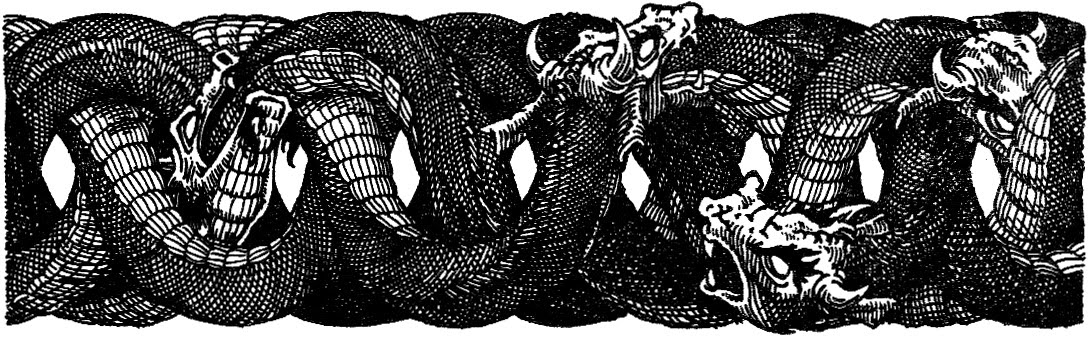
    In 1980, one odd illustration appeared only in the second printing of the module where intertwined, horned dragon-serpents devour each other at the bottom of page 5.


    The mysterious serpents

    Some of the 6th and 7th printings of the Holmes basic sets included this printing of B2 and a few more copies sold individually. Later in 1980, the illustration disappeared from the third and subsequent printings, just as D&D's popularity started its greatest ascent. This makes it safe to call the illustration "rare."

    The striking image is reminiscent of Celtic knotwork designs and M. C. Escher but who illustrated it? The artists credited in the module are David S. LaForce (a.k.a. "Diesel"), Erol Otus and Jim Roslof. However, this looks nothing like any of their art styles.

    Now compare the illustration to the works of fellow TSR artist Dave Trampier:

    Boat masthead (D3 Vault of the Drow), Gorgon (Monster Manual) and Kobold-Hating Dragon (Dungeon Masters Guide) all by David A. Trampier
    We see the same toothy snout and careful balance between light and dark in the boat masthead. The gorgon's cross-hatching style and line weight are almost identical; even the shading on the horns is the same. The dragon exhibits the same serpentine neck with similar scales and soft underbelly. I feel safe in saying all four images were created by the same hand.

    There were small changes between the first and second printings of the module, including the addition of the intertwined serpents image and a dragon illustration by David S. LaForce (previously seen in The Strategic Review). An editor probably added them to fill some white space between paragraphs. It is highly likely Tramp's contribution was overlooked and TSR staff neglected to include him in the art credits. In fact, third and later printings are heavily revised and include illustrations by Jeff Dee and Bill Willingham, both equally uncredited.

    As far as I know, the intertwined serpents image was never published again. I believe this is the first time Trampier is acknowledged as the creator of this image.

    For more information about module B2 and the early days of Basic D&D I recommend Zenopus Archives. "Zenopus" maintains a terrific repository of information on the original, blue-book, basic rules set and its author, the late Dr. John Eric Holmes. Stay up to date with his blog where he is currently comparing an original manuscript for Holmes' Basic Set against the printed versions, noting where editor Gary Gygax was making subtle adjustments to the original D&D rules.


    Thursday, March 27, 2014

    David Trampier passed away March 24, 2014

    This certainly isn't the next blog post about David Trampier that I had planned.

    http://www.legacy.com/obituaries/thesouthern/obituary.aspx?n=david-trampier&pid=170356694&fhid=8429


    A man with David Trampier's name, matching David Trampier's age and last known location, passed away in Helia Healthcare in Carbondale, IL. I can hope for a case of mistaken identity but this looks like DAT himself. He would have turned 60 on April 22 this year.

    Thanks to Charles Akins for reporting the news:

    http://dyverscampaign.blogspot.com/2014/03/did-david-trampier-just-die-at-age-of-59.html

    Dave, we hardly knew ye. I hoped that as a community of fans we might better understand you in this series of posts. Like so many great artists, we lost you too early.

    All is quiet in Toad Town tonight.

    [UPDATE] Castle Perilous game store of Carbondale has more information:

    http://thecastlesramparts.blogspot.com/2014/03/dave-trampier-wormy-artist-passes-away.html 

    Saturday, March 8, 2014

    Rare Dave Trampier Art Part 2

    Adventure Gaming magazine vol. 1 no. 5 "hidden" interior art

    UPDATED - see bottom of page

    This piece took some work to "unearth" as it was left hidden behind a wall of text.

    Tim Kask recalls hiring his friend, Dave Trampier, to work on issue 5 of Adventure Gaming magazine:

    "After I started ADVENTURE GAMING Magazine, he did a couple pieces of art for me, and I did a cover story article on TITAN that he added and published some advanced rules in."
    We discussed the first of the "couple pieces of art" in my last post, a vibrant, full-color painting of a scene from the world of Titan. As Titan co-creator, Trampier also wrote a two-page article titled, "Evolving Forces in TITAN." It provides an excellent analysis on how to compare creatures of slightly differing power levels and how to know when creatures become a liability instead of an asset.

    The magazine also features two articles by Titan's other co-creator, Jason B. McAllister. "The History of TITAN" gives a thorough look at the development of the game, much more interesting than his "The Giver of the Law: TITAN Design Notes" article later published in Avalon Hill's The General magazine Vol. 20, No. 2. "The History" contains lots of details on game board design and simplification of unit stats that we game designers enjoy. "Waging TITAN: Tactics" serves as a good primer on both the tactics and strategies needed for this unusual game.

    Note that none of the three articles contain any "advanced rules" that Kask mentions, above.

    It is in McAllister's first article, "The History of TITAN," where we find Trampier's other piece of art, printed in light gray and hidden behind the text:
    I could see what appeared to be a scene from the game with a titan, a minotaur and what appeared to be an angel hugging a dragon all on a volcanic landscape. Trampier's signature was clearly legible in the lower left, but not much else was. It might be a rough sketch for the cover image painting for this issue.

    With a little bit of Photoshop wizardry, I removed all the text and worked to restore the image as best I could. I painted in some of the missing lines with my Wacom tablet. What I discovered surprised me:
    There are a lot of creatures in this scene! On the left, two rangers and a warbear surround a lone minotaur, who knocks one of ranger off his pegasus (in Titan, every ranger gets a pegasus. It's one of the perks of the job). A titan stands behind the volcano, avoiding combat (as often happens in the game. Two trolls with their iconic hammers are near the center of the image. On the right, an archangel is clearly not hugging that dragon so much as he is jabbing his greatsword through its head. I thought their relationship might be a lot friendlier. Ah well...
    The scene is richly detailed and sometimes hard to read (those trolls tend to blend into the rock face). Above is a guide to the creatures in the image. There may be another creature as I think I see something between the two rangers. If you spot any more details, please let me know!

    As far as I know, this drawing was never published anywhere else. Can anybody with the Gorgonstar publications of Titan and Battlelands of Titan confirm that it was not published in those games?

    UPDATE - Reader Teacher, Trooper, Gamer, Dad (that is a long name!) helped me out by recognizing one more creature in this melee: a lion helping the minotaur strike down that poor ranger on the left.
    Updated recovery of Tramp's image.
    That now puts the total at TEN Titan creatures, until now only probably only seen by a few people involved in the production of Titan and Adventure Gaming magazine.