Showing posts with label tactical miniatures. Show all posts

Saturday, August 16, 2014

#5 Most old school RPG owned - Older than Braunstein #RPGaDAY

My oldest RPG might be a controversial choice - "Proto RPG" is a better term. This predates 1974's release of Dungeons & Dragons and 1971's Chainmail. It is older than the first Braunstein game played in 1967, direct inspiration for Dave Arneson's Blackmoor.

When this game was released, The Milton Berle Show was still on the air and the Apollo Program was yet to launch its first, fateful mission.

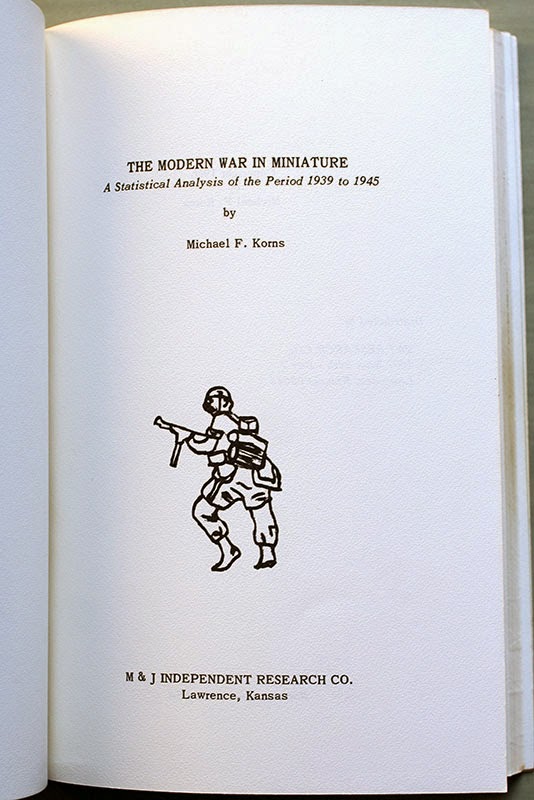
Modern War in Miniature by Michael F. Korns

This is Michael F. Korns' 1966 game Modern War in Miniature (MWIM), probably self-published by Korns and a partner in Kansas under "M & J Research Co." I believe the rules are still available in reprint as part of the book More Wargaming Pioneers from The History of Wargaming Project.

MWIM is an unusual WWII, skirmish-level wargame. As normal, two players act as commanders (one Allied, one Axis), directing their combat units in battle. Miniatures are moved across the terrain on a sand table. What is unusual is that a Judge mediates all actions and is the only one with full access to the sand table. The judge is the only one who needs to know the rules and randomly determines the outcomes of all actions. He talks to the Allied and Axis players individually, out of earshot of each other, describing what they can see and hear in 2-second segments of time. It sort of takes the adversarial roles and judge's mediations of a Braunstein game into short time-span, tactical turns. Everything is on a personal scale making it different from a typical wargame.

Partial example of gameplay
The above example of gameplay shows that the player is expected to embrace their role and step into the boots of the commanding officer. This reads much like samples of gameplay in many RPGs, with the players stating what "I" do in the situation to the GM. Only the adversarial rather than cooperative roles of the players are different.

Note that any TEXT IN ALL-CAPS is said loud enough for both players to hear. "Schmeisser" is used here as a colloquial term for a German MP38 or MP40 sub-machine gun (which always annoyed me since they were designed by Heinrich Vollmer, not Hugo Schmeisser).

How to generate random percentile numbers with d6s
How do you generate random percentile or fractional results without percentile dice? This chart, a subject of discussion on Jon Peterson's Playing at the World blog, shows how to use a 2d6 result for rough percentages. As Peterson mentions, Mike Carr adapted this chart for use in the 1972 edition his game Fight in the Skies (it is titled "Percentage Index" in my 6th edition TSR rules). This shows that the gamers in the Twin Cities of Minnesota were aware of MWIM.

Small Unit Tactical Combat Referee's Rule Book
Modern War in Miniature eventually developed into Small Unit Tactical Combat (SUTC) in 1971. Above, you see my 2nd edition Referee's Rule Book from 1972. Several other SUTC products were released  published by "The Limpex Company" of Mountain View, CA. From what I could gather, Korns lived and gamed there during that time. Coincidentally, I moved to that area in 2005.

A Monster Manual of WWII combat forces
SUTC is very similar to its MWIM predecessor. Gone is the chart of simulating random percentile results with 2d6; now there is a chart of random two-digit numbers for the referee to pick from. It appears that this alternate evolutionary line of gaming died out after SUTC. I can't find any games that Korns published after that.

Was MWIM an influence on Gary Gygax? Probably not for Dungeons & Dragons, but according to Peterson, it did insppire Leon Tucker, Gygax's and Mike Reese's co-designer in the development of Tractics.
Friday, May 31, 2013

Alien Conquest Game: Part II


I established the theme of my tactical miniatures game: Bug-eyed alien saucer-men at war against Earth's military might. That sounded like a fun, gonzo opportunity for some light-hearted wargaming. One goal I kept in mind was to keep the violence toned down. These are cartoony toys going to war, not hardened soldiers mired in a battlefield of blood.

Inspiration from Tex Avery

I decided that no character would ever get "killed," only knocked out when they are defeated. Much like in Warner Brothers' Looney Tunes cartoons, characters would be knocked to the ground with tweeting birds flitting around their heads, only to recover soon after. This is the concept behind the role-playing game Toon (created by game design legends Greg Costikyan and Warren Spector).

As a game mechanic, being "knocked out" is the same as "killed" unless there is a way for a character to recover. I allowed characters to revive knocked out allies by spending one game turn next to them. However, this could make the games run long as it takes longer to knock out each and every enemy unit. I needed a different game objective other than wiping out all enemy forces.

Capture to Win

The mechanic I needed came from the Alien Conquest storyline itself: Capture. The Alien forces are working to capture us Earthlings to use our big brains as power sources (most aliens have teeny-tiny brains). Earth's defenders, the ADU (Alien Defense Unit), wants to capture as many aliens as possible to study them and better understand their enemy. I decided that capturing enemy units and bringing them to a player's "home base" on one side of the table would be the game's main objective.

Aliens round up Earthlings
The Alien forces use mind-controlling Pluuvian Brain-Beasts (a.k.a. "Clingers") to capture both innocent Earthling citizens and ADU soldiers alike. Once a Clinger has attached itself to a character's head, the Alien player may move that figure at will on his/her turn. Additionally, Alien troops may escort citizens back to home base with the business end of  a ray gun. Captured Earthlings may be sealed in green capture pods and loaded onto some vehicles.

ADU Forces study captured aliens
The ADU may capture Alien troops by first knocking them out and then slapping a pair of handcuffs on them. Then, they are escorted back to base by ADU troops and may be placed in blue containment pods for study or loading onto vehicles.

Study for Advantage

As further incentive to capture Alien units, I plan to include mechanics allowing the Earth player to find weaknesses to exploit. This is partially inspired by the Alien Cyborg's defeat after someone illogically offered it a birthday cake. Tom Wham's fantastically fun The Awful Green Things from Outer Space is a game all about trying different weapons to fight an unknown, invading alien force with unexpected and hilarious results ("I tried the fire extinguisher on the creature but that just made it grow bigger. Then I threw a bottle of acid at it, causing it to burst into 5 smaller aliens!"). I plan to use something similar for using improvised weapons like oil cans, pizza, birthday cake, etc.

Please note: LEGO® is a trademark of The LEGO Group of companies. This website is not affiliated, authorized, or sponsored by The LEGO Group. I do not claim to represent The LEGO Group and this game is completely my creation. While the project may use the LEGO® Alien Conquest world as a theme, any text about the game's mechanics are under my copyright.

Saturday, November 3, 2012

Alien Conquest: a game for NaGa DeMon


http://nagademon.com/
This is November and that means National Game Design Month (NaGa DeMon, for short) is here. To celebrate, many game designers volunteered to design, playtest, and play a game of their creation by the end of the month. Click the banner above for more information and feel free to join in on the fun!

My choice for NaGa DeMon is to create a game based on one of my favorite recent LEGO® properties: Alien Conquest from 2011. It is all about green-skinned aliens descending to Earth in flying saucers to harvest the brains of human beings to power their spaceships. It is a fun mix of Mars Attacks and other B-Movie style science fiction motifs in a cartoony, modern setting.
The Alien Invaders

The Alien invaders from Planet X2 1/2 are here to take our brains! A wide variety of bug-eyed bad guys (and gals) come in minifig form, complete with ray guns, flying saucers, and Pluuvian Brain-Beasts (the little one-eyed critters in the front). Who can defend us against this unstoppable menace?
The Alien Defense Unit Forces
The Alien Defense Unit (ADU) is Earth's only hope to fend off the invading aliens. Their team of soldiers, pilots, computer specialists, and scientists will find the invaders' weakness and send those creeps back where they came from!

Alien Conquest had an expansive product line but was short lived. A few of the recent Collectible Minifigures (such as Alien Villainess and Galaxy Patrol) seem to be part of the overall Alien Conquest storyline, but the main line is finished.

After picking up many sets from the series, I realized it had the makings of a great tactical miniatures game. Not your typical grognard slog-fest (that I would certainly enjoy) but a fast-paced, fun game with a lot of tactical decisions and the means to outmaneuver and outthink your opponent. I completed my collection of Alien Conquest sets*, read up on the established back story (such as there is one), and set out to design a new game.

Next update: what is the goal of the game?

Please note: LEGO® is a trademark of The LEGO Group of companies. This website is not affiliated, authorized, or sponsored by The LEGO Group. I do not claim to represent The LEGO Group and this game is completely my creation. While the project may use the LEGO® Alien Conquest world as a theme, any text about the game's mechanics are under my copyright.

* With the exception of the ADU Walker promotional set only available in the UK. Drat!