Tuesday, August 19, 2014

#9 Favorite Dice - Random Number Generators of Chaos and Entropy #RPGaDAY

I already wrote about my favorite die and how it started me on the path of gaming over 30 years ago. I use it in a set with some of my other oldest dice when feeling nostalgic (which is often).

But one of my other favorite sets is my Chaos Dice.

Can't you feel the CHAOS!? Blood and souls for my lord Arioch!
Blood red on obsidian black is the perfect color scheme for Servants of Chaos laying waste to all Order in the world. Unfortunately, it is a terrible color scheme to read unless the lighting is really bright. In sub-optimal conditions, I'll use a set with stronger contrast.
I rolled an 8... I think
These are Chessex's old "Arrows of Chaos" dice. I purchased them when they first became available and built the rest of the set from other Chessex dice. They look cool but, like most specialty dice, are a real pain to read. I supplement the set with a brick of smaller, matching d6s with normal pips, perfect for those high-level fireballs (not pictured here because I can't find them... darned entropy!).

Monday, August 18, 2014

#8 Favorite Character - Wonko the Sane #RPGaDAY

My favorite character is my silver-haired, half-elf jester, Wonko the Sane (yes, named after the Hitchhiker's Guide to the Galaxy character).
Wonko's main stats

I first rolled Wonko up in November, 1990 - a 1st edition AD&D character using the Jester NPC rules from the pages of Dragon magazine (revised and reprinted in Best of Dragon Vol. IV). When 2nd edition AD&D and the Complete Splat Books were all released, I used the Jester kit rules from The Complete Bard's Handbook. Those rules were notably less silly (no more punfighting).


Wonko playing his electric mandolin, still smiling at only 2 HP
Wonko is a lot of fun to draw, especially with his striped leisure suit jacket, polka-dotted cape and checkered trousers. In the top image, you see Wonko wielding his Short Sword +1/+4 Vs. Reptiles and another strange weapon.  It is a stick with an Odie stuffed animal on one end and a Rug of Smothering with the command word "Don't Make Me Laugh!" on the other. Wonko must need his Buck and a Quarter Quarterstaff weapon proficiency to wield it.

Other unusual supplies on his character sheet include his electric mandolin (see second image), a hanging fern, one can of WD-40, a dust rag and "five belts of priestly origin" that I am assuming came from some Gygaxian adventure.


Lars Leafblower is fed up with Wonko's tomfoolery
Wonko survived to 10th level, annoying a number of nasty bad guys along the way, including Strahd von Zarovich in I6 Ravenloft and whoever was in "A Rose for Talakara" (which I have in my notes as "A Rose for Somebody"). Like most jesters, he had a tendency to annoy his fellow party members as well. In the third image, we see what happens when you push a druid too far.*

Want to a jester in an old-school campaign? This website compiles all the early Jester rules for D&D, including errata and Gary Gygax's musings on the class.

* My friend Duane came up with some of the goofiest character names. In addition to Lars Leafblower he ran another memorable druid: Waz Weedwhacker.

#7 Most "Intellectual" RPG Owned - It's not the game, it's the setting #RPGaDAY

How does one define an "intellectual" game?

I never owned or played Mage: the Ascension, Ars Magica, In Nomine or Aria: Canticle of the Monomyth - all games known for being intellectual or, at least, pretentious.

Call of Cthulhu comes to mind as most player characters are intellectuals: academics, scientists and librarians. However, the game tends to push the characters (and sometimes players) to their emotional breaking points. Close, but it doesn't quite fit.

Jonathan Tweet's Everway system generates random results by interpreting draws from a tarot-like Fortune deck. Players "read" paintings in the game's Vision deck to create their character concepts.This has the potential for the most intellectual title. I'd like to see a game played while touring a museum, always interpreting the next piece of art whenever a random result is needed.

Ultimately, I don't think it is the system that is so intellectual so much as the campaign and setting. For that, I give the "most intellectual" award to a Traveller: 2300 AD inspired campaign played with GURPS rules I played back in 1994.
My character, Tachi, and some photocopied pages from the GURPS Space rule book. Even intellectual game characters need samurai swords.
The GM was an excellent world designer and the campaign made us take a hard look at a possible after-Earth, near-future humanity. There were no extreme technologies like hyperdrives and black hole guns. Most of the human diaspora lived in the colonies of the Moon, Mars, Titan and a few LaGrange Points after a poorly-understood cataclysm left the Earth uninhabitable. Our characters were troubleshooters in the largest human settlement: the interconnected Lunar colonies. The opaque, brown, toxic atmosphere obscuring the Earth above served as an ever-present reminder that mankind may never go home again.

The reason behind the Earth's catastrophe was never important. What we explored and focused on was how humanity and its culture changes moving forward in a post-Terran existence. Different societies perpetuated their respective cultures in pockets divided by their ancestral homelands, like ex-pat communities settling in Chinatowns, Japan Towns and Little Italys of major American cities. Those country origins of yore meant less and less with each generation as the true differences were between so-called Martians, Moonies, Titanians and the others.

For example, my character was Tachi, the tactician and weapons expert of the group and the only Mars native. Growing up in little over 1/3 of Earth's gravity, she was 6 feet tall and somewhat strong for a Martian. Compared to the Lunar natives who grew up in only 1/6 of Earth's gravity, she was very short and brawny! I was the "bruiser" of the party with an 11 Strength.

As someone who loves futurist books like Ben Bova's underappreciated The High Road, this game was easy to get into. The world was exotic yet familiar (bicycle was the common mode of transportation) and altogether plausible. This was a thoughtful campaign still punctuated by scenes of excitement and combat (often instigated by my character, ahem).

It was hard sci-fi at its best and it made us think.

Sunday, August 17, 2014

#6 Favorite RPG Never Get to Play - The Original Edition #RPGaDAY

There are plenty of choices for games that I have played in the past but don't get to play enough - Call of Cthulhu, James Bond 007, West End's Star Wars RPG, Powers & Perils and Gamma World come to mind. There are other games I own that I never played - Dallas ("The Television Role-Playing Game"), Gangbusters, Hawkmoon, Behind Enemy Lines and Boot Hill would all be fun for different reasons.

There is one game I know backwards and forwards, own every rule supplement for, and yet never officially played: the Original Edition of Dungeons & Dragons.

My complete set of OD&D digest-sized rule books
How did this happen? When I started playing in 1982, AD&D 1st ed. was the new hawtness. This edition had already faded into the mythic past like the contents of the Library of Alexandria. I did play nearly every other edition of the game (B/X, BECMI, 1st ed, 2nd ed, 3.0 ed, 3.5 ed).

My first exposure to this edition was a photocopy of Gods, Demi-Gods & Heroes that somebody gave me in the late 80s. It wasn't the entire book; just the Hyborian and Melnibonean mythos. In the mid 90s, I was blessed with luck and found a near-perfect "white box" OD&D set at a comic book store for $10. I picked up Chainmail from a dealer at the San Diego Comic-Con for $9.95. I assembled the rest of the set piece by piece, finally completing with Swords & Spells (invaluable for its definitions of OD&D spell ranges and durations).

I also have a copy of Tractics, perfect for combining with OD&D into a game of Sturmgeschutz & Sorcery!

Saturday, August 16, 2014

#5 Most old school RPG owned - Older than Braunstein #RPGaDAY

My oldest RPG might be a controversial choice - "Proto RPG" is a better term. This predates 1974's release of Dungeons & Dragons and 1971's Chainmail. It is older than the first Braunstein game played in 1967, direct inspiration for Dave Arneson's Blackmoor.

When this game was released, The Milton Berle Show was still on the air and the Apollo Program was yet to launch its first, fateful mission.

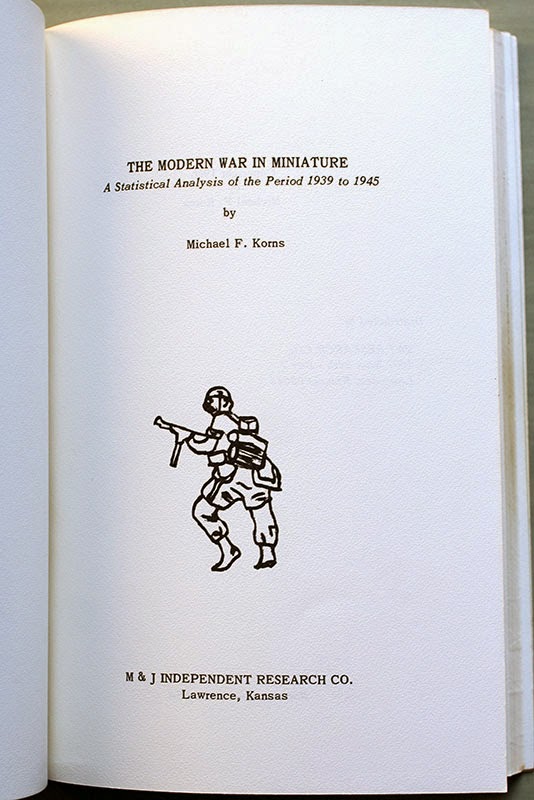
Modern War in Miniature by Michael F. Korns

This is Michael F. Korns' 1966 game Modern War in Miniature (MWIM), probably self-published by Korns and a partner in Kansas under "M & J Research Co." I believe the rules are still available in reprint as part of the book More Wargaming Pioneers from The History of Wargaming Project.

MWIM is an unusual WWII, skirmish-level wargame. As normal, two players act as commanders (one Allied, one Axis), directing their combat units in battle. Miniatures are moved across the terrain on a sand table. What is unusual is that a Judge mediates all actions and is the only one with full access to the sand table. The judge is the only one who needs to know the rules and randomly determines the outcomes of all actions. He talks to the Allied and Axis players individually, out of earshot of each other, describing what they can see and hear in 2-second segments of time. It sort of takes the adversarial roles and judge's mediations of a Braunstein game into short time-span, tactical turns. Everything is on a personal scale making it different from a typical wargame.

Partial example of gameplay
The above example of gameplay shows that the player is expected to embrace their role and step into the boots of the commanding officer. This reads much like samples of gameplay in many RPGs, with the players stating what "I" do in the situation to the GM. Only the adversarial rather than cooperative roles of the players are different.

Note that any TEXT IN ALL-CAPS is said loud enough for both players to hear. "Schmeisser" is used here as a colloquial term for a German MP38 or MP40 sub-machine gun (which always annoyed me since they were designed by Heinrich Vollmer, not Hugo Schmeisser).

How to generate random percentile numbers with d6s
How do you generate random percentile or fractional results without percentile dice? This chart, a subject of discussion on Jon Peterson's Playing at the World blog, shows how to use a 2d6 result for rough percentages. As Peterson mentions, Mike Carr adapted this chart for use in the 1972 edition his game Fight in the Skies (it is titled "Percentage Index" in my 6th edition TSR rules). This shows that the gamers in the Twin Cities of Minnesota were aware of MWIM.

Small Unit Tactical Combat Referee's Rule Book
Modern War in Miniature eventually developed into Small Unit Tactical Combat (SUTC) in 1971. Above, you see my 2nd edition Referee's Rule Book from 1972. Several other SUTC products were released  published by "The Limpex Company" of Mountain View, CA. From what I could gather, Korns lived and gamed there during that time. Coincidentally, I moved to that area in 2005.

A Monster Manual of WWII combat forces
SUTC is very similar to its MWIM predecessor. Gone is the chart of simulating random percentile results with 2d6; now there is a chart of random two-digit numbers for the referee to pick from. It appears that this alternate evolutionary line of gaming died out after SUTC. I can't find any games that Korns published after that.

Was MWIM an influence on Gary Gygax? Probably not for Dungeons & Dragons, but according to Peterson, it did insppire Leon Tucker, Gygax's and Mike Reese's co-designer in the development of Tractics.

Friday, August 15, 2014

#4 Most Recent RPG purchase - 2 of 9 Doctrines of Darkness #RPGaDAY

I've been focused on studying gaming books from the earliest era of role-playing: anything before 1981, by my reckoning. My most recent acquisition was two related adventures published by Dimension Six, Inc.
The Nine Doctrines of Darkness and The Nine Doctrines of Darkness: The Second Adventure were both written by Randy Fraser and published in 1980 and 1981, respectively. These appear to be designer's only contributions to the hobby. I knew of publisher Dimension Six from their marginally useful Compleat Fantasist book of tables to translate characters from one game to another.

Each adventure focuses on recovering one of the nine titular doctrines of darkness, a set of evil artifact tomes detailing the nine principles that uphold all Evil (that's capital-E evil) as written by Lord Erlich, and Evil Arch Mage, before he perished in his final evil destruction brought on by the evil knowledge of perfect evil. Before collapsing evilly onto the floor, he polymorphed each doctrine into an ordinary object and scattered them around the world. Now, the polymorph spells are wearing off and the elf king's favorite wineskin just turned into a powerful, evil grimoire of evil evil evil.

Why a party would undertake these adventures depends on its alignment. Good characters must prevent the Doctrines from falling into the wrong hands. Evil characters are those wrong hands who want to use the powers of the Doctrines. The first adventure plays very differently due to this duality of interests. A non-evil party comes to the elf king's side to help protect him from every evil-doer looking to claim the Doctrine. An evil party assaults the elf king's castle and steal the book for themselves.

These adventures must have been created for evil parties. It is much more fun to assault or infiltrate the good castle than to patrol the forest kingdom fighting random encounters. The second adventure is loaded with awesome magic items that non-evil characters can't touch without, at best, suffering damage. The lone +3 holy sword doesn't compare to the evil staff that shoots 20d6 lightning bolts (among other powers). Good characters can't even destroy the books as, "no efforts either magical or physical can harm the Doctrine in any way."

The first adventure is short, sparsely detailed and luridly illustrated. There are some odd new monsters (Shammy: a red-furred gorilla wielding a huge axe). The second adventure is about thirteen pages longer than the first and includes some decent room illustrations to be shown to the players (much like S1 Tomb of Horrors). In addition to some wilderness adventuring (complete with some decent hooks for further adventuring) it has a thoroughly detailed, three-level temple complex to explore. This is more of a typical dungeon delve. There are some good tricks, traps and challenges but, like many adventures of the day, it misses details that give the temple the feel of a functioning place. For example, there are guard rooms filled with ninja guards (!) and umber hulks (!!) near the front door but nobody is posted to guard duty.

Since only the first two adventures were published, it begs the question, "what happened to the other seven Doctrines of Darkness?" We may never know, but I know that Catacomb Librarian was subjecting his gaming group to these adventures recently. Whatever became of them? Cat. Lib. also found an old review of the first adventure by Aaron Allston (R.I.P.).

Wednesday, August 13, 2014

#3 First RPG Purchased - Holmes Basic blue box on the cheap #RPGaDAY

I first started role-playing when I was nine years old, learning from friends at school and playing with their books. With an allowance limited to less than one dollar per week, I relied on birthday or Christmas gifts for my first RPG books. I could afford to buy a few dice or miniatures for myself but would take all summer to save up for one AD&D hardback manual.

My mother was an antique dealer and visited thrift stores in a hunt for underpriced artifacts to resell in her shop. I was often in tow and would always scour the games, toys and books. It was on one of these trips that I made my first RPG purchase: an unplayed copy of the original 1st edition Basic D&D boxed set edited by Dr. John Eric Holmes.
Not my original Holmes Basic set, but a close replacement

I was pleased but puzzled as I'd never seen a D&D set like this one. I knew the 2nd edition basic set edited by Tom Moldvay. This game, I was sure, must be the original D&D set: the near-mythical 0th edition (that wasn't quite right, but it was still a good find). The price was right (probably 75 cents - the cost of one new lead miniature) and I took it to the register.
A tale of two B2 spear-wielding, armored minotaurs. Erol Otus' original Holmes-era illustration on the left and Bill Willingham's Moldvay-era version on the right

Once I got home and read the rules, I was even more puzzled. This was a D&D set from an alternate universe. Cardboard chits instead of dice? All weapons deal 1d6 damage? Why does this copy of The Keep on the Borderlands have different illustrations like that goofy minotaur eating a drumstick? Most importantly, where is Morgan Ironwolf?
Instant adventure: just add dice

Long before the days of "edition wars" we used whatever rule books we had together in a mishmosh of Basic/Expert/Advanced D&D. I'd alternate between the Moldvay and Holmes rule books, but defaulted to Moldvay for any rules differences. Soon thereafter, I completely switched to AD&D and rarely played the B/X or BECMI rules after that. We still played some of the modules (B4 The Lost City is still a personal favorite) but adopted them to play with AD&D.

For more on The Keep on the Borderlands and the Holmes edition basic set, be sure to bookmark Zenopus Archives and the Zenopus Archives Blog. Zenopus' latest project is a fascinating, page-by-page examination of Holmes' original manuscript for his rule book and a comparison with the printed version. Highly recommended!